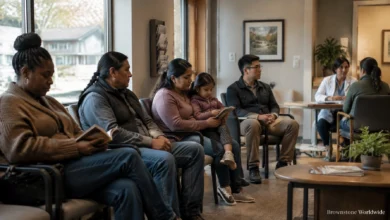
Involuntarily commitment for mental illness may increase under Trump order

President Trump has recently signed a new order aimed at addressing homelessness in the United States by making it easier to involuntarily treat people with serious mental illnesses. The administration plans to expand involuntary commitments by reversing judicial policies that restrict the use of this controversial approach and providing grants, legal advice, and other assistance to local and state governments. Several agencies, including the Department of Health and Human Services, will be involved in auditing grant recipients to ensure that funds do not support organizations with conflicting values.
While some studies have shown an increase in involuntary commitments, critics argue that the administration’s efforts are focused on moving unhoused individuals out of public view and into private psychiatric hospitals. White House Press Secretary Karoline Leavitt stated that the goal is to remove vagrant criminals from the streets and redirect resources towards substance abuse programs to ensure community safety and provide help to those struggling with addiction or mental health issues.
However, public health professionals caution against expanding involuntary commitment, emphasizing that it should be a last resort. They believe that involuntary treatment lacks sufficient evidence and could deter individuals from seeking care. Jennifer Mathis, deputy director for the Bazelon Center for Mental Health Law, expressed concerns about the order’s directive to agencies to seek opportunities to overturn basic protections against arbitrary commitment.
The order also includes cracking down on public drug use, urban camping, and loitering, as well as potentially pursuing legal action against organizations operating supervised drug consumption sites. Harm reduction programs will be deprioritized, and there will be a shift away from the “housing first” approach to homelessness favored by the previous administration. Instead, the Department of Housing and Urban Development will collect federal health information from unhoused individuals receiving services and share it with law enforcement.
Experts note that these initiatives were not developed in consultation with public health professionals at the Substance Abuse and Mental Health Services Administration, the agency traditionally overseeing relevant policy recommendations and grantmaking. Despite a Government Accountability Office report questioning the effectiveness of involuntary outpatient treatments, the order instructs local and state officials to prioritize this approach to get people off the streets.
Critics, including former SAMHSA executive officer Paolo del Vecchio, argue that Trump’s actions to expand involuntary treatment and institutionalization risk reverting to outdated practices of warehousing individuals in hospitals instead of providing appropriate care. The push for involuntary treatment raises concerns about human rights and the effectiveness of such interventions in addressing homelessness and mental health challenges.