‘Constitutional hardball’: National gerrymander battle turns the heat up in Missouri

The battle over Missouri’s new gerrymandered congressional map has escalated into a high-stakes fight between Republicans and Democrats, with millions of dollars being poured into the fray as both parties vie for control of the House majority in the upcoming 2026 elections.
After President Donald Trump urged Texas to redraw its congressional lines, Missouri was one of six states that followed suit, with the GOP-dominated legislature passing a new map in September that would eliminate Democratic Rep. Emanuel Cleaver’s seat in Kansas City.
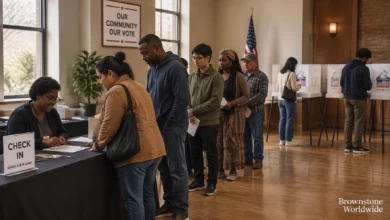
Democrats in the state wasted no time in organizing a campaign to repeal the new map through a popular referendum. The campaign committee, People Not Politicians, has been working tirelessly to gather the necessary 107,000 valid signatures needed to send the new maps to a vote. If successful, the state would be unable to enact the new maps until voters have their say.
The referendum campaign has attracted an unprecedented amount of funding from both sides, with well-funded organizations rushing into the state to support their respective causes. The Republican National Committee, the National Republican Campaign Committee, and Trump-aligned PACs have donated significant sums to support the GOP’s efforts to block the referendum.
On the Democratic side, dark money groups have contributed over $1.25 million to People Not Politicians, including a hefty donation from American Opportunity Action. The level of fundraising on both sides is unprecedented for a ballot measure fight in Missouri, highlighting the importance of the battle in the national political landscape.
However, the fight has not been without its controversies. Opponents of the referendum have resorted to questionable tactics, including offering canvassers money to stop collecting signatures and baseless accusations of employing “illegal aliens” against a firm working on signature collection for People Not Politicians.
Missouri Attorney General Catherine Hanaway, a Republican, has also entered the fray, filing a federal lawsuit to block the referendum on the grounds that it violates both the U.S. and Missouri Constitutions. Hanaway has also sought to use Trump’s anti-immigration stance to target the firm working on signature collection, accusing them of employing undocumented workers.
The federal case, along with at least six other lawsuits related to the new maps and the potential referendum, adds a layer of complexity to the already contentious battle. With a Trump-appointed judge set to decide whether to block the referendum before the Dec. 11 signature deadline, the outcome of the fight remains uncertain.
As the battle over Missouri’s congressional map continues to intensify, both Republicans and Democrats are pulling out all the stops in a bid to gain the upper hand in the fight for control of the House in 2026. The outcome of this high-stakes battle could have far-reaching implications for the future of Missouri’s political landscape and beyond. Missouri is currently embroiled in a legal battle over its new congressional districts, with the American Civil Liberties Union (ACLU) and People Not Politicians teaming up to challenge the redistricting process. The ACLU has filed a case in a Missouri state court, arguing that the mid-decade redistricting violates a clause in the state’s constitution.
In addition to this legal challenge, People Not Politicians is also suing Republican Secretary of State Denny Hoskins for his handling of the referendum procedure. They are particularly concerned about the language used in the potential ballot measure, which describes the old maps with six GOP-leaning seats as “gerrymandered,” while portraying the new district lines with seven GOP-leaning seats as a “more compact” map that “better reflects statewide voting patterns.”
Travis Crum, a professor at Washington University Law School in St. Louis who specializes in election law, described the situation in Missouri as “constitutional hardball.” The outcome of these legal battles could have far-reaching implications for the state’s political landscape.
Even if the ballot referendum goes before voters, there is no guarantee that the new map will be blocked for the 2026 elections. The numerous redistricting-related court cases in Missouri are currently being adjudicated, with hearings and rulings expected to take place before the end of January. This timeline gives state election officials enough time to schedule a potential ballot measure election next year.
Despite the uncertainty surrounding the legal challenges, GOP consultant Aaron Baker believes that the “noise” surrounding the issue will peak or has already peaked by mid-January. The outcome of these legal battles will shape the future of Missouri’s congressional districts and could have a significant impact on the state’s political landscape.
In conclusion, Missouri’s redistricting battles highlight the complex and contentious nature of the redistricting process. The outcome of these legal challenges will have far-reaching implications for the state’s political landscape and could set a precedent for future redistricting efforts across the country.