A Serious Look at Interest Rates
Exploring the Impact of the AI Boom on the Job Market
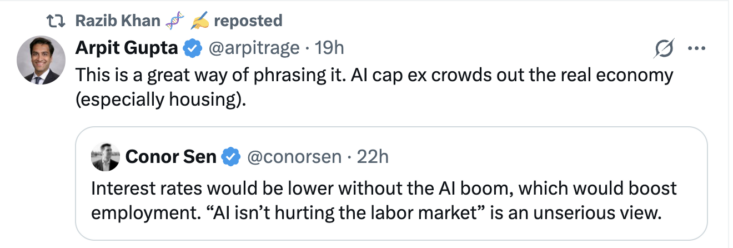
These tweets caught my eye:
There has been speculation about whether the AI boom is negatively impacting the job market. However, upon closer examination, the argument may not be as convincing as it initially seems. Let’s delve into this issue further.
Interest rates could potentially decrease in a recession, which might stimulate employment. Arguing that “Economic booms don’t hurt the job market” may oversimplify the complex dynamics at play.
One must be cautious about drawing conclusions based solely on price changes, as it can lead to fallacious reasoning. Despite experiencing a period of high inflation, the labor market has remained relatively robust, with unemployment hovering around 4.2%. This resilience could be attributed to the gradual nature of the disinflation policy and the persistent inflation levels above the Fed’s target.
While it is true that a more stringent monetary policy could potentially elevate unemployment rates, the AI boom tends to elevate the natural rate of interest, which can have expansionary effects on the economy. Factors such as immigration rates also influence the natural rate of interest, making it challenging to determine if current monetary policy is excessively tight.
Some may argue that increased AI spending displaces labor-intensive industries, but the Fed’s actions should theoretically offset this impact. Looking back at historical events like the internet boom of 1999-2000, we see that it did not have a detrimental effect on the labor market. In fact, unemployment reached historic lows during that period. Even the subsequent mild recession in 2001 was primarily due to the Fed’s adjustment of NGDP growth.