Bessent touts Trump Accounts as rainy day fund and slams critics as “out of touch”
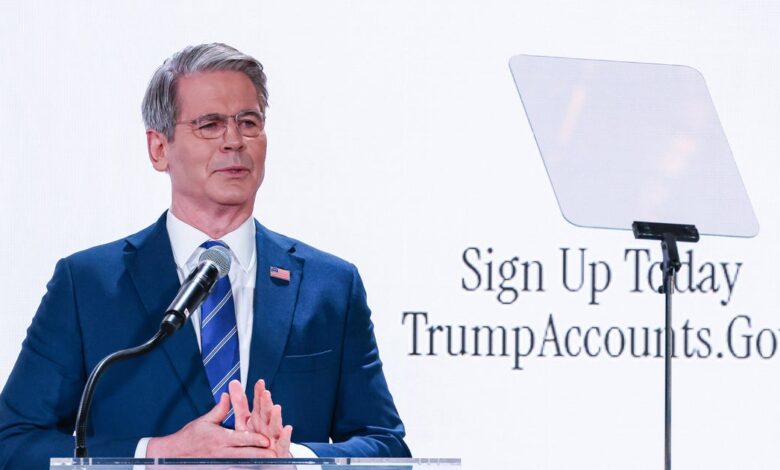
U.S. Treasury Secretary Scott Bessent recently spoke about the benefits of the Trump administration’s new savings program for U.S. children, known as the “Trump Accounts.” In an interview with “CBS Saturday Morning” co-host Kelly O’Grady, Bessent highlighted how these accounts could serve as a “rainy day fund” for children when they reach adulthood.
The program, established under the Republicans’ tax and spending law, aims to create tax-preferred investment accounts for approximately 25 million children born between Jan. 1, 2025, and Dec. 31, 2028. The federal government will kickstart each account with $1,000, which will be invested in the stock market.
Bessent emphasized that even if a child doesn’t receive the $1,000 government contribution, families can still make tax-free contributions to the account. Additionally, companies like Bank of America and JPMorgan Chase have pledged to contribute $1,000 to accounts opened by their employees.
The funds in these accounts will remain invested until the child turns 18, at which point they can be used for qualified expenses such as education, buying a home, or starting a business. Contributions are capped at $5,000 per year per child, and there have been 600,000 signups for the program in just one week.
However, concerns have been raised about the potential for the Trump Accounts to widen the U.S. wealth gap, as higher-income families may be able to contribute the maximum amount while lower-income households may struggle to do so. Bessent dismissed these concerns, noting that philanthropists like Michael and Susan Dell have pledged to direct their contributions to lower-income areas.
Furthermore, Bessent believes that the Trump Accounts will help educate Americans about investing, particularly the 38% of households that do not own stocks. He emphasized the importance of financial literacy and the opportunity for individuals to participate in the financial markets for 18 years through these accounts.
When asked about affordability issues facing Americans, Bessent attributed rising inflation to the Biden administration while crediting President Trump for initiatives like boosting wage growth, lowering prescription drug costs, and introducing tax cuts. The Trump administration has proposed various measures to address affordability concerns, including capping credit card interest rates and preventing institutional investors from buying single-family homes.
Bessent also addressed the independence of the Federal Reserve and defended the Department of Justice’s investigation into Federal Reserve Chair Jerome Powell. He emphasized the importance of holding the Fed accountable for its actions and ensuring that it remains beyond reproach in its dealings. Accountability is a crucial aspect of independence, especially in the realm of governance and decision-making. While independence allows for freedom and autonomy, it does not absolve individuals or organizations from being held accountable for their actions and decisions.
In a democratic society, independence is often associated with freedom from external control or influence. This can be seen in the independence of the judiciary, where judges are expected to make impartial decisions based on the law, free from political or other forms of interference. However, this independence does not mean that judges are above the law or immune from scrutiny. Judges are still subject to accountability mechanisms, such as judicial review and disciplinary proceedings, to ensure that they uphold the highest standards of integrity and professionalism.
Similarly, in the corporate world, independence is often valued in the form of independent directors on boards of directors. These independent directors are expected to provide unbiased and objective oversight of the company’s management, safeguarding the interests of shareholders and stakeholders. However, their independence does not exempt them from their fiduciary duties or responsibilities. Independent directors are still accountable for their actions and decisions, and can be held liable for breaches of their duties.
In the media industry, independence is essential for journalistic integrity and freedom of the press. Journalists are expected to report the news objectively and without bias, holding those in power accountable and providing the public with accurate information. However, this independence does not mean that journalists are immune from criticism or accountability. Journalistic standards and ethics require reporters to be transparent about their sources, fact-check their information, and correct any errors or inaccuracies.
Overall, independence and accountability are two sides of the same coin. While independence allows for freedom and autonomy, accountability ensures that individuals and organizations are held responsible for their actions and decisions. By upholding both independence and accountability, we can promote transparency, integrity, and trust in our institutions and society as a whole.