Brokeback Mountain Re-Release: Still Incredibly Poignant 20 Years On
Rediscovering Brokeback Mountain: A Cinematic Masterpiece
Open on: The lone countryside, early in the morning. It’s an unassuming still shot as a soft guitar melody starts to build. If it is your first time watching, you don’t know how quickly Gustavo Santaolalla’s simplistically moving score will be one of the things that quietly wrecks you as Brokeback Mountain progresses. Director Ang Lee gives the vast space room to breathe, making its wide-open skies and jagged mountain peaks characters in their own right. We are immediately immersed in the freedom the West promises, but are also shown that that freedom is limited when you aren’t what society expects you to be.
The adaptation of Annie Proulx’s short story first hit cinemas in December 2005, but Focus Features is re-releasing it this weekend in America to celebrate its 20th anniversary (though you can also watch it at home on Prime Video in the UK and US). Even all these years later, the gravity of this film remains profound.
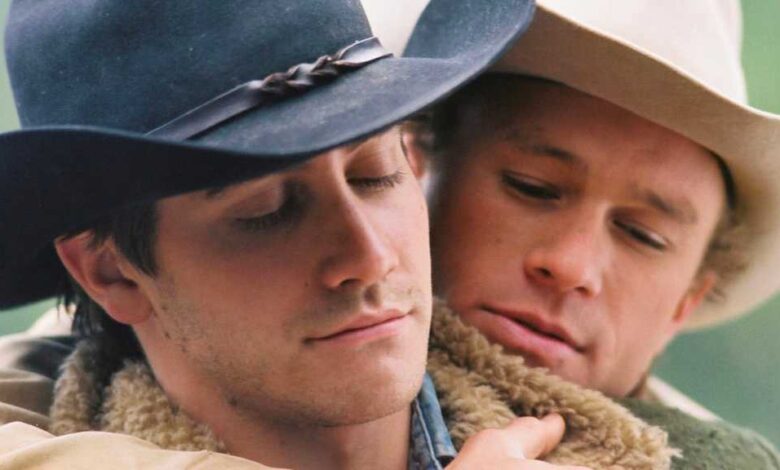
We are thrown headfirst into the unexpected romance between two sheepherders (yes, not cowboys at all) working up on Brokeback Mountain one summer. Part of what makes this film work was Jake Gyllenhaal’s (Jack Twist) and the late Heath Ledger’s (Ennis del Mar) dedication to their roles – Ledger, especially, given Ennis’s stoicism and penchant for conveying emotions through actions rather than words. Gyllenhaal brings vivacity to Jack, a clear delineation between these two men and how they present to the world.
It’s clear that Brokeback is their own sort of paradise. Up there, they can do whatever they want without being ashamed. As he allows himself to fall in love, we begin to see a more tender side to Ennis. It’s clear that he wants it to continue, and perhaps in a different timeline it did. That sort of gut-wrenching “what if” possibility is part of what makes this film so compelling to audiences even as the years pass.
It’s difficult to downplay the impact Brokeback Mountain had not just on the public, but on cinema as a whole. In a time when queer media was still a punchline, Lee took a chance on a script that had been bouncing around Hollywood for years because no one wanted to be the ones to make the “gay cowboy movie.” What people didn’t see then was that it was more than that. The sexuality is secondary, and it isn’t the punchline of a joke.
I was twelve when Brokeback Mountain came out. I remember passionately defending it when people would call it “the gay cowboy movie,” even going so far as to have arguments with adults over it. I also remember asking my mom that if I got good grades the semester it came out on DVD would she buy it for me, and she did. To this day I don’t think she understands what it means to me. Proulx has since become one of my inspirations.
This is one of those movies I have lost track of how many times I’ve watched it. It is hauntingly beautiful and quietly powerful. At its core, it’s about one thing: Love, and the different ways that love can take shape. It also shows us that love is unpredictable and sometimes scary; it makes sense, really, that the film’s tagline is “love is a force of nature.”
However, as much as this film is a romance, that romance is only part of it. What Jack and Ennis get is droplets in a bucket as the decades pass. Society forces them into marriages that are just as rough on their wives, because neither is ever truly present. What they look forward to are those weekends away together, often under the guise of fishing trips. It would be easy to make those women villains in their own right, but Brokeback goes to great lengths to avoid that. Lureen (Anne Hathaway) and Alma (Michelle Williams) are quietly pained in their performances as women who are aware, or at least suspect, in Lureen’s case. Hathaway and Williams deliver powerhouse performances of their own, standing equally as tall against their male costars.
To this day, people are still watching this movie for the first time and writing think pieces on how much it affected them. Even now, there are countless articles about why Brokeback Mountain is so important. It changed cinema as a whole, opening up a door for people to see that queer stories weren’t just punchlines. It could be argued that the landscape of LGBTQ+ cinema today wouldn’t be what it is without Brokeback paving the way.
Ennis and Jack are, simply, two characters that stick with you. They were men who deserved love, and who shouldn’t have had to hide. It is so easy to picture a happier life for them on that ranch Jack talked about. Much like the open skies of Wyoming, the script and the story itself give so much room for us to be immersed even when there is no dialogue. If you know the short story, those gaps are even more devastating in how well they’re expressed onscreen without the narrative.
There is one surefire way to get me to cry, I have always told people: Simply say “Jack, I swear.”
You can book tickets for the Brokeback Mountain re-release now on AMC Theatres and Fandango in the US, and stream Brokeback Mountain on Amazon Prime Video – there’s a 30-day free trial for new users.
Related articles the perspective of a parent who is concerned about the impact of social media on their child’s mental health.
As a parent in today’s digital age, I am increasingly concerned about the negative impact that social media can have on my child’s mental health. With the rise of platforms like Instagram, TikTok, and Snapchat, our children are constantly bombarded with images and messages that can be harmful to their self-esteem and overall well-being.
One of my biggest worries is the pressure that social media places on young people to present a perfect and curated version of themselves online. This can lead to feelings of inadequacy, anxiety, and low self-esteem as they compare themselves to the seemingly flawless lives of their peers. The constant need for likes, comments, and validation can also create a dangerous cycle of seeking external approval for self-worth.
Furthermore, the unrealistic beauty standards perpetuated on social media can have a damaging effect on our children’s body image and self-confidence. With filters, editing tools, and photo manipulation at their fingertips, young people are often left feeling like they don’t measure up to the unattainable standards of beauty that are portrayed online.
Another concerning aspect of social media is the potential for cyberbullying and online harassment. Our children are vulnerable to cruel comments, harassment, and even threats from their peers or strangers on social media platforms. This can have a profound impact on their mental health, leading to feelings of isolation, depression, and even thoughts of self-harm.
As a parent, it is crucial that we are proactive in monitoring our children’s social media usage and educating them about the potential risks and pitfalls of these platforms. We must have open and honest conversations about the importance of self-love, authenticity, and setting healthy boundaries when it comes to social media.
It is also important to encourage our children to take breaks from social media, engage in offline activities, and prioritize their mental health and well-being above their online presence. By fostering a supportive and loving environment at home, we can help our children navigate the complex world of social media and protect their mental health in the process.