China doubles down on promoting yuan as confidence in U.S. dollar ebbs
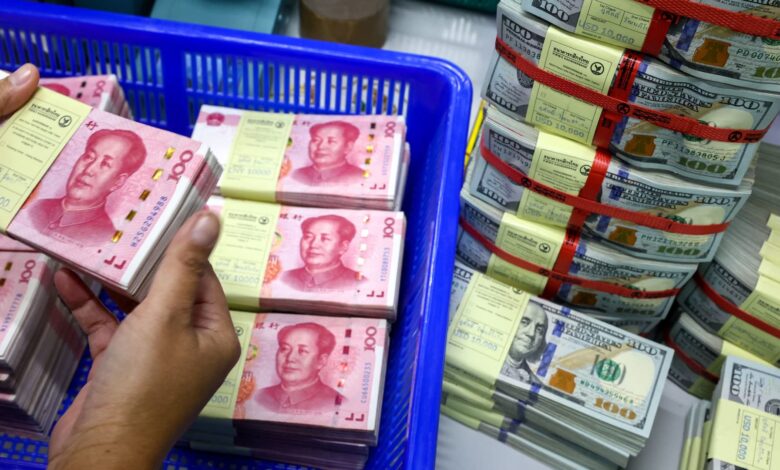
A bank employee counting China’s renminbi (RMB) or yuan notes next to U.S. dollar notes at a Kasikornbank in Bangkok, Thailand, January 26, 2023.
Athit Perawongmetha | Reuters
China is exploring more avenues for foreign institutions to utilize the yuan, amid growing uncertainty in the U.S. dollar.
Experts suggest that these initiatives are aimed at challenging the dominance of the greenback, especially as the U.S. dollar index has experienced a significant decline this year. Meanwhile, the offshore yuan has strengthened against the dollar.
In a notable move signaling Beijing’s commitment to reduce reliance on a single sovereign currency, the People’s Bank of China Governor Pan Gongsheng discussed strategies at the Lujiazui Forum to address this issue.
Additionally, plans were announced to establish a center for digital yuan internationalization in Shanghai and promote the trading of yuan foreign exchange futures. China has also introduced a digital version of its currency to replace physical cash.
Recent developments in Beijing’s efforts have focused on the futures market, with major Chinese exchanges allowing qualified foreign institutional investors to trade more futures and options contracts.
These contracts cover commodities such as natural rubber, lead, and tin on exchanges in Shanghai, Dalian, and Zhengzhou.
Further expansions in the futures market have provided international institutions with a broader range of hedging products and increased the influence of the yuan in global commodity pricing.
China’s initiatives to attract global investors to use the yuan include proposals to allow foreign currencies as collateral for trades settled in yuan and participation in on-exchange exchange-traded fund options trading for hedging purposes.
Notable financial institutions like Morgan Stanley have also received approval to offer brokerage services for mainland China commodity futures, signaling increased access to Chinese markets.
While there is interest from global investors in diversifying towards China, concerns remain about Beijing’s regulatory controls and market transparency.
Global payments
In addition to investment products, China has established a network of offshore yuan clearing banks and promoted cross-border interbank payment systems over the years.
Chinese banks lending to emerging markets have increasingly used the yuan instead of the U.S. dollar, driven by lower lending costs.
Efforts to promote bilateral trade settlement in yuan and provide financing opportunities in Hong Kong demonstrate China’s commitment to advancing the internationalization of the currency.
While the yuan’s global payment share slightly decreased in May, initiatives supporting its internationalization continue to gain momentum.
De-dollarization
Beijing’s recent push to promote the yuan aligns with a broader shift away from the dollar in Asia, driven by geopolitical tensions and monetary dynamics.
Policy uncertainties in the U.S. and a selloff in the greenback have prompted overseas investors to diversify their holdings and hedge against U.S. assets by turning to the yuan.
These developments underscore China’s efforts to reduce reliance on the U.S. dollar and establish the yuan as a viable alternative in global finance.