China factory activity edges up in November but remains in contraction
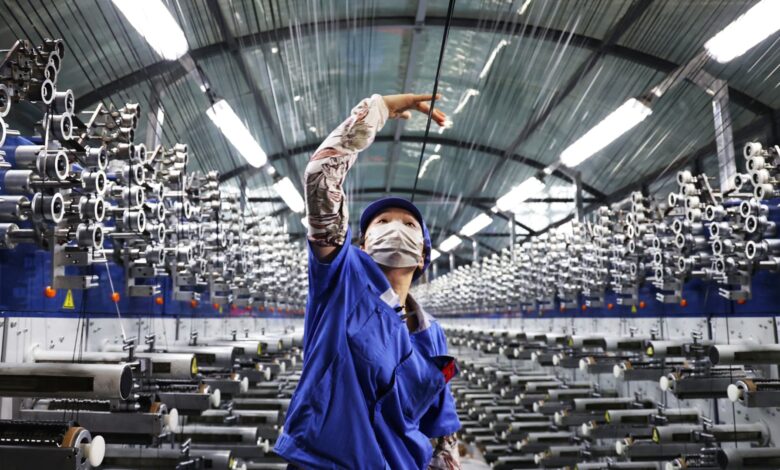
A worker walks past molten steel at a steel factory in Huai’an, in China’s eastern Jiangsu province on July 22, 2025.
– | Afp | Getty Images
China’s factory activity increased slightly in November but continued to show contraction for the eighth consecutive month. Meanwhile, the services sector weakened as the boost from previous holidays faded, according to official data released on Sunday.
The manufacturing purchasing managers’ index rose to 49.2, up 0.2 points from October, according to the National Bureau of Statistics. The figures met economists’ expectations but remained below the 50-point mark that signifies expansion.
The non-manufacturing business activity index dropped to 49.5, down 0.6 points from October, while the composite PMI output index decreased to 49.7, indicating a slight decline in both manufacturing and services activities.
Improvements were seen in supply and demand in manufacturing, with the production index reaching 50 and new orders rising to 49.2, stated Huo Lihui, chief statistician at the bureau’s Service Industry Survey Center.
High-tech manufacturing continued to expand for the tenth consecutive month at 50.1, while equipment manufacturing and consumer goods producers saw a decline below 50. Energy-intensive industries experienced a slight rebound to 48.4, up 1.1 percentage points from October.
Small enterprises showed a significant rebound in business activity, with the PMI for small enterprises increasing by 2 percentage points to 49.1, the highest in nearly six months. Medium-sized firms edged up to 48.9, while large manufacturers weakened to 49.3.
Market confidence slightly improved, with the index measuring expectations for production and operations rising to 53.1. Industries such as non-ferrous metal smelting and aerospace-related equipment reported strong sentiment, with readings above 57.
Holiday boost fades
Non-manufacturing activity, which includes construction and services, softened due to a decline in services. Huo attributed this decrease partly to the fading impact of earlier holiday-driven spending.
China’s Golden Week holiday ran from Oct. 1 to 8 this year, boosting travel and consumer spending temporarily before returning to normal levels in the following months.
Although overall service-sector activity fell to 49.5, some areas showed strength, such as railway transportation, telecommunications, broadcasting and satellite transmission, and financial services, all with readings above 55.
Real estate and residential services continued to struggle below the 50 mark, highlighting ongoing weakness in property-related activities. Construction activity improved slightly to 49.6, supported by stronger expectations for near-term growth.
The non-manufacturing new orders index declined to 45.7, reflecting softer demand. Input prices increased to 50.4, and service-sector sales prices, while still below 50, narrowed their decline.
Manufacturing employment saw a slight increase to 48.4, while non-manufacturing employment also rose marginally to 45.3. Supplier delivery times for factories improved to 50.1.
China’s monthly PMI readings, which are derived from surveys of approximately 3,200 manufacturers and 4,300 non-manufacturing firms, are considered a leading indicator for economic momentum.
Trade strains
China’s manufacturing activity has been in contraction since April, following the implementation of new tariffs by U.S. President Donald Trump that impacted producers.
Industrial profits experienced a 5.5% decline in October, the steepest drop since June, reversing the strong gains seen earlier. Earnings for major industrial firms in the first ten months of the year rose by 1.9%, showing a slowdown compared to the previous months.
The broader Chinese economy has cooled, with growth dropping to 4.8% in the third quarter.
Trade tensions with the U.S. escalated in October, leading to threats of new 100% tariffs before a late-month deal was reached in South Korea. The agreement reduced U.S. tariffs on fentanyl-related products, paused Beijing’s rare-earth controls, and reopened China’s purchases of American agricultural goods.
Despite the trade truce, domestic demand in China remains weak due to a prolonged property market downturn and challenging labor conditions, impacting consumer spending. Policymakers are focusing on boosting consumption and technological self-reliance in the long term, without implementing significant new stimulus measures as the economy remains on track to achieve its 5% growth target.