China fourth-quarter growth slows to 4.5%, weakest in nearly three years
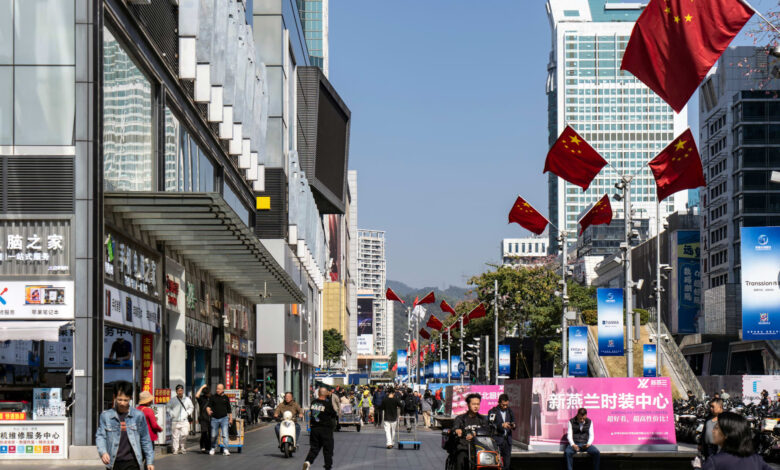
Pedestrians in the Huaqiangbei electronics market area in Shenzhen, China, on Wednesday, Jan. 14, 2026.
Qilai Shen | Bloomberg | Getty Images
China’s economy experienced a slowdown in the fourth quarter of nearly three years as domestic demand weakened, although full-year growth met Beijing’s target despite trade tensions with the U.S. and a prolonged real estate downturn.
Gross domestic product expanded by 4.5% in the October-to-December period, according to data from the National Statistics Bureau released on Monday. This marked a deceleration from the 4.8% growth in the third quarter and represented the slowest reading since the first quarter of 2023, when growth also stood at 4.5%.
For the full year, economic output reached 5%, in line with the official target.
December data revealed a weakening in domestic consumption and a steepening decline in investment, while manufacturing showed improvement.
Retail sales in December grew by 0.9% year-on-year, falling short of economists’ expectations for 1.2% growth and slowing from the previous month’s 1.3% increase. This marked the slowest growth since December 2022. Industrial output, on the other hand, increased by 5.2% in December, surpassing expectations for 5% growth.
Fixed-asset investment, which includes real estate, contracted by 3.8% last year, worse than economists’ forecast of a 3% decline.
The urban unemployment rate remained steady at 5.1% in December.
Following the data release, the mainland Chinese CSI 300 index rose by 0.6% before retreating, while Hong Kong’s Hang Seng Index dipped by 0.8%. The offshore yuan also strengthened slightly against the U.S. dollar.
“We must adopt more proactive and effective macro policies and continue to expand domestic demand,” stated the statistics bureau in an official English language release.
Supply-demand imbalance
In 2025, China’s economy demonstrated resilience, aided by lower-than-expected tariff rates and exporters diversifying away from the U.S., allowing policymakers to delay extensive stimulus measures.
China reported a record trade surplus last year, driven by increasing exports to non-U.S. markets as manufacturers redirected shipments to avoid higher U.S. tariffs.
China’s net exports contributed significantly to its GDP, while consumption played a key role in the economic output.
Economists have urged for economic reforms to shift the growth model towards domestic consumption and reduce reliance on exports and investment.