China keeps benchmark lending rates unchanged despite slowing economic growth
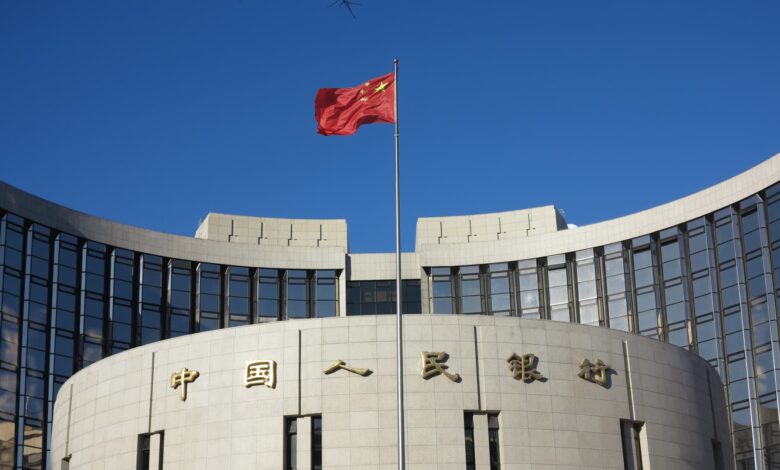
China’s central bank, the People’s Bank of China (PBOC), decided to keep its loan prime rates unchanged on Tuesday in an effort to provide targeted support for specific sectors in the economy. This move comes as the Chinese authorities focus on bolstering a slowing economy through sector-specific measures rather than broad policy easing.
The PBOC maintained its 1-year and 5-year loan prime rates at 3% and 3.5%, respectively, marking the eighth consecutive month of no changes. The 1-year rate plays a significant role in influencing both new and existing loans, while the 5-year benchmark impacts mortgage rates.
The decision to keep the rates steady comes at a time when China’s economic growth has been losing momentum. In the final quarter of 2025, the economy grew at a rate of 4.5% year on year, the slowest pace since the reopening from strict Covid restrictions in late 2022. The nominal GDP, a key indicator of corporate performance and household incomes, has been below 4% for three consecutive years, standing at 3.8% in the fourth quarter, the lowest level in 50 years excluding the pandemic-hit year of 2020.
Furthermore, the GDP deflator, which measures changes in the prices of goods and services, has remained negative for the 11th consecutive quarter, with expectations of continued deflation throughout the year. Retail sales growth hit a 3-year low of 0.9% in December, reflecting ongoing challenges in the housing market, a weak job market, and persistent deflationary pressures affecting consumer confidence.
In response to these economic challenges, China’s policymakers have emphasized the need for “more proactive fiscal policies” and a “moderately loose monetary policy” to support price recovery. Last week, the central bank reduced interest rates on its structural monetary policy tools, aiming to lower borrowing costs and encourage credit extension to targeted sectors at more favorable rates.
Looking ahead, Deputy Governor Zou Lan hinted at the possibility of further easing measures, including potential reductions in the reserve requirement ratio and policy rates. The stabilization of banks’ net interest margins and the recent appreciation of the yuan against the dollar have created room for additional policy rate cuts.
Despite the economic headwinds, China’s manufacturing and exports have remained resilient, with industrial production rising by 5.9% in 2025 and exports climbing by 5.5%, resulting in a trade surplus of nearly $1.2 trillion. However, fixed-asset investment in urban areas experienced a 3.8% decline last year, the first annual decrease in decades, driven by a slowdown in property investment and efforts to address local debt risks.
In conclusion, the PBOC’s decision to maintain loan prime rates reflects a cautious approach to supporting the economy through targeted measures while leaving room for potential future easing actions to stimulate growth and address ongoing challenges. The world is constantly changing, and with it, our understanding of the universe is evolving. Scientists are constantly making new discoveries and pushing the boundaries of what we know about the cosmos. One of the most exciting areas of research in recent years has been the study of dark matter and dark energy.
Dark matter and dark energy are two of the most mysterious and elusive substances in the universe. They make up the vast majority of the universe’s mass-energy content, yet we know very little about them. Dark matter is thought to make up around 27% of the universe, while dark energy is believed to account for around 68%. Together, these two mysterious substances make up a staggering 95% of the universe, leaving just 5% for the ordinary matter that we are familiar with.
Despite its name, dark matter is not actually dark in the traditional sense. It doesn’t emit, absorb, or reflect any electromagnetic radiation, which is why it is so difficult to detect. Scientists have only been able to infer the existence of dark matter through its gravitational effects on visible matter, such as stars and galaxies. Dark matter is thought to be made up of particles that interact very weakly with ordinary matter, which is why it has proven so elusive.
Dark energy, on the other hand, is even more mysterious. It is thought to be responsible for the accelerated expansion of the universe, a discovery that was made in the late 1990s and earned the Nobel Prize in Physics in 2011. Dark energy is believed to be a repulsive force that is pushing galaxies apart at an ever-increasing rate. Scientists are still trying to understand the nature of dark energy and how it fits into our current understanding of the universe.
Recent research has shed some light on the nature of dark matter and dark energy. One study, published in the journal Nature Astronomy, suggested that dark matter may not be as cold as previously thought. Cold dark matter is a theoretical form of dark matter that moves at relatively low speeds, but this new study found evidence that dark matter particles may be moving faster than previously believed.
Another study, published in the journal Physical Review Letters, suggested that dark energy may be even more mysterious than we thought. The researchers found that the properties of dark energy may change over time, which could have profound implications for our understanding of the universe.
As our technology and understanding of the universe continue to advance, we are sure to learn more about dark matter and dark energy. These mysterious substances hold the key to unlocking some of the biggest mysteries of the cosmos, and scientists are working tirelessly to unravel their secrets. The study of dark matter and dark energy is a thrilling frontier of modern science, and the discoveries that await us are sure to be mind-blowing.