China urges Beijing-backed development bank to focus more on Belt and Road Initiative
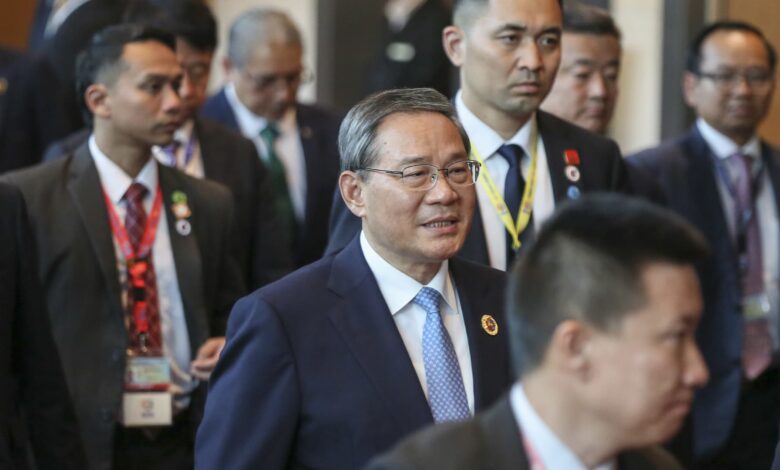
Chinese Premier Li Qiang emphasized the importance of the Asian Infrastructure Investment Bank (AIIB) increasing its support for China’s Belt and Road Initiative during the bank’s 10th annual meeting. This call for enhanced collaboration comes at a time when the United States is scaling back its support for traditional Western-led institutions like the World Bank and the International Monetary Fund.
In his address at the opening ceremony of the AIIB meeting, Premier Li stressed the need for the bank to uphold open regionalism and facilitate connectivity among Asian nations and beyond. He highlighted the significance of aligning the AIIB’s efforts with both the Belt and Road Initiative and the Global Development Initiative, two key programs spearheaded by China.
This move by China to leverage the AIIB’s support for its flagship initiatives is seen as a strategic response to the trade and economic policies pursued by the Trump administration. Stephen Olson, a former U.S. trade negotiator, noted that China is capitalizing on the shifting global dynamics to counterbalance U.S. efforts to sway countries away from Chinese influence.
AIIB President Jin Liqun acknowledged China’s desire to enhance the quality of Belt and Road projects, emphasizing the positive impact of the AIIB’s work. The bank, which boasts 110 member countries, plays a pivotal role in evaluating and financing infrastructure projects across various regions.
While the U.S. is not a member of the AIIB, several European nations, including the U.K., France, and Germany, are part of this China-led institution. Additionally, countries like Russia, Israel, Singapore, and Vietnam are actively engaged with the AIIB, underscoring its global reach and influence.
In a bid to contribute to the economic transformation of the Middle East, the AIIB expressed its willingness to support restructuring efforts and enhance educational opportunities in the region. This commitment aligns with China’s broader vision of promoting sustainable development and poverty alleviation through its initiatives.
The Belt and Road Initiative, launched by Chinese President Xi Jinping in 2013, aims to bolster global connectivity through the development of transportation networks spanning Asia, Europe, and Africa. While critics raise concerns about debt sustainability and the dominance of Chinese firms in these projects, China remains steadfast in advancing its regional and global influence.
The recent appointment of Zou Jiayi, a seasoned Chinese official, as the next president of the AIIB underscores China’s continued leadership within the institution. With a track record in finance and governance, Zou is poised to steer the AIIB towards greater success and impact in the coming years.
Indonesia, a key AIIB member, highlighted its strong partnership with the bank in implementing infrastructure projects worth billions of dollars. This collaboration underscores the AIIB’s evolution from an emerging institution to a significant player in global development financing.
In closing, Premier Li’s call for international collaboration and non-politicization of trade resonates with China’s commitment to reshaping global economic norms. By engaging with business leaders and government officials at forums like the World Economic Forum, China seeks to foster a more inclusive and cooperative approach to international trade and investment. In today’s fast-paced world, it can be easy to overlook the importance of self-care. With busy schedules and constant demands from work, family, and social obligations, taking time for yourself can often fall to the wayside. However, practicing self-care is essential for maintaining both physical and mental well-being.
Self-care can take many forms, from simple acts of kindness towards yourself to more structured practices such as meditation or exercise. It’s important to find what works best for you and make it a priority in your daily routine.
One of the simplest ways to practice self-care is to take time for yourself each day. This can be as little as 10 minutes of quiet time to relax and unwind, or as much as an hour-long yoga session. Taking this time to focus on yourself can help reduce stress, improve mood, and boost overall well-being.
Another important aspect of self-care is to take care of your physical health. This includes eating a balanced diet, getting enough sleep, and exercising regularly. These simple habits can have a huge impact on your overall health and well-being, making it easier to handle the stresses of daily life.
In addition to physical health, mental health is also crucial when it comes to self-care. Taking time to practice mindfulness, meditation, or other relaxation techniques can help reduce anxiety and improve mental clarity. It’s also important to seek help from a mental health professional if needed, as taking care of your mental health is just as important as taking care of your physical health.
Self-care is not selfish, it’s necessary. By taking care of yourself, you are better able to take care of others and handle the challenges that life throws your way. So take some time for yourself today, whether it’s a walk in nature, a bubble bath, or a good book. Your mind and body will thank you for it.