China’s robot vacuum Roborock plans mass-market cleaners with AI arms
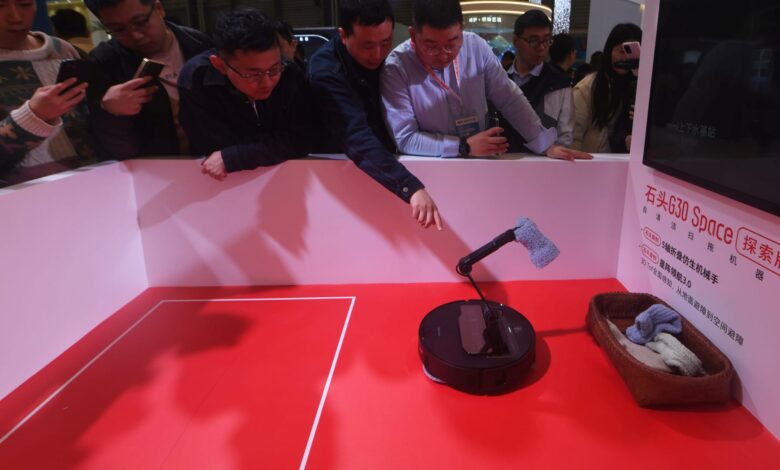
Roborock, a Beijing-based robot vacuum cleaner company, is making waves in the industry with its innovative products. In 2025, the company launched a vacuum cleaner equipped with a robotic arm designed to move socks and other obstructions out of the way. This cutting-edge technology is a glimpse into the future of household robotics.
Quan Gang, the president of Roborock, envisions a world where human-like robots are a common sight in households by 2030. He believes that advances in generative artificial intelligence will play a crucial role in making this vision a reality. Roborock’s latest high-end cleaner, equipped with an AI-powered robotic arm, is expected to become affordable for the mass market in the coming years, with a price tag of just a few hundred U.S. dollars.
Despite the company’s focus on the premium segment, Quan emphasizes the importance of making their products accessible to a wider audience. He notes that robot vacuums still have a low household penetration rate, with China at 5.6% and the United States at 22%. Quan believes that by offering advanced technology at an affordable price, Roborock can significantly increase its market share.
The competition in the robotic vacuum and robotic arm category has been heating up, with multiple Chinese companies vying for the top spot. Roborock’s Saros Z70, equipped with an AI-powered arm, has garnered attention for its innovative design. While initial reviews have been mixed, the company remains committed to developing products that bridge cutting-edge technologies with mainstream price points.
However, the road to widespread adoption of household robots is not without challenges. Jeff Burnstein, president of the Association for Advancing Automation, points out that vacuum cleaners are currently the only successful application of robots in homes. For humanoid robots to enter households, there must be a compelling quality for the price.
Roborock has faced challenges with tariffs affecting the pricing of its products. Despite this, the company is focused on expanding its global supply chain partnerships and investing in research and development. With a dedicated AI lab and research institute, Roborock is committed to pushing the boundaries of innovation in the robotics industry.
As AI becomes increasingly critical for household robots, Quan envisions a future where robots can integrate specialized knowledge and skills, much like installing an app on a smartphone. This approach could revolutionize the way we interact with robots in our homes, making them more versatile and intelligent.
Overall, Roborock’s vision for the future of household robotics is ambitious and exciting. With a focus on affordability, innovation, and accessibility, the company is poised to lead the way in shaping the future of smart home technology. The cleaning industry is constantly evolving, with Roborock leading the way in innovative technology. According to experts, Roborock has the best data on cleaning tasks, making them a top choice for consumers looking for efficient and effective cleaning solutions. While other companies may excel in different areas, such as cooking, Roborock is at the forefront of the cleaning market.
As the demand for cleaning robots continues to grow, the humanoid market is also expected to see significant growth. Estimates suggest that the humanoid market could reach $5 trillion by 2050, with a substantial portion of that revenue coming from China. This indicates a strong interest in humanoid technology, particularly in tasks such as cooking, cleaning, and assisting the elderly.
According to industry experts, the key to success in the humanoid market lies in creating robots that can multitask effectively. While single-function robots are limited in their capabilities, a versatile humanoid that can perform a variety of tasks could be a game-changer. Companies worldwide are investing in research and development to create safe, affordable humanoids that can handle multiple functions with ease.
Although the technology is still evolving, there is optimism that advancements in robotics will lead to the creation of multitasking humanoids. This innovation could revolutionize the way we approach household tasks, eliminating the need for multiple specialized robots. Instead, a single humanoid could handle a range of chores, from cleaning to cooking to providing assistance to those in need.
In conclusion, the future of cleaning and robotics is bright, with companies like Roborock leading the charge in creating efficient and effective cleaning solutions. As the humanoid market continues to grow, the focus will be on developing robots that can multitask and handle a variety of functions with ease. With advancements in technology, we may soon see a new generation of robots that can revolutionize the way we approach everyday tasks.