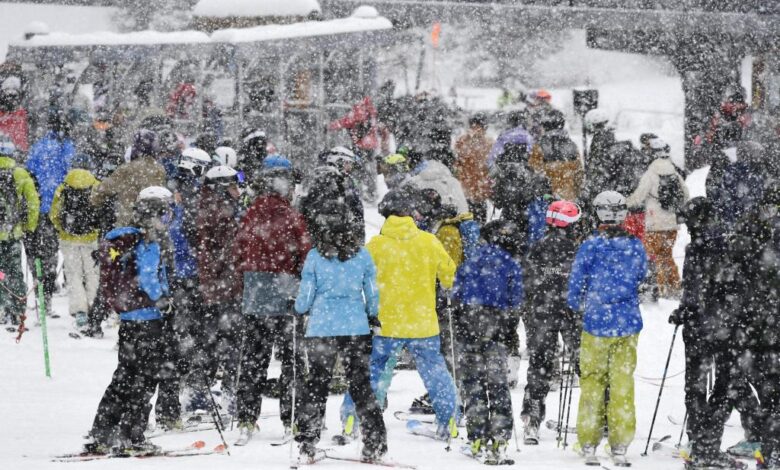
Colorado ski resort officials tracking uncertainty in travel trends, U.S. consumer confidence
Canadians have decided to forego traveling to the United States as a form of protest against President Trump’s tariff policies and his “51st state” rhetoric. This boycott has raised concerns among travel analysts regarding consumer confidence and spending in the U.S., especially due to inflation and other economic pressures.
While Colorado ski resorts that heavily rely on out-of-state visitors are uncertain about the impact of these challenges on their business this winter, resorts that primarily cater to Colorado skiers are starting the 2025-26 ski season with optimism.
“Our season pass sales and forward bookings are all looking positive,” stated Copper Mountain general manager Dustin Lyman during a roundtable discussion with other Summit County ski resort leaders in October. “It appears that it will be a great season.”
Similar sentiments were echoed by the leaders of Arapahoe Basin and Loveland, which attract mainly Front Range day skiers.
“We are quite optimistic,” said Loveland’s chief operating officer, Rob Goodell. “Our early season sales for ticket products and lessons are all up compared to last year. There is a lot of excitement about the upcoming season.”
“The same goes for us,” added Alan Henceroth, the counterpart at A-Basin. “I believe it will be an excellent year.”
Tim Wolfe, the director of the Colorado Tourism Office, mentioned that overall winter bookings in Colorado are either flat compared to last year or slightly increasing. The introduction of daily United Airlines flights from Mexico City to Denver, which started in October and will continue through March, is expected to boost tourism. Data from Inntopia, a travel industry source, showed a 35% increase in bookings from Mexico to the U.S. for the ski season compared to the previous year as of October 31.
“Mexico is a significant international travel market for the state of Colorado,” Wolfe emphasized.
While bookings from Western Europe increased by 9.6%, the Canadian boycott led to a 53% drop in bookings from north of the 48th parallel. Canadian travel journalist Claudia Laroye noted that the boycott was a spontaneous grassroots movement driven by feelings of upset, anxiety, fear, and anger over the economic impact of the tariffs.
Trump’s remarks about Canada potentially becoming the 51st state were seen as a personal affront to Canadian pride and sovereignty.
“It’s quite unsettling,” Laroye remarked.
Tom Foley, the senior vice president of business intelligence at Inntopia, believes that the boycott will persist as it has become deeply ingrained in society. He added that Canadian ski resorts are benefiting from the situation by attracting business that would have otherwise gone to the U.S.
Within the U.S. economy, consumer confidence has been on a downward trend over the past year. Wall Street analyst Patrick Scholes, specializing in the ski and hospitality industry at Truist Securities, predicts that Colorado’s pricier resorts, which appeal to wealthier travelers, will still perform well even as lodging prices surge during the Christmas holidays.
“The overall travel trends in the United States have been sluggish,” Scholes observed. “However, the upper-end income brackets show strength in travel. These customers are feeling positive about their investments and job security, which bodes well for luxury vacations at resorts during Christmas and New Year’s.”
Ski.com, based in Aspen, serves as a travel platform for booking flights, lodging, lift tickets, equipment rentals, and other travel services at resorts worldwide. Chief marketing officer Dan Sherman reported strong bookings for Colorado, but there are lingering concerns.
“Our year-over-year growth is positive, so everything appears promising,” Sherman stated. “The stock market continues to thrive, but consumer confidence does not necessarily reflect that, leading to uncertainties about the future on a day-to-day basis.”
Tourism experts have noticed a shift in travelers’ booking behavior, with more bookings being made closer to the travel date, making long-term forecasts less reliable.
“For the key months of December, January, February, and March, we are either flat or slightly down,” shared Julia Theisen, the tourism director for the Town of Snowmass Village, home to the Snowmass ski resort. “We have observed a trend of more last-minute bookings over the past year. While it’s hard to predict right now, we are not overly concerned about winter performance.”

Aside from travel, ski area operators are also monitoring the impact of higher tariffs on their operations.
“Our retail department is facing uncertainties with incoming orders due to tariffs,” Goodell explained. “We cannot predict the final costs because of these trade policies. Deliveries, such as snowcats, incur additional charges due to tariffs. While we try to minimize passing on these costs to our guests, things have become more expensive.”
Subscribe to our weekly newsletter, The Adventurist, to receive outdoor news directly in your inbox.