Delivery Canceled! Uber Eats delivery robot hit by train
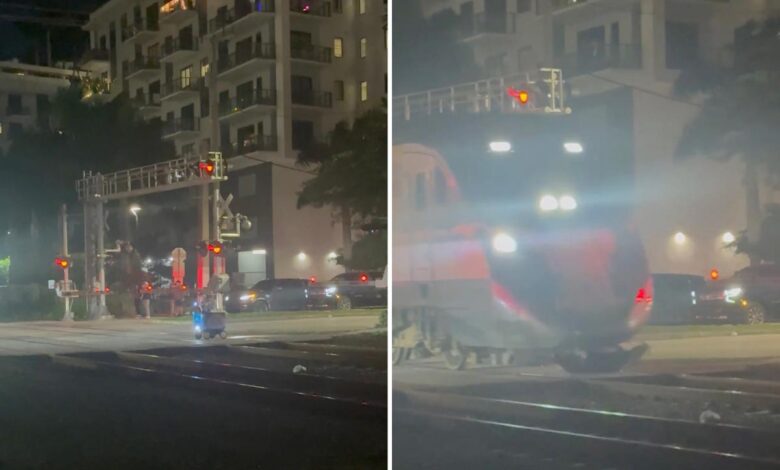
An unfortunate incident occurred in Miami when an Uber Eats delivery robot got stuck on a railroad track and was subsequently destroyed by a passing train. The robot, which was not carrying any delivery at the time, malfunctioned and found itself in a precarious position on the tracks. Shocked onlookers witnessed the collision as a Brightline commuter train plowed into the motionless robot.
The incident was captured on video by Miami native Guillermo Dapelo, who was walking his dogs at the time. The video quickly went viral, showing the train approaching the helpless robot. Despite efforts to alert the company about the robot’s predicament, the train was unable to stop in time to avoid the collision.
Thankfully, no humans were harmed in the incident, but the robot met an unfortunate end. The average locomotive weighs 200 tons and takes nearly a mile to come to a complete stop when traveling at 55 miles per hour, highlighting the immense force involved in the collision.
Uber Eats delivery robots are typically the size of a suitcase and move at a leisurely pace of five miles per hour. They are equipped with AI, cameras, and sensors to navigate sidewalks and avoid obstacles. While they are mostly autonomous, human operators can take control in complex situations such as crossing streets or navigating challenging terrain.
The Uber Eats robot delivery program initially launched in Santa Monica, California, before expanding to other urban areas like Beverly Hills and West Hollywood. With approximately 95 million users globally and 31 million in the US alone, Uber Eats has become one of the most popular food delivery services. Despite the success of the program, efforts to reach Uber Eats for comment on the incident were unsuccessful.
In conclusion, the unfortunate demise of the Uber Eats delivery robot serves as a reminder of the challenges and risks involved in implementing autonomous delivery systems in urban environments. While technology continues to advance, incidents like this highlight the importance of safety measures and oversight in the deployment of such systems. The world of technology is constantly evolving, and one of the latest trends in the industry is the rise of artificial intelligence (AI). AI is a branch of computer science that aims to create machines that can perform tasks that typically require human intelligence, such as speech recognition, decision-making, and problem-solving.
One of the most exciting applications of AI is in the field of autonomous vehicles. Autonomous vehicles, also known as self-driving cars, are vehicles that can navigate and operate without human intervention. These vehicles use AI algorithms to analyze data from sensors, cameras, and other sources to make decisions about driving, such as steering, accelerating, and braking.
The development of autonomous vehicles has the potential to revolutionize the transportation industry. By eliminating human error, autonomous vehicles have the potential to reduce accidents and save lives. They can also improve traffic flow and reduce congestion on roads, leading to faster and more efficient transportation.
However, there are still many challenges that need to be overcome before autonomous vehicles can become mainstream. One of the biggest challenges is ensuring the safety and reliability of these vehicles. AI algorithms must be able to accurately interpret and respond to complex and unpredictable driving situations, such as bad weather, road construction, and erratic human drivers.
Another challenge is regulatory approval. Governments around the world are still grappling with how to regulate autonomous vehicles and ensure they meet safety standards. There are also ethical considerations to take into account, such as who is responsible in the event of an accident involving an autonomous vehicle.
Despite these challenges, the potential benefits of autonomous vehicles are too great to ignore. Companies like Tesla, Google, and Uber are investing heavily in AI technology to develop autonomous vehicles, and many experts believe that they will become a common sight on roads in the near future.
In conclusion, the rise of AI in autonomous vehicles is an exciting development that has the potential to revolutionize the transportation industry. While there are still many challenges to overcome, the benefits of autonomous vehicles are too great to ignore. With continued investment and research, we may soon see a future where self-driving cars are the norm rather than the exception.