Even Robinson Crusoe Understood The Price And Value Of Money
The concept of money is a fundamental aspect of any economy. It serves as a medium of exchange that enables transactions between individuals and businesses. But what exactly determines the price of money? In a free market economy, the commodity with the highest marketability tends to become the preferred medium of exchange. This common medium allows for economic calculation, which in turn enables entrepreneurs to identify opportunities, make profits, and drive society forward.
Unlike goods and services, determining the price of money is more complex. Since prices are already expressed in terms of money, we need to find another way to measure the purchasing power of money. People buy and sell money based on their expectations of what it will buy them in the future. This decision-making process is guided by the law of diminishing marginal utility, which states that the value of each additional unit of a good diminishes as more units are acquired.
Money is no exception to this principle. Its value lies in the satisfaction it can provide, whether that be in purchasing goods, providing security, or creating future options. When individuals exchange their labor for money, they do so because they value the purchasing power of that money more than the immediate use of their time. The cost of money in an exchange is determined by the highest utility a person could have derived from the amount of cash they gave up.
The law of diminishing marginal returns applies to money as well, with each additional unit providing less satisfaction than the previous one. However, what constitutes a homogenous good varies from person to person. Each individual assigns value to money based on their own preferences and desires. To one person, a unit of money may be equivalent to the price of a hot dog, while to another, it may represent the cost of a rib-eye steak.
Money only holds value when it is exchanged between individuals. In isolation, money is meaningless, much like any language that requires at least two people to function. Money serves as a tool for communication, enabling individuals to exchange goods and services efficiently.
Inflation plays a significant role in shaping the value of money. People make decisions about saving, spending, or investing based on their time preference and expectations about money’s future value. Whether money is saved or invested, it is always serving a purpose for its owner. Even money that is not actively being spent is providing a sense of security and optionality.
The concept of “idle money” is misleading, as money is always owned and performing a service for its holder. Exchanges occur at specific points in time, and money is always in use, even if it is not actively being spent. Historical prices and economic expectations are crucial for understanding the value of money and making informed decisions about saving and spending.
Governments use tools like the Consumer Price Index (CPI) to measure inflation and track changes in purchasing power. However, CPI often overlooks high-value assets like real estate and stocks, leading to a skewed representation of inflation. The creation of new money through monetary expansion inevitably leads to a decrease in purchasing power over time, affecting individuals at different income levels in various ways.
Inflation is often described as the most insidious form of theft, as it erodes savings, widens inequality, and creates financial instability. While the effects of inflation may be delayed and difficult to trace directly, its impact on society as a whole is significant. Ultimately, a sound monetary regime benefits everyone, including the wealthy, by preserving the value of money and promoting economic stability. Money has always played a crucial role in human civilization, facilitating trade, promoting economic growth, and enabling individuals to store value for the future. But the origins of money and its evolution over time reveal a fascinating story of how a simple concept transformed into a complex system that shapes our daily lives.
The idea of money can be traced back to the barter economy, where goods and services were exchanged directly for other goods and services. The good that eventually evolved into money must have had nonmonetary value before it became a medium of exchange. Its initial worth was determined by its utility in some other use case, and as it began to serve a second function as a medium of exchange, its demand and price increased.
This concept is at the heart of Mises’ Regression Theorem, which explains how money naturally emerges in markets and maintains a link to past valuations. Gold, for example, became money because it met the criteria of being durable, divisible, recognizable, portable, and scarce. Its use in jewelry and industry added to its value, making it a desirable medium of exchange.
However, the transition from gold-backed currencies to fiat money, where governments and central banks can create money out of thin air, has led to a distortion of the monetary system. Fiat currencies operate under the logic that increasing the money supply devalues each existing unit, benefiting early recipients of new money at the expense of everyone else. This inflationary system not only distorts economic calculation but also rewards debt over savings and undermines the stability of the financial system.
In this sense, fiat currency can be seen as the world’s largest pyramid scheme, enriching a select few at the expense of the majority. The acceptance of broken money is a result of the system we have inherited, rather than one that serves the best interests of society. However, as more people recognize the benefits of sound money – money that cannot be counterfeited – there may be a shift towards a more honest and sustainable monetary system.
Sound money arises through voluntary choice, not political decree, and allows for long-term prosperity and stability. It serves as a safeguard of time, a record of trust, and a universal language of human cooperation. When money is corrupted, it distorts savings, prices, incentives, and trust, ultimately undermining the foundation of civilization itself.
In conclusion, money is not just a medium of exchange but a moral institution that shapes our daily lives and interactions. By understanding its origins and the principles that govern its value, we can work towards creating a more equitable and sustainable financial system that benefits all members of society. The truth about modern money is a bitter pill to swallow. As consumer prices continue to rise, media outlets point fingers at various factors, but the real culprit remains hidden in plain sight: monetary expansion. Human beings have an innate tendency to exploit others by printing money, leading to a vicious cycle of debt and control.
The concept of fiat currency, where money is not backed by any tangible asset but created as debt, has become the norm in today’s financial system. Every new dollar, euro, or yuan comes into existence when a large bank issues a loan, with the expectation that it will be paid back with interest. However, since the interest is never created alongside the principal, there is never enough money in circulation to repay all debts, leading to a perpetual need for more debt to sustain the system.
Central banks manipulate the money supply through mechanisms like bailouts and quantitative easing, where new money is created to purchase government bonds. This process effectively trades IOUs for freshly printed currency, ultimately resulting in a continuous wealth extraction from productive individuals through inflation and debt servitude.
The ideology of Keynesian economics, which advocates for government spending to stimulate the economy, further perpetuates the cycle of money printing. However, this approach ignores the reality of value dilution through inflation, leading to a false sense of economic growth. In reality, wealth is created through production, planning, and voluntary exchange, not by increasing the number of digits on a central bank’s balance sheet.
Fiat currencies have a grim fate, as history has shown that they eventually collapse or are absorbed into larger systems. The Cantillon effect, named after economist Richard Cantillon, highlights how new money benefits the first recipients while ordinary workers and savers bear the cost. This transfer of wealth from value creators to those with political proximity underscores the inherent flaws in the fiat currency system.
Despite claims by politicians and economists that inflation is necessary for a healthy economy, the reality is quite the opposite. Inflation erodes trust in money, savings, and cooperation, ultimately undermining the foundation of civilization. The true drivers of human flourishing are productive individuals who contribute to the market through voluntary cooperation and value creation, not governments.
Praxeology, the study of human action, offers a framework for understanding the market process and appreciating the role of productive individuals in society. By focusing on human incentives and the unseen consequences of intervention, praxeology sheds light on the importance of free markets and voluntary exchange in driving innovation and progress.
In a world filled with fear, uncertainty, and doubt, it is crucial to recognize the power of productive individuals in shaping the future. By understanding the flaws of the current monetary system and the importance of voluntary cooperation, we can work towards a more sustainable and equitable financial system that benefits all members of society. In today’s world, it seems like the solution to every crisis is always more political control. Whether it’s terrorism, pandemics, or climate change, the answer always seems to be giving up more of our freedom in exchange for security. But is this really the best approach?
Those who study human behavior understand that for every individual, the end justifies the means. This is true not only for regular people but also for those in power. They promise safety and security in exchange for our freedom, but history has shown us time and time again that these fear-driven trade-offs rarely lead to positive outcomes. When we understand these dynamics, the world becomes clearer, and the noise fades away.
Instead of relying on politicians and governments to solve our problems, we can take matters into our own hands. By investing in ourselves—whether it’s through developing new skills, saving money, or building strong relationships—we can create a better future for everyone. By participating in the division of labor and producing value voluntarily, we can make a real difference in the world.
One way to take a stand against the current system is by avoiding the use of fiat currencies whenever possible. By doing so, we can help create a world with less theft and deceit. While this may not be easy, the most worthwhile endeavors are often the most challenging.
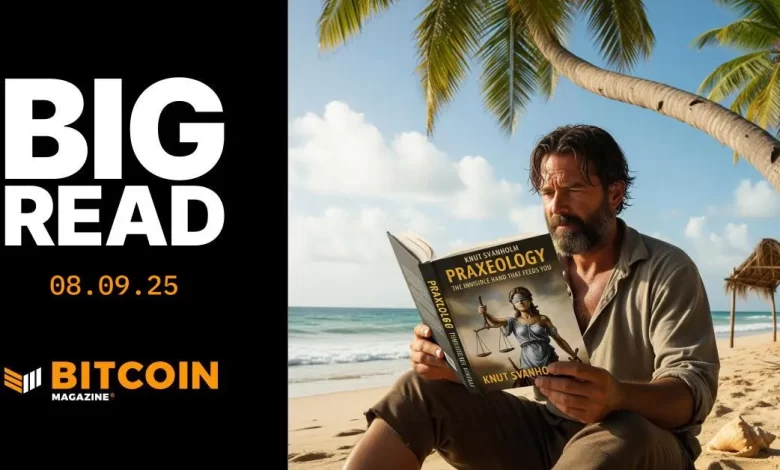
Knut Svanholm, a Bitcoin educator, author, and podcaster, highlights these ideas in his book “Praxeology: The Invisible Hand that Feeds You.” Published by Lemniscate Media, this book challenges readers to think differently about the world and their role in it.
In the end, the most radical action we can take in a broken system is to build something better outside of it. By focusing on personal growth, financial independence, and community building, we can create a more sustainable and equitable future for all. It’s time to turn off the noise, reclaim our time, and work towards a better world for ourselves and future generations.