FCC Chair Carr to Testify Before Senate Committee About Jimmy Kimmel Suspension
25 that they would resume airing Kimmel’s show after Disney reinstated the late-night host. In a joint statement, the companies said they were pleased with Disney’s decision and that they would continue to air “Jimmy Kimmel Live!” going forward.
The controversy surrounding Jimmy Kimmel and the FCC has raised concerns about the potential for government censorship of media outlets and the impact on free speech. As Brendan Carr prepares to testify before the Senate Commerce Committee, the public will be watching closely to see how this situation unfolds and what implications it may have for the future of broadcasting and the protection of free expression.
:
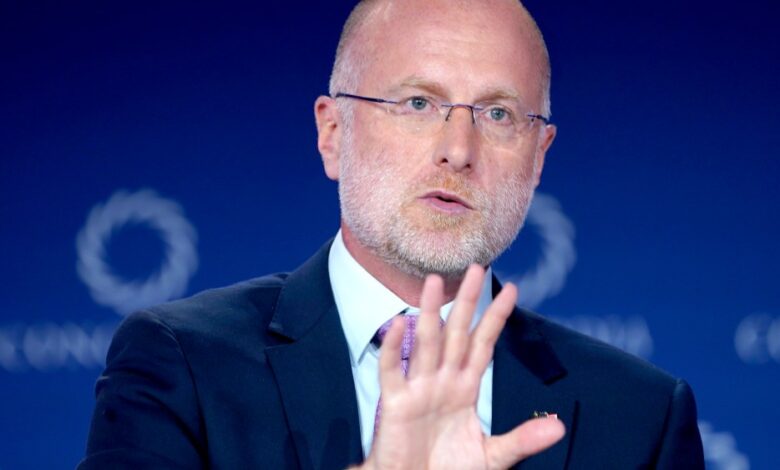
The controversy surrounding the temporary suspension of late-night host Jimmy Kimmel on ABC has attracted significant attention in recent weeks. Brendan Carr, the Trump-appointed chairman of the FCC, has agreed to testify before the Senate Commerce Committee to address the events that led to Kimmel’s benching.
The conflict began after Kimmel made controversial remarks on his show, prompting Carr to threaten ABC affiliates with investigations into “news distortion” unless they removed Kimmel from the air. This led to ABC’s suspension of “Jimmy Kimmel Live!” as a response to Carr’s actions.
The Senate Commerce Committee is expecting to hold a hearing in November to address the situation, with Carr, Republican Olivia Trusty, and Democratic appointee Anna Gomez all expected to appear. Sen. Ted Cruz, who chairs the committee, has criticized Carr’s actions, likening him to a “mafioso” and expressing concerns about the implications for free speech.
Carr has since clarified his remarks, stating that he never threatened to revoke broadcasters’ licenses and that the decision to preempt Kimmel’s show was made by the stations themselves. Despite this, the controversy has sparked a broader discussion about government censorship and the protection of free expression in the media.
Sen. Adam Schiff and other senators have sent letters to Carr raising questions about the incident, emphasizing the importance of upholding the free press and preventing political retribution against media outlets. The controversy has also prompted inquiries into the decisions of Nexstar and Sinclair, two major station groups that preempted Kimmel’s show.
Ultimately, ABC reinstated Kimmel after the suspension, leading Nexstar and Sinclair to resume airing the show. As Carr prepares to testify before the Senate Commerce Committee, the public will be closely monitoring the proceedings to see how this situation is resolved and what it may mean for the future of broadcasting and free speech protections. Sinclair and Nexstar recently made headlines when they announced that they would be ending their preemption of “Jimmy Kimmel Live!” and would start airing the show on their ABC affiliates. This decision came as a surprise to many, as both companies had previously chosen to preempt the show.
Both Sinclair and Nexstar were quick to clarify that their decisions were not influenced by any government pressure or communication. Instead, they asserted that their choices were made independently based on their own programming strategies.
The decision to preempt “Jimmy Kimmel Live!” initially sparked controversy and raised questions about the relationship between networks and their affiliates. Some speculated that the move was a result of political pressure or censorship. However, both Sinclair and Nexstar maintained that their actions were justified and in line with their programming goals.
This development sheds light on the evolving dynamics between networks and their affiliates. As the media landscape continues to evolve, conflicts between networks and affiliates are becoming more common. The decision to end the preemption of “Jimmy Kimmel Live!” is just one example of the challenges that both parties face in navigating this complex relationship.
Moving forward, it will be interesting to see how this decision impacts the relationship between Sinclair, Nexstar, and ABC. As the media landscape continues to evolve, it is clear that networks and affiliates will need to find new ways to collaborate and communicate effectively in order to navigate these challenges.