Five takeaways after U.S., Denmark hold White House talks
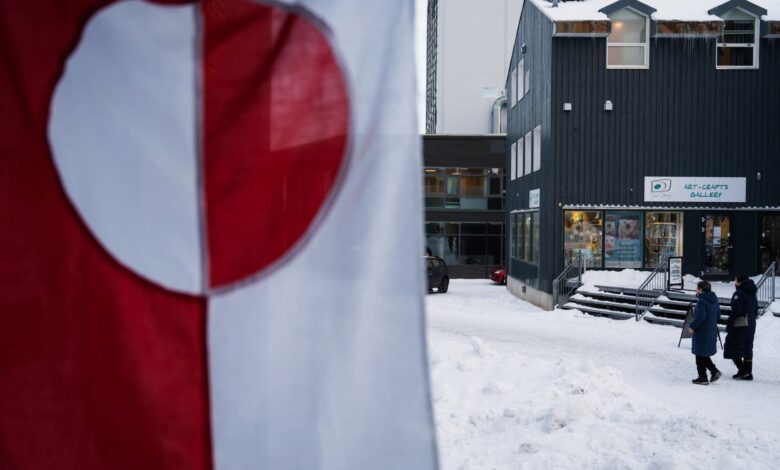
Greenlandic flags are displayed on a building in Nuuk, Greenland, on January 14, 2026.
Alessandro Rampazzo | AFP | Getty Images
A crucial meeting between the U.S., Denmark, and Greenland regarding the future of the Arctic island concluded without a significant breakthrough, raising concerns about finding a timely resolution.
The meeting at the White House on Wednesday, attended by U.S. Vice President JD Vance, U.S. Secretary of State Marco Rubio, Danish Foreign Minister Lars Lokke Rasmussen, and Greenland’s Vivian Motzfeldt lasted approximately an hour.
Rasmussen described the discussion as “frank but constructive,” expressing disapproval of U.S. President Donald Trump’s repeated threats to annex Greenland as “completely unacceptable.”
CNBC outlines five key insights from the White House confrontation.
Establishment of a working group
The White House discussions were deemed significant by some as the U.S., Denmark, and Greenland agreed to form a high-level working group to explore a path forward for the self-governing Danish territory.
Penny Naas, senior vice president at GMF, a think tank in Washington, stated that by doing so, the three nations had managed to avoid a worst-case scenario.
“Greenland’s strategic importance has made it a focal point of sustained U.S. interest, including periodic attempts at acquisition. However, Greenlanders have been clear: they cherish their strong connections with Denmark, NATO, and Europe, and do not envision their future as part of the United States,” Naas conveyed in an email to CNBC.
“Bridging this divide, between a U.S. administration that still hints at a desire to ‘own’ Greenland and a Greenlandic population firmly devoted to self-determination, will necessitate ingenuity and a realistic understanding of the concerns on all sides,” she added.
Rasmussen mentioned that the working group intends to convene in the upcoming weeks to seek a compromise. He indicated that Denmark and Greenland were open to the idea of the U.S. establishing additional military bases on the island but stressed that there were certain “red lines” that Washington must not cross.
Trump’s unwavering stance
Moments before Wednesday’s meeting commenced, Trump asserted that anything short of Greenland becoming part of the United States would be “unacceptable.”
He reiterated this position later, stating to reporters in the Oval Office: “We require Greenland for national security.”
Guntram Wolff, a senior fellow at Bruegel, a think tank based in Brussels, remarked that Trump’s pursuit of Greenland’s control is viewed as “completely unacceptable” to Europe and raises doubts about the integrity of the NATO military alliance.
US President Donald Trump speaks during a signing ceremony in the Oval Office of the White House in Washington, DC, US, on Wednesday, January 14, 2026.
Francis Chung | Politico | Bloomberg | Getty Images
“If the U.S. president asserts that he can only defend what he owns, essentially, he is admitting that he cannot defend Europe under any circumstances because he doesn’t possess Europe, correct?” Wolff informed CNBC’s “Europe Early Edition” on Thursday. “Therefore, this implies that Article 5 of NATO, the U.S. president’s support for European security, can no longer be taken for granted,” he added.
NATO’s Article 5 mutual defense clause dictates that an attack on one NATO member is considered an attack on all allies. Both the U.S. and Denmark, responsible for Greenland’s defense, are NATO members.
Implications of Russia and China
Trump, who has long desired control of the resource-rich island, has repeatedly asserted in recent weeks that only the U.S. can counter an alleged threat from Russia and China towards Greenland.
“The issue is that Denmark is powerless if Russia or China decides to occupy Greenland, but we have the capability to act,” Trump declared on Wednesday, emphasizing that he cannot depend on Copenhagen to safeguard Greenland.
Marisol Maddox, a senior fellow at the Institute of Arctic Studies at Dartmouth University, highlighted that while Russia and China have been expanding their cooperation in the Arctic, including militarily and dual-use infrastructure and research, such activities are not observed in Greenland.
A Greenland flag waves as individuals stroll on the day of a meeting between top U.S. officials and the foreign ministers of Denmark and Greenland, in Nuuk, Greenland, on January 14, 2026.
Marko Djurica | Reuters
“However, the location of joint Russian and Chinese military operations is off the coast of Alaska, an area that remains under-invested in by the U.S.,” Maddox conveyed to CNBC via email.
“Since President Trump initially raised concerns about Greenland’s security, Denmark has stepped up and announced substantial defense investments,” Maddox remarked.
“Through collaborative efforts, we have effectively thwarted predatory investments by Chinese state-affiliated companies in Greenland and other Arctic regions,” she added.
NATO deployment in Greenland
Following Denmark’s request, several NATO members have confirmed intentions to dispatch military personnel to Greenland this week as part of a joint exercise known as “Operation Arctic Endurance.”
Prior to the White House meeting, Denmark announced plans to strengthen its military presence in Greenland, with activities potentially encompassing safeguarding national infrastructure, deploying fighter jets, and conducting naval operations.
Germany, France, Sweden, and Norway have all affirmed their participation as a show of solidarity for both Copenhagen and Nuuk.
“As part of the NATO alliance, it is a central priority for the Government of Greenland that defense and security in and around Greenland are reinforced, achieved through close collaboration with our NATO allies,” stated Greenland’s Motzfeldt in a release.
Future prospects
Looking ahead, analysts are grappling with the potential for a resolution to the deadlock.
Rasmus Brun Pedersen, associate professor at Aarhus University in Denmark, anticipates Denmark and NATO allies enhancing their military presence in Greenland to persuade the Trump administration that Arctic security is being taken seriously.
“We will witness a substantial increase in arms by NATO in the region, and hopefully, this will serve as evidence to the United States that their security concerns have been addressed. However, the U.S. stance suggests that they may remain unconvinced by this approach. Therefore, the question of where a compromise can be found remains unanswered,” Pedersen shared on CNBC’s “Squawk Box Europe” on Thursday.

“And hopefully the United States will say, OK there were no troops before, but now that President Trump has been able to force its reluctant NATO allies to increase their presence in the region and that can be claimed as a victory.”
Pedersen warned, however, that the U.S. position shows that it might well turn out to be unconvinced by this strategy. “So, where the compromise lies, that’s a good question.”