How China Raced Ahead of the U.S. on Nuclear Power
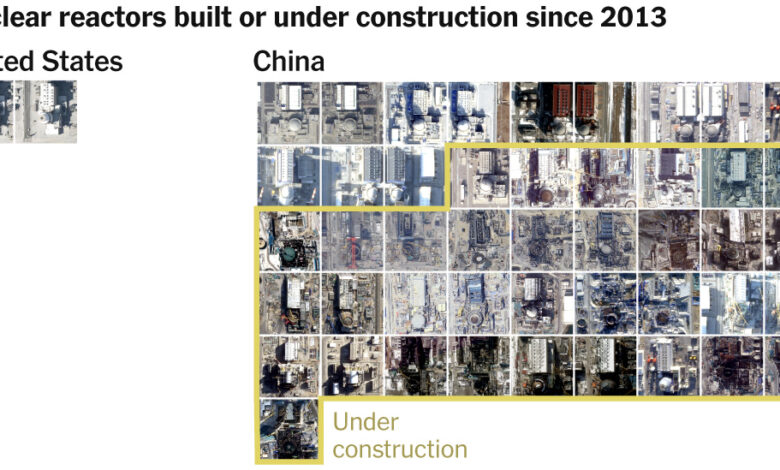
China is quickly becoming the global leader in nuclear power, with nearly as many reactors under construction as the rest of the world combined. While its dominance of solar panels and electric vehicles is well known, China is also building nuclear plants at an extraordinary pace. By 2030, China’s nuclear capacity is set to surpass that of the United States, the first country to split atoms to make electricity.
Many of China’s reactors are derived from American and French designs, yet China has overcome the construction delays and cost overruns that have bogged down Western efforts to expand nuclear power.
At the same time, China is pushing the envelope, making breakthroughs in next-generation nuclear technologies that have eluded the West. The country is also investing heavily in fusion, a potentially limitless source of clean power if anyone can figure out how to tame it.
“The Chinese are moving very, very fast,” said Mark Hibbs, a senior fellow at the Carnegie Endowment for Peace who has written a book on China’s nuclear program. “They are very keen to show the world that their program is unstoppable.”
As the United States and China compete for global supremacy, energy has become a geopolitical battleground. The United States, particularly under President Trump, has positioned itself as the leading supplier of fossil fuels like oil, gas, and coal. China, by contrast, dominates the manufacturing of solar panels, wind turbines, and batteries, seeing renewable power as the multi-trillion-dollar market of the future.
Nuclear power is enjoying a resurgence of global interest, especially as concerns about climate change mount. That’s because nuclear reactors don’t spew planet-warming emissions, unlike coal and gas plants, and can produce electricity around the clock, unlike wind and solar power.
The Trump administration wants to quadruple U.S. nuclear power capacity by 2050, even as it ignores global warming, and it hopes to develop a new generation of reactor technology to power data centers at home and sell to energy-hungry countries overseas. Officials fear that if China dominates the nuclear export market, it could expand its global influence, since building nuclear plants abroad creates deep, decades-long relationships between countries.
Yet in the race for atomic energy, China has one clear advantage: It has figured out how to produce reactors relatively quickly and cheaply. The country now assembles reactors in just five to six years, twice as fast as Western nations.
While U.S. nuclear construction costs skyrocketed after the 1960s, they fell by half in China during the 2000s and have since stabilized, according to data published recently in Nature. (The only two U.S. reactors built this century, at the Vogtle nuclear plant in Waynesboro, Ga., took 11 years and cost $35 billion.)
Construction costs of nuclear reactors
It starts with heavy government support. Three state-owned nuclear developers receive cheap government-backed loans to build new reactors, which is valuable since financing can be one-third of costs.
“The Chinese are moving very, very fast,” said Mark Hibbs, a senior fellow at the Carnegie Endowment for Peace who has written a book on China’s nuclear program. “They are very keen to show the world that their program is unstoppable.”
As the United States and China compete for global supremacy, energy has become a geopolitical battleground. The United States, particularly under President Trump, has positioned itself as the leading supplier of fossil fuels like oil, gas, and coal. China, by contrast, dominates the manufacturing of solar panels, wind turbines, and batteries, seeing renewable power as the multi-trillion-dollar market of the future.
Nuclear power is enjoying a resurgence of global interest, especially as concerns about climate change mount. That’s because nuclear reactors don’t spew planet-warming emissions, unlike coal and gas plants, and can produce electricity around the clock, unlike wind and solar power.
The Trump administration wants to quadruple U.S. nuclear power capacity by 2050, even as it ignores global warming, and it hopes to develop a new generation of reactor technology to power data centers at home and sell to energy-hungry countries overseas. Officials fear that if China dominates the nuclear export market, it could expand its global influence, since building nuclear plants abroad creates deep, decades-long relationships between countries.
Yet in the race for atomic energy, China has one clear advantage: It has figured out how to produce reactors relatively quickly and cheaply. The country now assembles reactors in just five to six years, twice as fast as Western nations.
While U.S. nuclear construction costs skyrocketed after the 1960s, they fell by half in China during the 2000s and have since stabilized, according to data published recently in Nature. (The only two U.S. reactors built this century, at the Vogtle nuclear plant in Waynesboro, Ga., took 11 years and cost $35 billion.)