In world’s first humanoid boxing match, gloating robot face plants
Robots have long been subjected to mistreatment and abuse, being kicked, burned, and bludgeoned for the entertainment of humans. However, in a recent turn of events, robots are now getting the opportunity to fight back, albeit in a controlled and monitored environment.
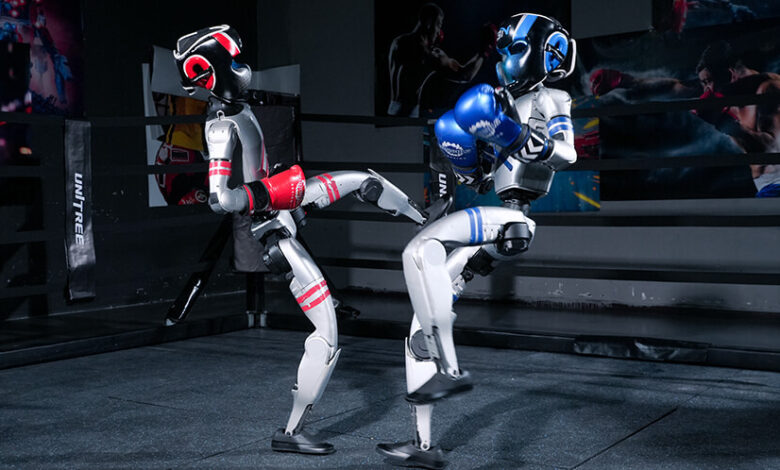
Chinese robotics maker Unitree recently live-streamed the world’s first boxing match between humanoid robots. The event, titled “Unitree Iron Fist King: Awakening,” featured a tournament-style face-off between four of Unitree’s 4.3-foot-tall G1 robots. These robots were reportedly remotely controlled by human engineers, with some autonomous, pre-programmed actions thrown in.
One of the standout moments of the event occurred during a semifinal match between two robots, “Silk Artisan” and “AI Strategist.” After a tense round where Silk Artisan stumbled and fell to the ground, AI Strategist initially gloated but then tripped over its opponent’s head, leading to a surprising victory for AI Strategist.
Following this victory, AI Strategist and its human overseer went on to compete against another robot named “Energy Guardian,” securing a decisive win and being crowned the first humanoid robot boxing champion.
Prior to the event, Unitree released a video showing the robots training with their human coaches, showcasing their boxing skills and ability to learn from past mistakes. The robots were also seen previewing their moves at an elementary school in Hangzhou, China.
The history of forcing robots to fight for entertainment is not new, with shows like “Battle Bots” dating back to the late 1990s, where remote-controlled robots battled it out. Engineers around the world have been experimenting with teaching humanoid robots how to fight, some being remotely controlled by humans, while others learning to mirror human movements.
China is emerging as a hub for humanoid robot athletic competitions, with recent events showcasing the capabilities of these machines. From half-marathon races to boxing matches, robots are proving their agility and prowess in controlled environments. While the concept of robots engaging in combat may seem unsettling to some, these events highlight the advancements in robotics technology and the potential for these machines to perform complex tasks in the future. The highly anticipated robot half-marathon in Beijing left many spectators disappointed as the results were underwhelming. Reports from the event revealed that several robots failed to even make it past the starting line, while others veered off course, with one even crashing into a barrier during the race. The first robot to cross the finish line, created by the Beijing Humanoid Robot Innovation Center, finished nearly an hour and forty minutes after the first human runner completed the race. In the end, only six robots managed to complete the half-marathon.
Despite the lackluster performance of the robots in the race, the event drew significant attention from media outlets and technology enthusiasts around the world. While some were hopeful that the robots would showcase advancements in robotic technology and artificial intelligence, the outcome of the race highlighted the challenges and limitations that still exist in the field of robotics.
Following the disappointing results of the half-marathon, organizers of the event decided to host a boxing match between a human fighter and a robot as a way to redeem the showcase of robotic capabilities. The boxing match was highly anticipated, with many eager to see how a robot would fare against a human opponent in a physical competition.
The updated story revealed that the boxing match ended in a surprising victory for the robot, showcasing its speed, agility, and precision in the ring. The outcome of the match sparked further discussions about the potential applications of robotics in sports and entertainment, as well as the ethical considerations surrounding the integration of robots into human activities.
As technology continues to advance and robots become more sophisticated, events like the robot half-marathon and boxing match serve as important milestones in the development and integration of robotics into society. While the results of the half-marathon may have been underwhelming, the success of the robot in the boxing match demonstrates the potential for robots to excel in physical competitions and challenges in the future.