

Jensen Huang woos Beijing as Nvidia finds a way back into China
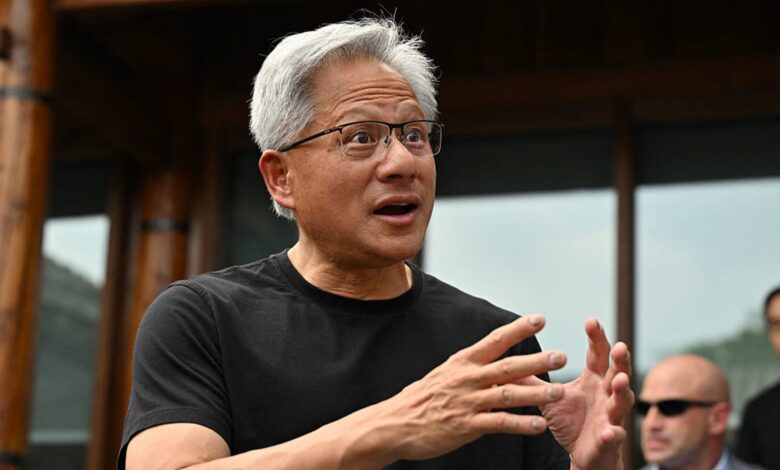
Nvidia CEO Jensen Huang recently made his third trip to China in just about half a year, where he met with Chinese officials and discussed the future of Nvidia’s operations in the country. With Nvidia being the world’s first newly-minted $4 trillion market cap company, Huang had reasons to be optimistic about the company’s prospects in China.
During a press conference in Beijing, Huang expressed his satisfaction in being able to resume sales of Nvidia’s less advanced H20 artificial intelligence chips in China after a three-month pause. He attributed this development to an exchange between the U.S. and China, involving the release of rare earth minerals.
Wearing his iconic black leather jacket, Huang engaged with the media and answered questions in the scorching heat. He shared insights on his meetings with Chinese Vice Premier He Lifeng and Xiaomi CEO Lei Jun, highlighting discussions on artificial intelligence, autonomous driving, and robotics.
Addressing the issue of export controls, Huang mentioned that Nvidia expected to resume shipments of its H20 chips to China soon, following assurances from the U.S. government. He emphasized that Nvidia complies with government policies and is prepared to adapt to tariffs and export restrictions.
Despite facing challenges due to U.S. restrictions on chip sales to China, Huang remained optimistic about Nvidia’s future in the country. He mentioned that Nvidia’s market share in China had significantly decreased due to export controls but expressed hope for the company to introduce more advanced chips in the market in the future.
Regarding the competition from Chinese tech giant Huawei, Huang acknowledged their capabilities in chip design and their development of alternative AI systems. He highlighted Huawei’s Ascend chips and their “CANN” system as a viable alternative to Nvidia’s technologies, emphasizing the importance of recognizing China’s manufacturing prowess.
In conclusion, Jensen Huang’s visit to China provided valuable insights into Nvidia’s strategy and outlook in the country. Despite challenges posed by export controls and competition from local tech giants, Huang expressed confidence in Nvidia’s ability to navigate the complex landscape of the Chinese market and continue to innovate in the field of artificial intelligence. Huawei’s AI-specific cloud computing system, CloudMatrix, has been making waves since its launch last year. Despite the challenges that many developers face in transitioning to Huawei’s AI chip systems, Nvidia CEO Jensen Huang remains confident that it is only a matter of time before they catch up.
In a recent press conference, Huang praised Chinese AI models, such as DeepSeek, Qwen, and Kimi, highlighting their excellence and potential. He emphasized that the key to success in the AI field is not just about having the smartest model, but also about having the most useful one. Chinese-developed DeepSeek, in particular, made headlines earlier this year for its cost-effective AI model that rivaled OpenAI.
One of the aspects that Huang admires about Chinese AI models is their open-source nature, which allows for widespread accessibility and use across various industries. Many companies worldwide have already adopted DeepSeek R1 for applications in healthcare, robotics, imaging, and more.
As the press conference drew to a close, a reporter asked Huang if he would consider returning to China in the future. Huang responded with optimism, stating, “I hope so. You have to invite me.” With China’s AI industry continuing to innovate and push boundaries, it’s clear that Huang sees great potential for collaboration and growth in the region.
Overall, Huawei’s CloudMatrix and the advancements in Chinese AI models showcase the rapid evolution of artificial intelligence technology. As developers worldwide work to adapt to these changes, it’s evident that the future of AI is bright and full of possibilities.