Kennedy, disability advocates paint different realities as ADA turns 35
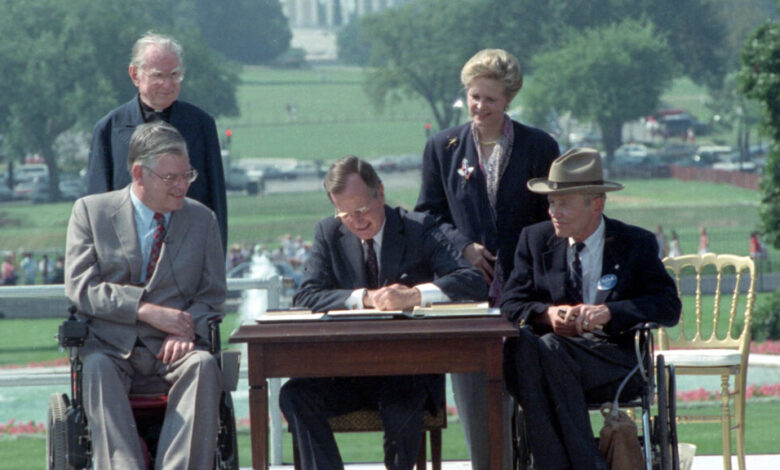
Reflections on the 35th Anniversary of the Americans with Disabilities Act
As stirring speeches echoed through the fluorescent room of the federal health department headquarters in Washington, D.C., on Monday morning, members of the disability community and federal officials gathered to celebrate the 35th anniversary of the Americans with Disabilities Act (ADA). They reflected on the monumental impact of this landmark law, which has provided critical protections and technologies that have allowed disabled individuals to thrive. However, amidst the celebrations, it became evident that many challenges still exist for marginalized communities.
Health secretary Robert F. Kennedy, Jr. took the stage and paid tribute to his relatives, including his uncle, former Sen. Ted Kennedy, who played a pivotal role in the passage of the ADA. However, Kennedy’s speech mostly delved into the past, reminiscing about his aunt Rosemary, who had an intellectual disability. The absence of a focus on the present and future implications of the ADA left many in the disability community disheartened.
Organizations within the disability community are actively advocating against recent cuts to Medicaid, which could jeopardize the long-term care received by many individuals. They are also voicing concerns about Kennedy’s stance on autism and vaccines, as well as the reduction of workforce in the Administration for Community Living. Anjali Forber-Pratt, the director of research at the American Association on Health & Disability, emphasized the importance of preserving programs and services that support individuals with disabilities.
While the ADA has laid the foundation for legal protections against discrimination, some advocates worry about the impact of current policies on the disability community. Kennedy’s involvement in the celebration of the ADA’s anniversary prompted mixed reactions, with some individuals choosing to boycott the event, while others emphasized the need to commemorate the progress made.
Whit Downing, an autistic woman, highlighted the significance of including individuals with disabilities in discussions and decision-making processes. She stressed the importance of ensuring that marginalized voices are heard and represented at a national level. Similarly, Jill Jacobs, the executive director of the National Association of Councils on Developmental Disabilities, emphasized the need for bipartisanship in advocating for reliable care and services for individuals with disabilities.
Jordyn Zimmerman, a non-speaking autistic woman, shared her journey of empowerment through access to communication tools provided by the ADA. She underscored the profound impact of the ADA in enabling individuals with disabilities to advocate for themselves and others. Zimmerman’s story serves as a testament to the transformative power of the ADA in promoting inclusivity and empowerment.
As the disability community reflects on the legacy of the ADA and looks towards the future, it is essential to prioritize the voices and needs of individuals with disabilities in shaping policies and initiatives. The ADA has undoubtedly paved the way for progress, but there is still work to be done in dismantling barriers and advancing the rights of all individuals.
The world of technology is constantly evolving, with new advancements and innovations being made every day. One such innovation that has been gaining traction in recent years is the use of artificial intelligence (AI). AI is a branch of computer science that aims to create machines that can think and learn like humans. This technology has the potential to revolutionize industries ranging from healthcare to finance to transportation.
One of the key areas where AI is making a significant impact is in the field of healthcare. AI-powered tools and technologies are being used to analyze medical data, diagnose diseases, and even assist in surgeries. For example, AI algorithms can analyze medical images such as X-rays and MRIs to detect abnormalities or tumors that may be missed by human eyes. This can lead to earlier detection and treatment of diseases, ultimately saving lives.
In addition to diagnostics, AI is also being used to personalize treatment plans for patients. By analyzing a patient’s medical history, genetic information, and lifestyle factors, AI algorithms can recommend the most effective treatment options for each individual. This personalized approach to healthcare can lead to better outcomes and reduced healthcare costs in the long run.
Another area where AI is making a significant impact is in the financial industry. AI-powered algorithms are being used to analyze market trends, predict stock prices, and even detect fraudulent activities. These technologies can help financial institutions make more informed decisions, reduce risks, and improve customer experiences.
In the transportation industry, AI is being used to develop autonomous vehicles that can navigate roads without human intervention. Companies like Tesla, Google, and Uber are investing heavily in AI technology to develop self-driving cars that are safer and more efficient than human drivers. These autonomous vehicles have the potential to reduce traffic congestion, lower emissions, and improve road safety.
While the potential benefits of AI are vast, there are also concerns about the ethical implications of this technology. For example, AI algorithms can be biased and perpetuate discrimination if not properly trained on diverse datasets. There are also concerns about the impact of AI on jobs, as automation could lead to displacement of workers in certain industries.
Overall, the rise of artificial intelligence is reshaping industries and transforming the way we live and work. As this technology continues to evolve, it is important for policymakers, businesses, and individuals to consider the ethical implications and work together to harness the full potential of AI for the greater good.