Luxury shopper recovery faces four key headwinds
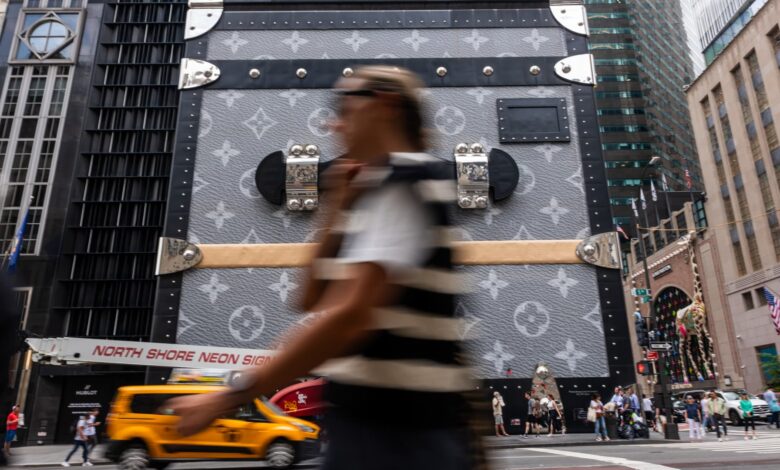
The 19-story façade of the Louis Vuitton luxury store stands wrapped in a design reminiscent of their monogrammed trunks in Manhattan, New York City.
Spencer Platt | Getty Images News | Getty Images
High-end spenders are painting a mixed picture when it comes to the luxury market’s long-awaited recovery, with softer sales still weighing on company forecasts.
But better-than-feared results from bellwether fashion house LVMH moved luxury stocks higher Friday, as investors bet on the emergence of green shoots of recovery.
LVMH posted a 4% year-on-year drop in second quarter sales to 19.5 billion euros after the market close Thursday, slightly below a consensus forecast for a 3% decline.
“This was not a stellar quarter for LVMH,” Deutsche Bank’s Adam Cochrane, a luxury equity research analyst, wrote in a Friday note. “However, we see some glimmers of hope with a sequential improvement in cFX [constant currency] sales expected from 3Q onwards and most of the sales weakness related to weaker tourism.”
Here’s a look at four key trends to look out for as earnings season rolls on, with fresh numbers due next week from Kering, Hermes and Prada.
Japan weakness
Foreign exchange fluctuations are a perennial concern for luxury firms, but that’s even more the case this quarter as they face high comparable sales from last year.
A sharp decline in the Japanese yen sparked a surge in tourist flows and luxury shopping in the country in 2024. But now brands are battling a rebalancing.
Richemont saw sales in Japan drop 15% year-on-year in the three months to June, following a 59% jump over the same period the year prior. Burberry also cited a “challenging performance” in Japan in the second quarter, and Moncler said Japan was its only negative-performing Asia market — both without providing specific figures.
Some firms noted, however, that a downturn in tourism to Japan — and to a lesser extent Europe — has resulted in an uptick in domestic spending in certain other markets.
“[In China] we have seen tangible improvement locally,” said LVMH’s Chief Financial Officer Cécile Cabanis during an earnings call Thursday, citing a “repatriation from the big drop we’ve seen in tourism to Japan.”
U.S. sales spike
Several luxury firms have also pointed to a strengthening of U.S. sales in the second quarter, even as consumers wait with bated breath for the impact of tariffs.
Burberry, Richemont, Moncler and Brunello Cucinelli all reported increased sales in their American markets over the second quarter, while LVMH noted that American demand was “broadly unchanged.”
Still, the extent to which that uptick is driven by U.S. customers frontloading purchases ahead of the full onset of tariffs is not yet clear, according to the firms.
“To tell you that this was driven by an anticipation of buying links to the tariffs? Honestly, I cannot tell you,” Roberto Eggs, Moncler’s chief business strategy and global market officer, said on an earnings call Wednesday.
Luxury companies have also been honing in on the U.S. market in recent quarters in a bid to compensate for continued soft demand in the key Chinese market.
Burberry CEO Joshua Schulman said the company’s recent U.S. growth indicated the “diversity of the luxury consumer that exists in that market,” from elite, high-spenders to high-traffic mall shoppers.
Price increases
U.S. tariffs are nonetheless weighing on the outlook for most European luxury houses, who rely heavily on localized production as part of their cache.
As such, many have suggested that they will need to raise prices in the coming quarters to offset added costs.
Brunello Cucinelli flagged price hikes of 3% to 4% in the U.S. while Moncler said it was implementing “mid-single-digit” percentage increases for the coming 12 months.
Burberry has been making adjustments to its prices since last year as part of a larger overhaul strategy. LVMH, on the other hand, stated that price increases would only be justified with an improvement in the product or slight adjustments in line with inflation. However, the French luxury conglomerate also mentioned that price hikes are among the various measures it can take to counter the impact of tariffs.
The cost of luxury goods has seen a 3% increase so far this year, the slowest rate since 2019, according to UBS’ evidence lab. Brands are trying to balance consumer retention with higher input costs following a surge in prices during the Covid-19 era.
Product mix remains a crucial factor in the luxury market, with brand appeal and product type both playing significant roles. Richemont, the owner of Cartier, continues to see success in jewelry while struggling with high-end watches. LVMH, owner of Tiffany, faces challenges in its jewelry and fashion sectors, despite the success of leather handbags at Hermes.
Barclays’ head of European luxury goods research, Carole Madjo, predicts that Hermes will continue its dominance in leather goods. Investors are eagerly awaiting updates from Kering, the owner of Gucci, on its product overhaul under artistic director Demna Gvasalia and incoming CEO Luca de Meo. Madjo believes that introducing new and innovative products could help Gucci regain its former greatness.