North Korea pledges to ‘unconditionally support’ Russia’s war in Ukraine
North Korea’s Unconditional Support for Russia’s War in Ukraine
In a recent report by North Korean state media, it was revealed that North Korea and its leader, Kim Jong Un, will continue to “unconditionally support and encourage” Russia’s war in Ukraine. The Korean Central News Agency stated that North Korea will back all measures taken by Russia to address the root cause of the Ukrainian crisis.
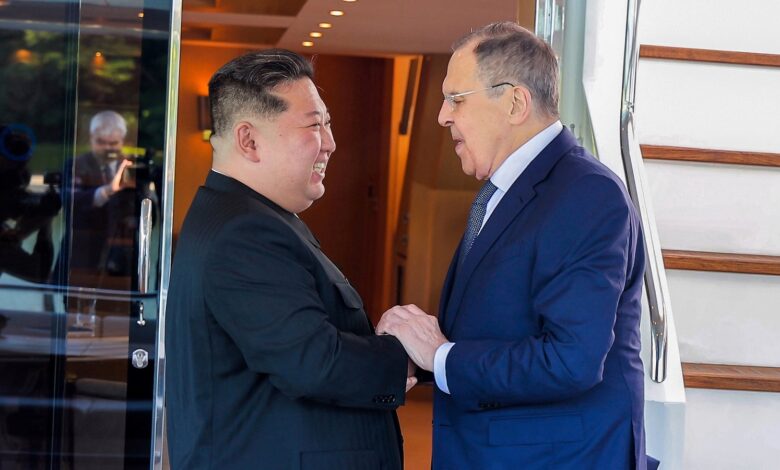
The announcement came after a meeting between North Korean Minister of Foreign Affairs Choe Son Hui and Russian Foreign Minister Sergei Lavrov. Kim Jong Un also met with Lavrov in Wonsan, a coastal city where North Korea recently opened a new beach resort. The meeting was described as a strategic dialogue, and the two diplomats signed a 2026-2027 exchange plan, focusing on mutual cooperation in international arenas.
The discussions between Choe and Lavrov come at a time of heightened tensions between Russia and the United States. Lavrov had recently met with U.S. Secretary of State Marco Rubio in Malaysia, where Rubio expressed disappointment and frustration with Russian actions. However, Lavrov stated that North Korea had reaffirmed its support for Russia’s objectives in the conflict with Ukraine.
Last year, Russia and North Korea signed a mutual-defense pact, and it was reported that North Korea had sent around 10,000 troops to aid Russia in its fight against Ukraine. The U.S. State Department also accused North Korea of supplying arms, including ballistic missiles and munitions, to Russia for use in the conflict.
In a statement, Lavrov expressed gratitude for the contribution of Korean People’s Army servicemen who fought alongside Russian troops in Kursk, where Ukraine had launched an offensive into Russian territory. The alliance between Russia and North Korea in the conflict with Ukraine highlights the complex geopolitical dynamics at play in the region.
The meeting between North Korea and Russia underscores the close relationship between the two countries and their shared interests in the conflict in Ukraine. As the situation continues to evolve, it remains to be seen how this alliance will impact the broader geopolitical landscape in the region.