Oil prices drop near $80 as US walks back claim that tanker was escorted through Strait of Hormuz
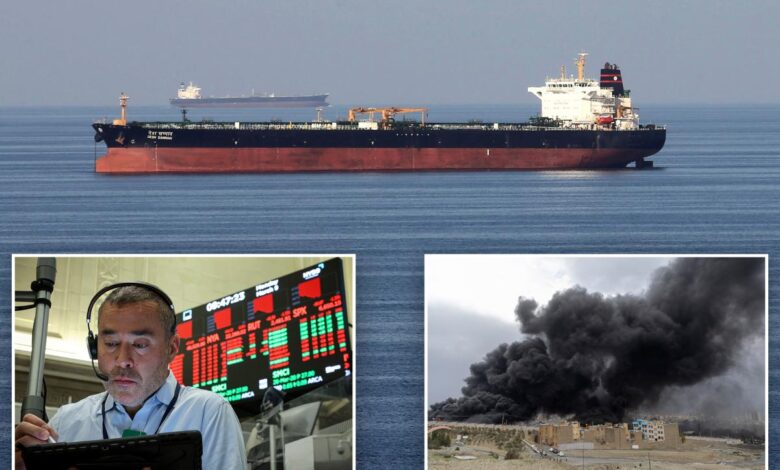
US stocks showed minimal movement on Tuesday as oil prices experienced a decline following President Trump’s indication that the conflict with Iran would be limited. However, the drop in oil prices slowed down after the White House retracted a statement claiming that an oil tanker had been escorted through an Iranian energy chokepoint.
The Dow Jones Industrial Average decreased by 34 points, the Nasdaq remained stable, and the S&P 500 saw a slight decline after President Trump mentioned that the war was “very complete, pretty much,” and G7 energy ministers convened to discuss the potential release of oil reserves.
Both West Texas Intermediate crude oil and Brent crude initially dropped to nearly $80 after reaching levels close to $120 the previous day, but later in the day, they rebounded to $83.45 and $87.80, respectively.
On Tuesday afternoon, Energy Secretary Chris Wright removed a social media post that claimed the US Navy had escorted an oil tanker through the Strait of Hormuz, a crucial Iranian waterway responsible for 20% of the world’s oil supply.
During a press briefing later that day, White House press secretary Karoline Leavitt clarified that the post was inaccurate, stating, “I can confirm that the US Navy has not escorted a tanker or a vessel at this time, though of course that’s an option the president has said he will absolutely utilize if and when necessary at the appropriate time.”
The Department of Energy did not immediately respond to The Post’s request for a comment.
House Intelligence Committee Chairman Rick Crawford (R-Ark.) mentioned that a US Navy escort could help in resuming traffic in the Strait of Hormuz, emphasizing that it’s more of a logistics issue than a supply problem.
Earlier in the day, Trump called for total surrender, and War Secretary Pete Hegseth stated that it would be the “most intense day of strikes” on Iran, with the war ending “on our timeline.”
Jeff Krimmel, founder of Krimmel Strategy Group, expressed surprise at the significant price fluctuations in major oil benchmarks, attributing it to the unpredictable statements made by the president.
National average gasoline prices rose to $3.54 a gallon on Tuesday, while diesel prices reached $4.78, potentially impacting the economy.
There is usually a one- to two-week delay between changes in oil and gasoline prices, and the shutdown of oil production in Iraq and Kuwait could exacerbate the situation.
Krimmel suggested that the oil markets might stabilize in the future or become more volatile depending on future developments.
He also noted that negative market responses could prompt the administration to reconsider its stance, drawing parallels to the administration’s fluctuating approach to tariff rates.
Despite the fluctuations, oil prices remained elevated compared to pre-conflict levels on Feb. 27, underscoring the ongoing uncertainty in the market.