Polls open for military-ruled Myanmar’s first election in 5 years
YANGON, Myanmar — Voters headed to the polls on Sunday for the first phase of Myanmar’s long-awaited general election, which is being overseen by the military government amidst a brutal civil war that has engulfed the nation.
Critics of the election argue that it is merely a ploy by the military to legitimize their rule, following the ousting of the elected government led by Aung San Suu Kyi in 2021. Suu Kyi’s party, the National League for Democracy, had won by a landslide in the previous election but was prevented from assuming power for a second term.
In major cities like Yangon and Naypyitaw, voters cast their ballots at various locations such as schools, government buildings, and religious institutions.
Opponents of the election claim that the results will lack credibility due to the exclusion of key political parties, restrictions on freedom of speech, and an overall atmosphere of repression.
Despite the controversy surrounding the election, neighboring countries like China, India, and Thailand may use it as an opportunity to support Myanmar’s stability. Western nations have continued to impose sanctions on Myanmar’s ruling military for their undemocratic actions and violent crackdown on dissent.
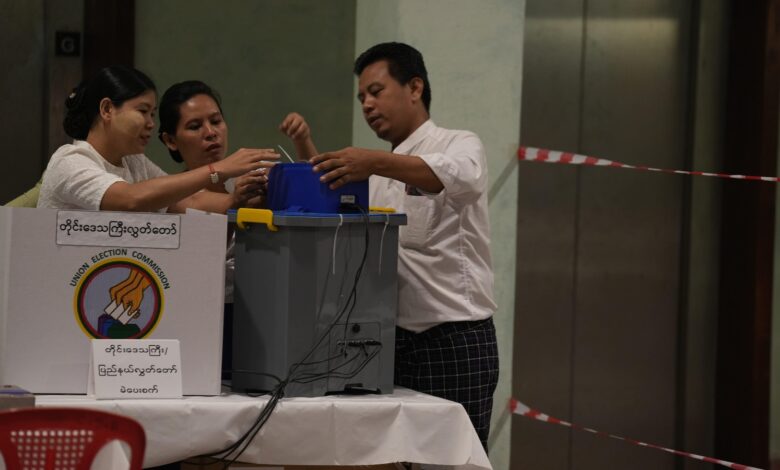
Security measures were heightened in Yangon ahead of the election, with armed guards stationed at polling stations and military presence on the streets. Election officials introduced electronic voting machines for the first time in Myanmar.
While opposition groups had threatened to disrupt the election process, no major incidents were reported. Suu Kyi, who is currently serving a prison sentence, is not participating in the election.
The lack of genuine choice in the election has raised concerns, especially as many voters had previously supported parties that no longer exist. The military’s harsh crackdown on dissent has made mobilizing opposition challenging.
The ongoing civil war in Myanmar has displaced millions and resulted in thousands of casualties. A new Election Protection Law has further restricted public criticism of the polls.
U.N. Human Rights Chief Volker Türk has condemned the violence and intimidation in Myanmar, highlighting the lack of freedom of expression and assembly. The military is expected to retain power after the election.
The election is being held in three phases, with final results expected to be announced later in January. Despite the participation of numerous candidates, only a handful have the potential to influence Parliament.
—
Associated Press writer Peck contributed to this report from Bangkok.