Pope Leo XIV’s visit rekindles hope in war- and crisis-battered Lebanon
BEIRUT — Mireille Khoury lights a candle next to a portrait of her late son, Elias, surrounded by images of Jesus and the Virgin Mary every evening when she returns to her Beirut apartment after work.
Elias was only 15 when he tragically lost his life in the August 2020 explosion at the Beirut port, which devastated surrounding neighborhoods in the Lebanese capital. Since then, Khoury has been actively participating in the monthly protests advocating for justice for the 218 lives lost in the tragic incident.
As the investigation into the explosion has stalled and hopes for accountability have diminished, the upcoming visit of Pope Leo XIV to Lebanon has reignited a sense of hope for Khoury and many others in the crisis-ridden country.
“We are in need of prayers and a miracle for our country to move forward,” expressed Khoury, who is looking forward to joining the pontiff in a silent prayer at the site of the port explosion on the final day of his visit to Lebanon.
The forthcoming visit of Pope Leo XIV marks his first official foreign trip and fulfills a promise made by his predecessor, Pope Francis, to visit Lebanon, a country where approximately one-third of the population is Christian. Leo will also journey to Turkey during his visit.
This fourth visit of a pope to Lebanon conveys a strong message of support at a time when the country is grappling with regional instability and internal crises, leaving it in a precarious state.
Since 2019, Lebanon has faced political unrest, economic collapse, the aftermath of the port explosion, and a recent conflict between Israel and the Hezbollah militant group. The war inflicted significant damage on southern and eastern Lebanon, resulting in over 4,000 casualties, including many civilians, and causing an estimated $11 billion in destruction.
For many Lebanese citizens, divine intervention seems to be the only solution for their country’s myriad challenges.
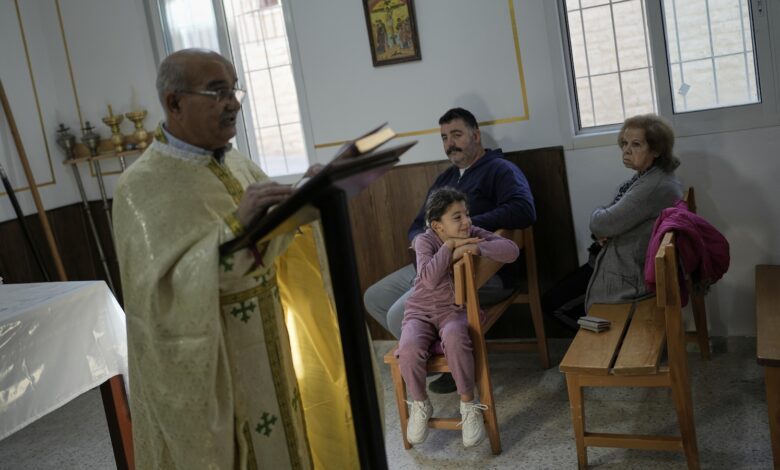
In the village of Dardghaya, a community comprising both Christians and Shiite Muslims in southern Lebanon, a small group gathered for Mass in a basement room adorned with images of religious figures. The town’s historic church, dedicated to St. George, remains in ruins following an Israeli attack during last year’s Israel-Hezbollah conflict.
Despite a ceasefire brokered by the U.S. in November 2024, Israel continues to conduct frequent strikes in southern Lebanon, aiming to prevent Hezbollah from rebuilding. This volatile situation has deterred many former residents from returning to Dardghaya.
Father Maurice el Khoury, the church’s priest, expressed optimism about the impact of Pope Leo’s visit, believing it could bring about a transformative change in Lebanon’s trajectory.
“We believe that the pope’s visit will not only benefit Christians but will also be a blessing and salvation for all of Lebanon,” el Khoury stated.
While some residents in southern Lebanon expressed disappointment at the absence of a visit to their war-torn areas in Pope Leo’s itinerary, Georges Elia from the Dardghaya congregation looks forward to participating in a meeting with the pontiff and youth groups at the Maronite Patriarchate in Bkerki, northern Lebanon.
Elia remains hopeful for a spontaneous visit by the pope to the south, a region he describes as “sacred land” in need of healing and support. “The south is bleeding, and it’s in need of (the pope) to help us return and stand firm on our land,” he emphasized.
The first papal visit to Lebanon in 1964 took place during a period of prosperity that many now nostalgically recall as the country’s golden era. Subsequent visits occurred as Lebanon was rebuilding after periods of conflict, such as in the late 1990s and during the Syrian conflict in 2012.
Lebanon has historically been a refuge for Christians and has maintained strong ties with the Vatican since gaining independence in 1943. The Catholic Church’s contributions to Lebanon, including educational and healthcare institutions, have fostered a unique relationship with not only the Christian community but also Muslims and other non-Christian groups.
Charles Hayek, a historian, highlighted the significance of Lebanon’s diplomatic relations with the Vatican, stressing the importance of lobbying for a small country to be heard on the global stage.
Pope Leo XIV’s agenda includes an interfaith dialogue with leaders of Lebanon’s Christian and Muslim communities in Beirut, a city that witnessed anti-government protests in 2019 and suffered severe damage from the port explosion.
Reflecting on the support received from Pope Francis following the port blast, Mireille Khoury shared her hopes of meeting the new pontiff to advocate for continued attention to the investigation and justice for the victims.
Khoury’s unwavering faith and hope sustain her, as she looks forward to a potential meeting with her late son in the afterlife.
___
Sewell reported from Dardghaya, Lebanon.