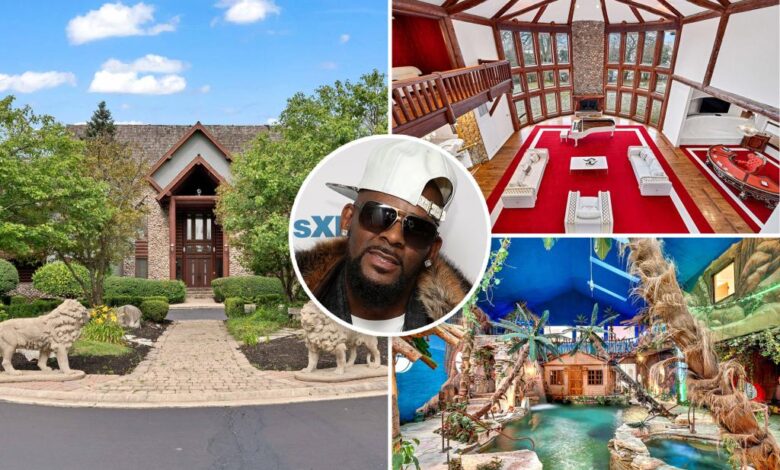
R. Kelly’s mansion sells for a fraction of its asking price
The Art Deco Palmolive Building, a 37-story skyscraper that has stood as a symbol of Chicago’s skyline since 1929, has seen its own struggles. After serving as offices for decades, the building converted to high-end condos in the mid-2000s.
But as the market softened, so did its appeal. One penthouse, once listed for $15 million, sold for $6.4 million in 2020. Another, originally priced at $14.5 million, went for $7.7 million last year.
Even so, some real-estate experts see a silver lining. “The Chicago luxury market is in the midst of a transformation,” said Compass agent Luke Kavr. “The market is seeing a shift in buyer preferences, with a focus on outdoor space, privacy, and unique amenities.”
And with interest rates at historic lows, he added, “now is an opportune time for buyers to take advantage of the market.”
For those who can afford it, there remains a wealth of options. A 36th-floor penthouse at No. 9 Walton, one of Chicago’s priciest new developments, hit the market in June for $18.5 million. The 7,100-square-foot unit boasts 14-foot ceilings, a 1,700-square-foot terrace with a spa and grill, and sweeping views of the lake and city.
“The luxury market in Chicago continues to show resilience and strength, despite some recent challenges,” said developer Dan Slack.
So while R. Kelly’s former palace may have sold at a steep discount, and Ken Griffin may be turning his back on the city, Chicago’s real-estate market remains a complex tapestry of price cuts and penthouse dreams. And with each sale, a new chapter in the city’s storied architectural history is written. When Michael Jordan first listed his Highland Park estate for $29 million in 2012, he probably never imagined that it would take 12 years to sell. The massive mansion, spanning 56,000 square feet with nine bedrooms, 15 baths, and gates shaped like his iconic number 23, finally found a buyer last year for $9.5 million, a fraction of its original asking price.
The new owner, real estate executive John Cooper, initially expressed his intention to preserve the property’s legacy. However, his plans quickly shifted as he rebranded the estate as Champions Point and listed it on Airbnb Luxe for a staggering $112,000 per week. The property was marketed as a luxury retreat complete with a basketball arena, putting green, and infinity pool. Despite the grandeur, finding renters proved to be a challenge, leading to its removal from the rental site.
In a similar tale of luxury real estate woes, former Goldman Sachs partner Muneer Satter and his wife, Kristen Hertel, recently sold their lakefront estate in Winnetka for $31.25 million. While on paper, this sale set a local record, the couple reportedly spent over $65 million developing the property, recouping less than half of their investment. The 1920s mansion, known as Windsor House, boasts architectural splendor with a two-story lakefront living room and a dramatic balcony staircase, reflecting the opulence of North Shore wealth.
The challenges in the Chicago luxury housing market are further highlighted by data from Sotheby’s Concierge Auctions Luxury Market Index, which showed that homes lingering on the market for over 180 days in 2024 sold for nearly 15% below the list price on average. The city’s average days on market nearly doubled, indicating a slowdown despite occasional high-profile sales.
Luxury broker Rafael Murillo of RM Luxury Group describes the current market as “a tale of two cities,” with neighborhoods like Lincoln Park experiencing a seller’s market while downtown high-rise properties favor buyers. Murillo notes that while there is strong activity in the luxury segment, prices have adjusted, presenting a favorable environment for buyers.
Despite the challenges, Murillo remains optimistic about Chicago’s real estate market, attributing much of the interest to out-of-state buyers who see potential in the city’s future. He believes that the market is in a recovery phase, adjusting to the lingering effects of the pandemic and political uncertainties. While confidence is gradually returning, Murillo anticipates a full rebound with new leadership in place.
Overall, the fundamentals of Chicago’s luxury housing market remain solid, with opportunities for buyers to capitalize on favorable pricing and future growth prospects. As the market continues to evolve, navigating the complexities of luxury real estate in the Windy City requires a strategic approach and a keen understanding of the shifting landscape.