Robots, already in hospitals, are ready to roll in other industries
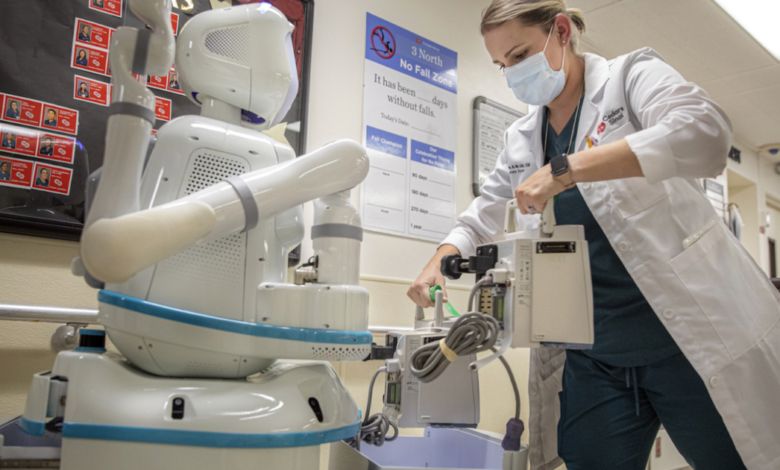
Robots have been a common fixture in science fiction for decades, but now they are becoming a reality in hospitals across the United States. One such robot, named Moxi, is making a difference at Cedars-Sinai Medical Center in Los Angeles and at roughly two dozen other hospitals around the country.
Moxi is designed to assist medical staff with various tasks, such as picking up lab samples, delivering toiletries, and transporting supplies. This allows hospital staff to focus more on patient care and less on menial tasks. According to Diligent Robotics, the Austin, Texas-based maker of Moxi, the robot is currently in use at 25 hospitals nationwide.
At Cedars-Sinai, Moxi has been a valuable asset for the past two years. The 900-bed hospital uses three robots to help with backend work like moving linens, retrieving medication, and assisting with patient belongings. David Marshall, the chief nursing executive at Cedars-Sinai, has seen positive responses from patients, staff, and visitors alike. One patient even requested that Moxi come back to say hello after her surgery.
Casey Wilbert, vice president of Rochester Regional Health in New York, was an early adopter of Moxi and now operates eight of the robots at his hospital. He appreciates the efficiency and reliability of the robots, noting that they don’t require overtime pay or sick days.
While robots like Moxi can handle certain tasks, there are limits to their capabilities. Marshall emphasizes that robots can’t replace human touch and interaction. They can’t hold a patient’s hand, wipe their brow, or help them with personal tasks like brushing their teeth.
Looking to the future, there is a growing interest in developing humanoid robots capable of performing more complex tasks. Jeff Cardenas, CEO of Apptroknik, believes that humanoid robots can adapt to human environments more effectively. Barclays analyst Zornitsa Todorova predicts significant growth in the humanoid robotics segment, with applications in defense, agriculture, manufacturing, and healthcare.
Elon Musk, the CEO of Tesla, is pushing for the rapid introduction of humanoid robots into the workplace and homes. His company is developing a humanoid robot called Optimus, which he believes will be capable of performing a wide range of tasks by the end of next year.
As robots continue to evolve and integrate into various industries, it is essential to consider how they can complement human labor rather than replace it entirely. With the right balance, robots like Moxi and future humanoid assistants could revolutionize healthcare and other sectors, improving efficiency and enhancing patient care. In a world where technology has advanced to unimaginable heights, the dream of building a robot to assist in various tasks is becoming a reality. For Michael Yip, an associate professor of electrical and computer engineering at UC San Diego, this dream is not just a fantasy but a goal that he and his team are actively working towards.
Yip’s lab is dedicated to developing surgical robots that have the potential to revolutionize the healthcare industry. With the belief that these robots can help individuals age more gracefully and with dignity, Yip envisions a future where robotic assistants play a crucial role in medical procedures.
According to Yip, the next decade will see the emergence of surgeon assistants that can perform autonomously in lower-stakes applications such as soft tissue cutting. The technology and capabilities for these robots already exist, and it is only a matter of time before they become a common sight in operating rooms.
Yip also predicts that humanoid robots will excel in healthcare settings due to their ability to interact with people in a more natural and intuitive manner. In home care environments and hospitals where navigating complex spaces is essential, a human-like form factor is crucial for seamless integration and effective assistance.
The potential for robotic assistants in healthcare is vast, and the benefits they offer are numerous. From improving surgical precision to providing personalized care to patients, these robots have the potential to transform the way healthcare is delivered.
As we look towards the future, the dream of building a robot that can help individuals in their time of need is no longer a distant possibility. With experts like Michael Yip leading the way, we are on the cusp of a new era where technology and compassion intersect to enhance the quality of life for all.