Samsung takes market share from Apple in U.S., foldable phone momentum
In 2014, Apple and Samsung were duking it out to rule the U.S. smartphone market. Samsung was selling devices with large screens, and iPhone fans were demanding a response.
It took Apple some time, but the company finally released the iPhone 6, breaking with previous iterations and giving consumers a large-screen option. The iPhone won.
But more than a decade later, recent smartphone sales and shipment figures signal that the Apple-Samsung fight has returned. And once again, it’s all about the screen.
In the second quarter, shipments from Samsung surged in the U.S., with its market share rising from 23% to 31% from the prior period, according to data from Canalys. Apple’s market share during the quarter declined to 49% from 56%.
Apple remains on top of the U.S. smartphone market, taking the majority of new smartphone sales in the U.S. It’s often in second place around the world, but the recent slips points to turbulence for Apple for the first time in well over a decade.
That’s one reason investors have sent Apple shares down 7.5% this year, underperforming all of the U.S. megacap tech companies other than Tesla. Samsung’s stock, meanwhile, is up about 35% in 2025.
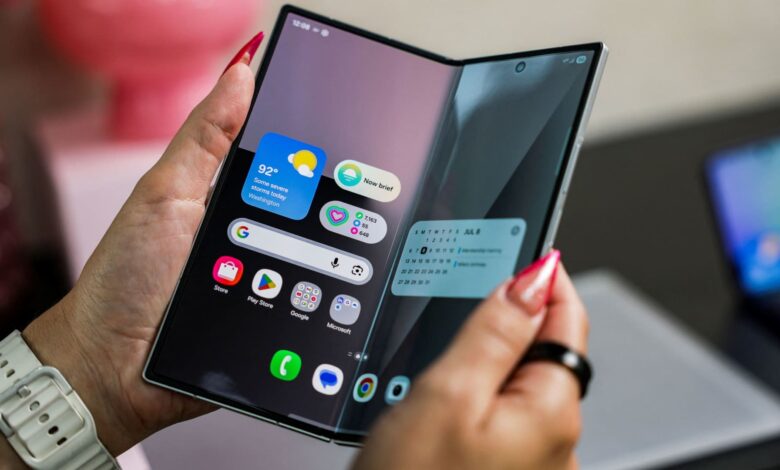
In July, Samsung introduced a pair of innovative new phones that feature foldable screens. One model, the Z Fold 7, can effectively turn into a tablet, while the Z Flip resembles an old-school flip phone with modern smartphone features. They were added to Samsung’s catalog of phones released this spring under its Galaxy brand, including a thin-and-light phone called the Galaxy S25 Edge.
The devices are also getting a lot of traction on social media, particularly around durability tests.
One user posted a livestream that showed him bending the Z Fold 7 over 200,000 times in a row. The video has been clipped and shared widely on social media, with one version of the clip accumulating more than 15 million views on YouTube.
In the past month, Samsung’s premium devices, including the Z Fold 7, were mentioned over 50,000 times on social media, and 83% of those mentions were positive or neutral, according to data from Sprout Social, a social media analytics company.
The market share numbers aren’t just the result of user preferences. Much of the shift in shipment figures in the June quarter, analysts said, can be attributed to tariffs, which are causing “disruption” in the industry as smartphone makers use different strategies to minimize the impact on their business.
But Samsung’s gains also reflect the company’s ability to offer a much wider range of products at different prices compared to Apple. That includes low-end phones, which accounted for much of Samsung’s second-quarter U.S. improvement, as well as high-end devices that cost more than any individual iPhone.
Samsung’s Galaxy and Z phone lineup “stretches from $650 up to $2,400. That is a massive span of devices,” said Canalys analyst Runar Bjorhovde. “There is an idea that you can target people at every single price point, and you can meet them at every spot.”
The iPhone has pretty much looked the same since 2017 — a rectangular piece of glass with a touchscreen on the front, and a few cameras on the back. These days, the company offers a series of four slates ranging from $829 to $1,599. Samsung and others are starting to go beyond the so-called candy bar shape and experimenting with new form factors.
Apple is expected to start doing the same — beginning with a potential launch next month of a slimmer iPhone that will compete with Samsung’s Galaxy Edge.
“Apple is clearly betting that its 5.5mm Air model is going to lift its fortunes as testing suggests a strong desire for the new form factor,” wrote Loop Capital managing director John Donovan in May.
JPMorgan Chase analyst Samik Chatterjee wrote in a report last month that Apple may release a folding phone next year to compete with Samsung’s Z Fold.
“Investor focus has already turned to the 2026 fall launches with Apple expected to launch its first foldable iPhone as part of the iPhone 18 lineup in September 2026,” Chatterjee wrote.
Trying new form factors offers Apple the opportunity to sell devices at higher prices, according to Bjorhovde.
Apple’s most expensive phone, the iPhone 16 Pro Max, currently starts at $1,199 for 256GB of storage and can go up to $1,599 for a version with 1TB of storage. The Samsung Galaxy Z Fold 7, which was announced last week, starts at $1,999 for the 256GB version and tops out at $2,419 for the 1TB version.
Chatterjee said he thinks Apple’s version of a folding phone could start at $1,999. Apple declined to comment.
A person holds a Samsung Galaxy Z Fold 7 phone during an event in New York, U.S., July 8, 2025.
Jeenah Moon | Reuters
Folding phones finally mature
Samsung’s first folding phone was released in 2019, but got off to a rocky start. The initial launch was delayed after reviewers — including CNBC — discovered that the early devices would break along their folding crease.
But Samsung says this time is different, and that folding phones are finally ready to go mainstream, especially with respect to durability.
“There really are no longer trade-offs towards owning a foldable device,” said Drew Blackard, vice president of mobile product management at Samsung Electronics America.
The South Korean company doesn’t provide sales numbers, but Blackard said the Galaxy Z Fold 7, the latest version, had 25% more preorders than any previous Samsung folding phone and that sales are outpacing the device’s predecessor by nearly 50%.
“Samsung with the foldable is able to actually optimize for innovation,” said Bjorhovde.
Stay Ahead of the Game with Samsung’s Latest Devices
According to Counterpoint Research, Samsung’s sell-through saw a 16% increase in the June quarter, driven by the demand for high-end devices, including the sleek S25 Edge. This surge in sales demonstrates the appeal of Samsung’s cutting-edge technology.
The emergence of artificial intelligence is paving the way for innovative consumer electronics that could potentially rival the iPhone. OpenAI’s recent acquisition of a startup led by former Apple design guru Jony Ive for $6.5 billion signals a shift towards the development of next-generation hardware.
AI startups are introducing new products like pins, pendants, and glasses that utilize voice control, offering users a unique and interactive experience. Samsung devices, along with other Android phones, have access to Google’s Gemini, a top-tier AI model that outshines Siri and Apple Intelligence in terms of features and functionality.
Folding phones, such as those offered by Samsung, are particularly well-suited for AI applications. Google’s innovative circle-to-search feature, which allows users to easily search for information by circling items on the screen, exemplifies the potential of AI on foldable devices.
Investors have expressed concerns over Apple’s AI delays, but analysts believe that Apple’s strong brand loyalty will sustain its market position. Apple’s strategic approach to technology adoption focuses on timing and readiness, rather than being the first to market.
As the tech landscape evolves, Apple is poised to capitalize on the mainstream acceptance of foldable devices. By remaining vigilant and strategic, Apple continues to set the pace for innovation in the industry.