Some of the military options Trump could consider on Iran after warning it’s in ‘big trouble’ over protests
President Donald Trump’s administration is considering various options for intervention in Iran following a crackdown on anti-government protests. The national security team is set to meet at the White House to discuss potential actions, including new sanctions against key regime figures or sectors such as energy and banking.
In a recent online post, Trump hinted at imposing a 25% tariff on any country doing business with Iran. This move is part of a larger strategy to pressure the Iranian government and address its handling of the protests.
Former U.S. officials believe that the president may consider military strikes, cyberattacks, or influence operations to support protesters and challenge the Iranian regime. White House press secretary Karoline Leavitt emphasized that all options are on the table, with diplomacy being the preferred approach.
Mick Mulroy, an ABC News contributor and former deputy assistant secretary of defense for the Middle East, highlighted the importance of assessing the impact of military action on regime change. He suggested that any military strikes would likely target specific Iranian leaders or security forces responsible for suppressing protests.
Meanwhile, Iran’s foreign minister, Abbas Araghchi, has expressed readiness for war with the United States but also openness to diplomatic negotiations. This dual stance complicates the situation and underscores the need for careful deliberation before any decisive action is taken.
Overall, the Trump administration faces a complex decision-making process as it navigates the challenges posed by Iran’s crackdown on protests. The outcome of the White House meeting will shape the future of U.S.-Iran relations and could have far-reaching consequences for the region. Iranian foreign ministry spokesperson Esmail Baghaei confirmed that the communication channel between Iranian Deputy Foreign Minister Abbas Araghchi and U.S. Special Envoy Steve Witkoff is still open. Baghaei mentioned that messages are exchanged through this channel whenever necessary, as stated during a televised meeting in Tehran.
In response to recent reports of protesters being killed in Iran, President Donald Trump warned that Iran was in “big trouble” and cautioned the government in Tehran against escalating violence. Trump emphasized that the United States would respond forcefully if Iran initiated any aggression.
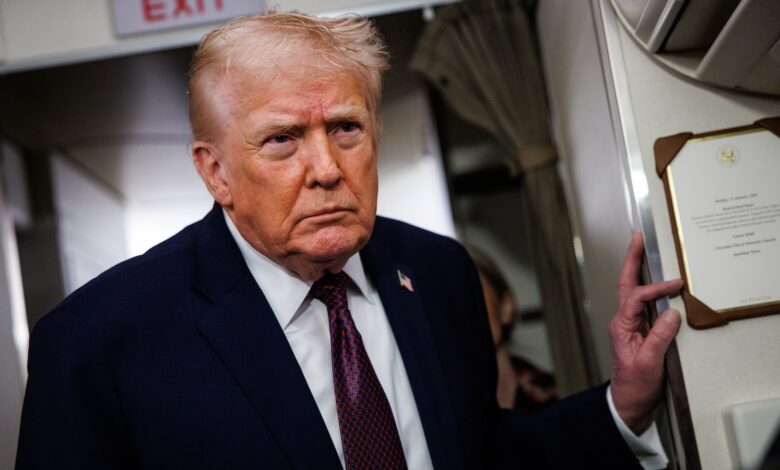
During a conversation aboard Air Force One, Trump revealed that Iranian officials had reached out to negotiate, hinting at a potential meeting in the near future. He suggested that Iran was seeking to engage in dialogue to alleviate tensions with the United States.
On Tuesday, Secretary of State Marco Rubio and Gen. Dan Caine, chairman of the Joint Chiefs of Staff, are expected to attend a meeting addressing the situation in Iran. Rubio engaged in discussions with counterparts from France and Cyprus over the weekend regarding the ongoing protests in Iran. Additionally, Rubio conferred with Israeli Prime Minister Benjamin Netanyahu to discuss the unfolding events in Iran.
The State Department recently issued warnings to Tehran in Farsi, cautioning against provoking President Trump. While military intervention in Iran remains a possibility, experts believe that Trump may opt for alternative strategies due to the associated risks.
Currently, there are 30,000 U.S. troops stationed in the Middle East and Persian Gulf region, with additional military assets likely to be deployed to safeguard against potential retaliatory actions. The presence of Navy ships, including guided missile destroyers, serves as a defense mechanism against ballistic missile threats in the region.
Notably, there is no aircraft carrier stationed in the Middle East or Europe at present, with the USS Gerald Ford and its strike group operating in the Caribbean Sea. The deployment of these assets aims to support operations in Venezuela.
In conclusion, discussions between Iranian and U.S. officials continue amid escalating tensions, with both parties expressing a willingness to engage in dialogue to address the prevailing challenges. The evolving situation in Iran underscores the importance of diplomatic efforts to mitigate conflict and promote stability in the region. The Future of Space Exploration: What Lies Beyond?
Space exploration has always captivated the human imagination, with visions of traveling to distant planets and galaxies igniting a sense of wonder and curiosity. And as technology continues to advance at an unprecedented rate, the possibilities for future space exploration are becoming increasingly tantalizing.
One of the most exciting developments in recent years is the increasing interest in sending humans to Mars. NASA has been working on its Artemis program, which aims to send astronauts back to the Moon by 2024 and eventually to Mars in the 2030s. Elon Musk’s SpaceX is also working on its ambitious plan to establish a human colony on Mars, with the goal of making life multi-planetary.
But Mars is just the beginning. Scientists are already looking beyond our own solar system to explore exoplanets – planets that orbit stars other than our Sun. The discovery of thousands of exoplanets in recent years has raised the possibility of finding Earth-like planets that could potentially harbor life.
One of the most promising avenues for future space exploration is the development of advanced propulsion systems that could enable faster travel to distant planets and stars. Concepts like warp drives, which would allow spacecraft to travel faster than the speed of light by bending space-time, are no longer confined to the realm of science fiction.
Furthermore, the rise of private space companies like SpaceX, Blue Origin, and Virgin Galactic is revolutionizing the space industry, making space travel more accessible and affordable. These companies are not only focused on sending humans to space but also on developing technologies that could enable the colonization of other planets and the exploitation of extraterrestrial resources.
The future of space exploration is not just about reaching new destinations but also about understanding the origins of the universe and the potential for life beyond Earth. Missions like the James Webb Space Telescope, set to launch in 2021, will allow scientists to peer back in time to the early universe and study the formation of galaxies and stars.
As we look towards the future of space exploration, one thing is clear: the possibilities are endless. Whether it’s sending humans to Mars, exploring exoplanets, or developing advanced propulsion systems, the next few decades are sure to be an exciting time for space enthusiasts and scientists alike. The only question that remains is: what lies beyond?