Taxing the Rich: It’s Complicated
Public Opinion and Taxation
Public opinion on taxation is a complex and nuanced topic that has evolved over time. From the Great Depression to the present day, Americans’ attitudes towards taxing the wealthy have shifted significantly. While there is a general consensus that the rich should pay more in taxes, the reasons behind this sentiment are varied and not always straightforward.
Historically, attitudes towards taxing the wealthy have been influenced by economic conditions and political ideology. During times of economic hardship, such as the Great Depression, there was opposition to redistributive taxation. However, as income inequality has increased in recent decades, so too has support for taxing the rich.
Recent surveys have consistently shown that a majority of Americans support increasing taxes on high-income earners. This trend is particularly notable given historical data that shows opposition to such measures in the past. It appears that Americans’ views on taxation are shifting in response to changing economic conditions and growing concerns about income inequality.
One of the key factors shaping public opinion on taxation is how individuals perceive the wealthy. Research has shown that Americans’ views on taxing the rich are often influenced by stereotypes about high-income individuals. Those who view the rich in a positive light are more likely to support tax cuts that benefit them, while those with negative perceptions of the wealthy are more inclined to support higher taxes on the rich.
Overall, the debate over taxation in the United States is multifaceted and complex. While economic self-interest and ideology play a role in shaping public opinion, attitudes towards taxing the wealthy are also influenced by perceptions of the wealthy as a group. As the political landscape continues to evolve, it will be interesting to see how public opinion on taxation evolves as well.
Ragusa 2015). These stereotypes provide a shorthand for citizens to make sense of a complex policy issue, and they play a crucial role in shaping attitudes towards taxing the rich.
Implications for Policy and Future Research
Understanding the factors that influence Americans’ views on taxing the rich is crucial for policymakers seeking to implement tax policies that align with public preferences. As my research suggests, economic self-interest, ideology, and stereotypes all play a role in shaping these views. Policymakers should consider these factors when crafting tax policies and communicating with the public about the merits of taxing the rich.
Future research in this area should continue to explore the role of stereotypes in shaping attitudes towards taxing the rich. Understanding how stereotypes influence public opinion can provide valuable insights for policymakers and help to inform strategies for effectively communicating about tax policies.
Overall, the complexity of Americans’ views on taxing the rich underscores the importance of considering a range of factors when analyzing public opinion on economic policy issues. By taking into account economic self-interest, ideology, and stereotypes, policymakers can better understand and respond to public preferences regarding taxation and income inequality.
“Why Support for Taxing the Rich is High and Why Many Conservatives Want Taxes to Go Up”
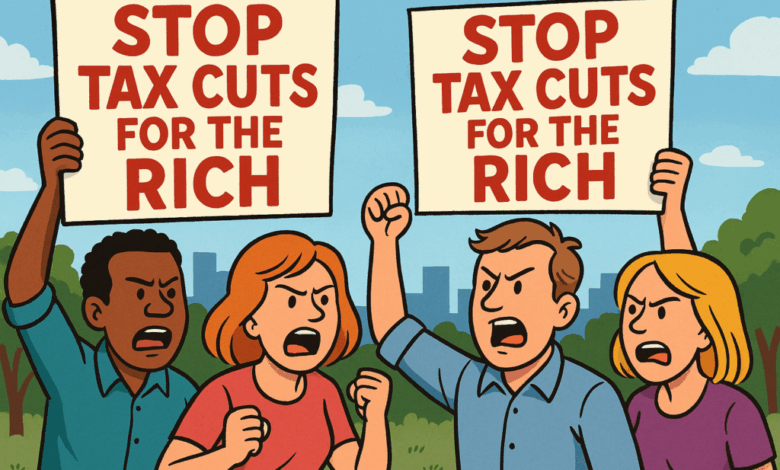
Recent surveys have shown that a significant portion of Americans support increasing taxes on the rich. This support is driven by negative stereotypes about the wealthy and a growing focus on income inequality in the media. The perception of the rich as selfish and undeserving of their wealth has led many Americans to believe that they should pay more in taxes.
However, not all Americans hold the same views on taxing the rich. Those who view the wealthy in a positive light, attributing their success to hard work and seeing them as valuable contributors to society, are more likely to support tax cuts for the rich. On the other hand, those who believe that the rich are privileged and selfish are more likely to advocate for higher taxes on this group.
The complexity of Americans’ opinions on tax policy reflects a broader issue of irrational and uninformed decision-making in politics. Research, such as Bryan Caplan’s book “The Myth of the Rational Voter,” suggests that voters often base their policy preferences on ideology, emotion, and biased thinking rather than economic principles. This can lead to unwise policy outcomes and a disconnect between what the public wants and what they actually get.
One explanation for the discrepancy between public opinion and policy outcomes is the issue of salience. When voters hold strong beliefs on a particular issue, they are more likely to influence policy outcomes. However, when their beliefs are weak or malleable, lawmakers have more flexibility to enact policies that may not align with public opinion.
Another possibility is that Americans may not actually want the rich to pay more in taxes. Surveys have shown that while there is general support for taxing the wealthy in the abstract, when asked to set specific tax rates, Americans often prefer rates that are lower than what high-income earners currently pay. This inconsistency highlights the complexity and contradictions in public opinion on taxing the rich.
In conclusion, Americans’ views on taxing high-income earners are multifaceted and often contradictory. Despite strong support for raising taxes on the rich in theory, the reality is more nuanced, with many Americans favoring lower tax rates for this group. This complexity underscores the challenges of tax policy and the need for a more informed and rational approach to decision-making in politics. Inequality and Growth have long been topics of discussion in the realm of economics and politics. A study published in The Political Quarterly delves into the relationship between inequality and economic growth, shedding light on the complex dynamics at play. The research, conducted by Sears and Funk in 1990, challenges the notion that self-interest has a significant impact on the political attitudes of the general public.
The study found that self-interest has a limited effect on shaping political beliefs, contradicting conventional wisdom. This has important implications for policymakers and politicians, as it suggests that appealing solely to self-interest may not be an effective strategy for garnering public support.
In 2025, the White House released a document titled “Myth vs. Fact: the One Big Beautiful Bill” which aimed to debunk misconceptions surrounding a major piece of legislation. This highlights the ongoing debate surrounding policy decisions and the need for clear and accurate information to inform public discourse.
Jordan Ragusa, a professor at the College of Charleston, has conducted extensive research on American and South Carolina politics, the Congress, political parties, elections, political economy, and statistical methods for the social sciences. His work, including books such as “Congress in Reverse: Repeals from Reconstruction to the Present” and “First in the South: Why the South Carolina Presidential Primary Matters,” contributes valuable insights to the field.
As we navigate the intricate relationship between inequality, growth, and political attitudes, it is crucial to consider the nuances and complexities at play. By engaging with research and analysis from experts like Jordan Ragusa, we can gain a deeper understanding of these issues and work towards creating a more equitable and prosperous society.