Trump accepts Nobel Peace Prize medal from Venezuelan opposition leader Machado
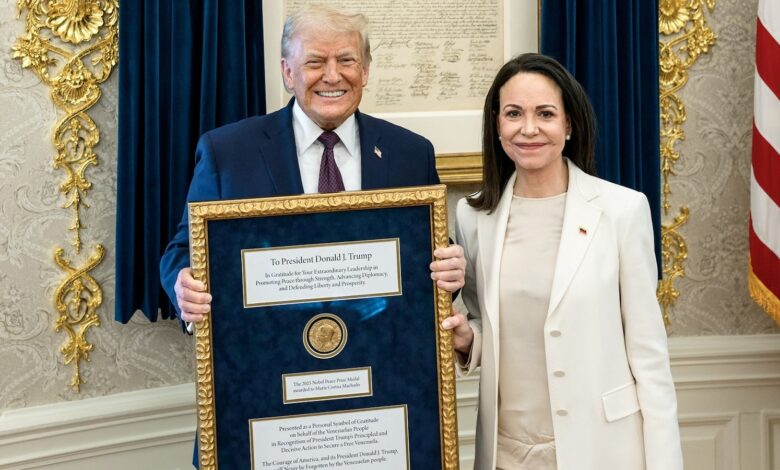
President Donald Trump had a historic meeting on Thursday with Venezuelan opposition leader Maria Corina Machado, where she presented him with her Nobel Peace Prize medal. The president graciously accepted the award, calling it a “wonderful gesture of mutual respect.”
In a statement on social media, Trump expressed his gratitude for the honor, describing Machado as a “wonderful woman who has been through so much.” He emphasized that it was a great privilege to meet her and receive the prestigious award.
Following the closed-door meeting at the White House, a White House official confirmed that Trump did accept the Nobel Peace Prize from Machado. However, specific details about the meeting were not disclosed immediately.
Machado, speaking to reporters as she exited the White House, shared the historical significance of the gesture. She recounted a tale from 200 years ago when General Lafayette presented Simon Bolivar with a medal featuring George Washington’s face, symbolizing the bond between the United States and Venezuela in their fight for freedom against tyranny. Machado explained that presenting her Nobel Peace Prize to Trump was a way of honoring that legacy and recognizing his commitment to freedom.
Simon Bolivar, known for liberating Venezuela and other Latin American countries from Spanish rule, held the medal given to him by Lafayette throughout his life. Lafayette, a Frenchman who fought alongside American colonists in the Revolutionary War, had a close relationship with George Washington.
Machado did not disclose further details about her meeting with Trump but highlighted her dedication to promoting democratic rights in Venezuela and transitioning the country from dictatorship to democracy. She won the Nobel Peace Prize in 2025 for her advocacy work and immediately dedicated the award to Trump and the people of Venezuela.
Notably, Machado expressed her desire to give or share the Nobel Peace Prize with Trump, particularly acknowledging his role in overseeing the successful U.S. operation to capture Venezuelan leader Nicolás Maduro. The meeting between Trump and Machado symbolizes a significant moment in the ongoing struggle for democracy and freedom in Venezuela. Venezuelan President Nicolas Maduro is currently facing drug trafficking charges in New York, to which he has pleaded not guilty. This development has caused a stir in the political landscape, with many speculating about the future of Venezuela and its leadership.
Opposition leader Maria Corina Machado has emerged as a key figure in this scenario. She recently met with President Donald Trump in Washington, where she expressed her support for a democratic transition in Venezuela. Machado’s efforts have been recognized globally, with the Norwegian Nobel Institute awarding her the Nobel Peace Prize. However, there has been controversy surrounding the prize, as it cannot be revoked or shared once announced.
President Trump’s interactions with Venezuelan leaders have also been closely watched. He recently had a positive conversation with acting President Delcy Rodríguez, signaling a potential shift in relations with the country. Despite previously canceling a planned attack on Venezuela, Trump emphasized the need for safety and security measures to remain in place.
Trump’s own aspirations for the Nobel Peace Prize have been well-documented. His campaign for the prestigious award has been met with criticism, particularly from White House officials who claim that politics played a role in Machado’s selection. However, the Nobel Committee has maintained that their decisions are based solely on the work and will of the nominees.
As the situation in Venezuela continues to unfold, all eyes are on Maduro’s trial and the potential impact it may have on the country’s future. Machado’s leadership, coupled with international support, could pave the way for a democratic transition in Venezuela. Only time will tell how these developments will shape the political landscape in the region. The technology industry is constantly evolving, and with each passing year, new advancements are made that push the boundaries of what is possible. From artificial intelligence to virtual reality, the possibilities seem endless. One of the most exciting areas of innovation in recent years has been the development of wearable technology.
Wearable technology refers to devices that are worn on the body, such as smartwatches, fitness trackers, and even clothing that is embedded with sensors. These devices are designed to collect data and provide valuable insights to the user, whether it be tracking their physical activity, monitoring their health, or even enhancing their daily life.
One of the most popular forms of wearable technology is the smartwatch. These devices have come a long way since their inception, with newer models offering features such as heart rate monitoring, GPS tracking, and even the ability to make phone calls and send messages. Smartwatches have become an essential accessory for many people, helping them stay connected and organized throughout the day.
Fitness trackers are another type of wearable technology that has gained popularity in recent years. These devices are designed to monitor the user’s physical activity, such as steps taken, calories burned, and even sleep patterns. Fitness trackers can provide valuable insights into a person’s overall health and help them set and achieve their fitness goals.
Beyond smartwatches and fitness trackers, wearable technology is also making its way into the world of fashion. Companies are now creating clothing and accessories that are embedded with sensors to track various aspects of the wearer’s health and well-being. For example, there are jackets that can monitor the wearer’s posture and provide feedback on how to improve it, as well as shoes that can track the user’s running gait and help prevent injuries.
The potential for wearable technology is vast, with new innovations being made every day. As technology continues to advance, we can expect to see even more sophisticated and intuitive wearable devices that will revolutionize the way we live and interact with the world around us.
In conclusion, wearable technology is a rapidly growing industry that is changing the way we live our lives. From smartwatches to fitness trackers to sensor-embedded clothing, these devices are revolutionizing the way we track our health, stay connected, and even express ourselves through fashion. As technology continues to evolve, the possibilities for wearable technology seem endless, and we can only imagine what exciting advancements the future holds.