Trump arrives in Asia for week of key talks — including with China’s Xi
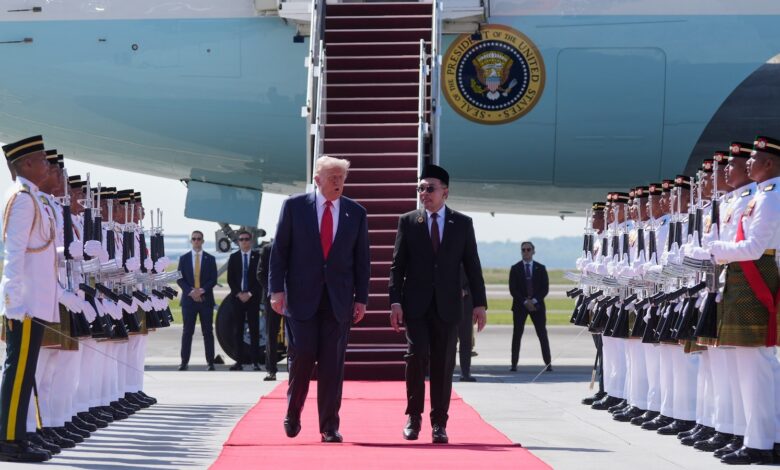
President Donald Trump embarked on a crucial journey to Malaysia as part of a significant weeklong tour of Asia. His primary focus during this trip was to engage in high-level meetings with key leaders in the region, with the main objective of finalizing a trade deal with Chinese President Xi Jinping in a bid to put an end to the ongoing trade war that has persisted for several months.
Upon his arrival in Kuala Lumpur, President Trump wasted no time in getting down to business. He met with the Prime Minister of Thailand and oversaw the signing of the “Kuala Lumpur Peace Treaty” alongside the prime ministers of Cambodia and Thailand. This treaty aimed to resolve the border conflict that had erupted between Cambodia and Thailand over the summer, leading to the release of 18 Cambodian prisoners of war and the deployment of observers from ASEAN countries to oversee the ceasefire agreement implementation.
During the signing ceremony, President Trump took credit for brokering the ceasefire, emphasizing the importance of promoting peace and prosperity over needless bloodshed and conflict. He also signed trade deals with Cambodia and Malaysia, laid the groundwork for a trade agreement with Thailand, and sealed a mineral deal with Malaysia, setting tariff rates on most imports from these nations to the U.S. at 19%.
The highlight of President Trump’s trip was his anticipated meeting with Chinese President Xi Jinping in South Korea. Amidst escalating tensions between the two countries, particularly regarding China’s tightened export controls on rare earth minerals, President Trump threatened to impose an additional 100% tariff on Chinese imports if talks with Xi failed. However, he remained optimistic about reaching a favorable agreement and discussed a wide range of issues, including trade, rare earths, and agricultural purchases.
Following his visit to Malaysia and South Korea, President Trump was scheduled to travel to Japan for discussions with the new Japanese Prime Minister, Sanae Takaichi. Subsequently, he was expected to attend the Asia-Pacific Economic Cooperation (APEC) Summit in South Korea, where he would engage with world leaders like Canada’s Prime Minister Mark Carney to address ongoing trade disputes.
In the midst of a complex geopolitical landscape, President Trump’s interactions with Asian leaders aimed to navigate the intricate web of trade relations and foreign policy dynamics. His approach to these critical discussions was crucial in shaping the future trajectory of U.S. relations with key Asian nations and addressing pressing global challenges.
It is evident that President Trump’s diplomatic efforts in Asia were pivotal in fostering economic ties and promoting stability in the region. As he continued to engage with world leaders and navigate challenging trade negotiations, the outcomes of his interactions would undoubtedly have far-reaching implications for international relations and global economic dynamics.