Trump nears 500 press interactions in second term, blowing past Biden, data show
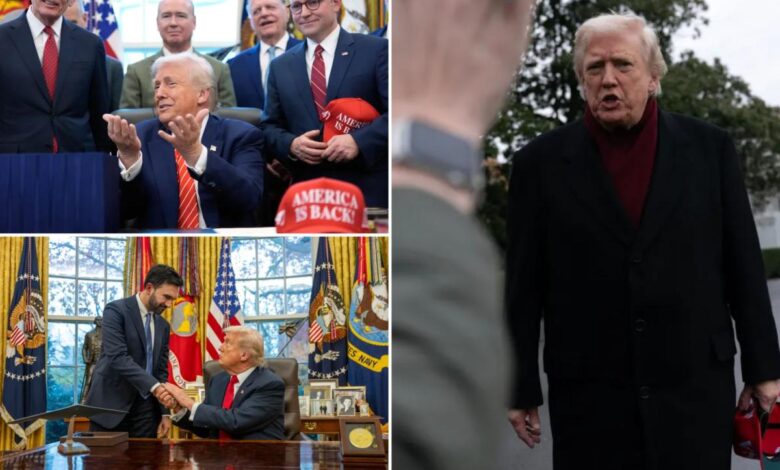
Trump Administration’s Approach to Press Engagement
The Trump administration has made significant strides in press engagement, with President Trump doubling his interactions with journalists during his second term compared to his first. According to data compiled by political scientist Martha Kumar, Trump had at least 493 exchanges with journalists in the first year of his second term, including interviews, event Q&As, and press conferences. This marks a dramatic increase from the 246 exchanges during the first year of his first term.
Kumar noted that one of the reasons for this increase in press engagement is Trump’s clearer agenda in his second term. With a focus on foreign relations, trade, immigration, tax, and healthcare policies, Trump has averaged more than two media sessions per workday. This is a stark contrast to President Joe Biden’s first-year rate of 1.1 media events per day and Trump’s own first-term rate of one per day.
The data also shows that Trump has been more accessible to journalists than his recent predecessors. Many of his interviews are unscheduled chats that begin when a reporter calls his cellphone, a practice no other president has provided. Trump has also taken questions on Air Force One or under its wing 73 times in his first year back in power, more than quadrupling Biden’s interactions in similar settings.
Additionally, Trump has heavily utilized the Oval Office for media availabilities, hosting press events and answering questions at 95 events in the Oval Office alone. This approach has garnered attention from both his base and the general public, with polling showing that people had a better understanding of Trump’s actions compared to Biden’s in his first 100 days.
Despite the increase in press engagement, Trump has held just 13 formal press conferences in his second term, the fewest by any president since Ronald Reagan. However, the White House maintains that Trump is the most transparent and accessible president in American history, with spokeswoman Liz Huston highlighting his willingness to take unrestricted questions from the legacy media.
On the other hand, Meghan Hayes, director of message planning in the Biden White House, raised concerns about Trump’s interactions veering into combat and insults, rather than honest answers. She emphasized the importance of a president providing truthful information to the public, regardless of the frequency of press engagements.
Overall, the data on Trump’s press engagement in his second term showcases a proactive approach to media interactions, highlighting the administration’s efforts to communicate with the public and address key issues facing the nation. The world of technology is constantly evolving, with new innovations and developments being introduced every day. One of the most exciting areas of tech is artificial intelligence (AI), which is revolutionizing industries across the board. From healthcare to finance, AI is being used to streamline processes, improve efficiency, and drive innovation.
One of the most notable applications of AI is in the field of healthcare. AI-powered algorithms are being used to analyze medical images, predict patient outcomes, and even assist in surgical procedures. In radiology, for example, AI can help radiologists detect abnormalities in scans more accurately and efficiently, leading to faster diagnoses and better patient outcomes. In addition, AI is being used to develop personalized treatment plans based on a patient’s unique genetic makeup and medical history.
In finance, AI is being used to detect fraudulent activity, predict market trends, and automate trading processes. Banks and financial institutions are using AI to analyze customer data and provide personalized recommendations for financial products and services. AI-powered chatbots are also being used to provide customer support and streamline the banking experience for customers.
In the field of education, AI is being used to personalize learning experiences for students. Adaptive learning platforms use AI algorithms to analyze student performance data and tailor lessons to individual learning styles. This not only helps students learn more efficiently, but also allows teachers to focus on areas where students may be struggling.
AI is also being used in the automotive industry to develop self-driving cars. These vehicles use AI algorithms to analyze sensor data and make real-time decisions about speed, direction, and braking. Self-driving cars have the potential to reduce accidents, improve traffic flow, and increase accessibility for individuals with disabilities.
Overall, AI is transforming industries in ways that were previously unimaginable. As technology continues to advance, the possibilities for AI applications are endless. It is clear that AI will play a crucial role in shaping the future of technology and society as a whole.