Trump responds to Europe with U.S.-India trade deal
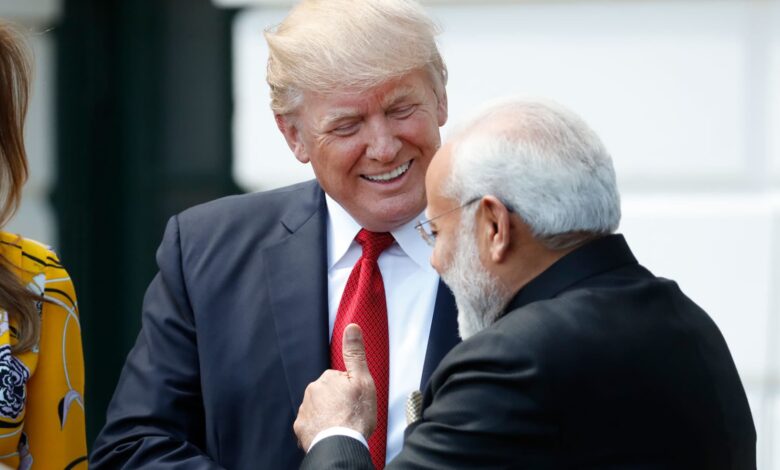
President Donald Trump has announced a new trade deal with India, following in the footsteps of Europe’s recent trade agreement with New Delhi. This move by the United States signals that it is not willing to be left behind by its global competitors in the realm of international trade.
The U.S.-India trade deal comes on the heels of other recent trade pacts signed by major global trading partners such as the European Union, China, and Canada. These agreements have left the United States, which has been known for imposing tariffs on its trading partners, looking isolated on the international stage.
President Trump revealed the details of the trade deal on the Truth Social media platform, stating that the main tariff on India would be reduced from 25% to 18%. Additionally, Washington would remove an additional 25% tariff imposed on India last summer in response to its Russian oil purchases. Trump also mentioned that India would stop buying Russian oil and purchase over $500 billion worth of U.S. products.
The U.S.-India trade deal has been welcomed by Asian markets and is seen as a strategic move by the United States to assert its position in the global trade arena. Analysts believe that this agreement is a response to the recent EU-India free trade agreement and demonstrates that the U.S. is not willing to be outpaced by its competitors.
Indian Prime Minister Narendra Modi confirmed the deal with the U.S. and expressed his delight that Indian products would now face a reduced tariff of 18%. While specific details of the agreement are still scarce, it is viewed as a mutually beneficial deal for both countries.
Some analysts caution that more information is needed to fully assess the long-term impact of the U.S.-India trade deal. Questions remain about how India will reduce its tariffs and non-tariff barriers, as well as the specifics of the increased purchase of U.S. goods mentioned by President Trump.
Overall, the U.S.-India trade deal is seen as a significant development in the realm of international trade and is expected to have positive implications for both countries. It represents a strategic move by the United States to strengthen its economic ties with India and secure its position in the global economy. In a recent UBS podcast, financial expert Paul Donovan discussed the interesting phenomenon of how tariff increases are often passed on to consumers, while tariff reductions are less likely to benefit the end consumer. This observation sheds light on the complexities of global trade and the impact it has on everyday consumers.
It is common knowledge that when tariffs are increased, businesses often pass on the additional costs to consumers in the form of higher prices. This is a straightforward and logical response to the added financial burden imposed by tariffs. However, when tariffs are reduced, the benefits are not always fully passed on to consumers. This can be attributed to various factors such as market dynamics, competition, and the willingness of businesses to prioritize consumer savings.
Donovan’s remarks highlight the need for consumers to be aware of how tariff changes can affect the prices they pay for goods and services. While tariff reductions may not always result in immediate cost savings for consumers, they can have a positive impact on the overall economy by stimulating trade and fostering competition.
In conclusion, Donovan’s insights serve as a reminder of the complexities of global trade and the importance of understanding how tariff changes can impact consumers. By staying informed and advocating for fair pricing practices, consumers can play a role in shaping a more transparent and equitable trade environment.