Trump says he may punish countries with tariffs if they don’t back the US controlling Greenland
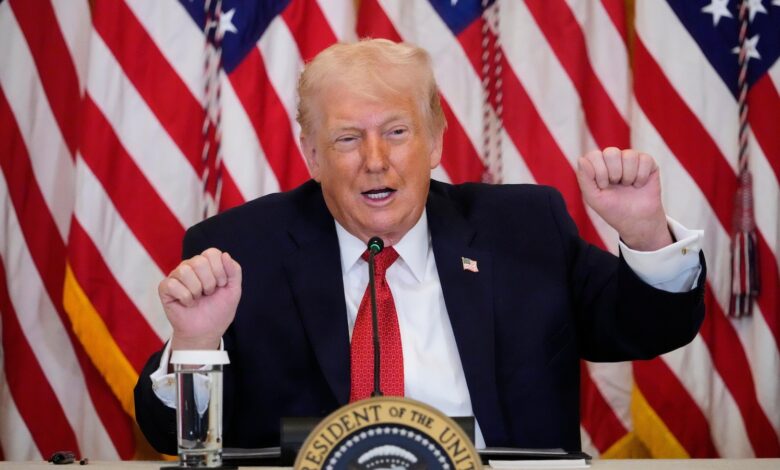
President Donald Trump hinted on Friday that he might impose tariffs on countries that do not support the United States’ desire to control Greenland. This statement was made as a bipartisan Congressional delegation worked to ease tensions in Copenhagen, Denmark.
For several months, Trump has been adamant about the U.S. taking control of Greenland, a semi-autonomous territory of NATO ally Denmark. He recently stated that anything less than U.S. possession of the Arctic island would be deemed “unacceptable.”
While speaking at a White House event on rural health care, Trump mentioned how he had previously used tariffs as a threat against European allies regarding pharmaceuticals. He suggested that he may consider using tariffs in a similar manner to coerce countries into supporting the U.S. on the Greenland issue.
The foreign ministers of Denmark and Greenland recently met with U.S. Vice President JD Vance and Secretary of State Marco Rubio in Washington, but the discussions did not resolve the significant differences between the parties. However, an agreement was reached to establish a working group, although Denmark and the White House have differing views on its purpose.
European leaders have emphasized that decisions regarding Greenland should be left to Denmark and Greenland alone. Denmark announced an increase in its military presence in Greenland in collaboration with allies.
In Copenhagen, a group of senators and House members engaged in discussions with Danish and Greenlandic lawmakers, as well as Danish Prime Minister Mette Frederiksen. Sen. Chris Coons expressed gratitude for the long-standing alliance between the U.S. and Denmark, while Sen. Lisa Murkowski highlighted the need to nurture this relationship.
Contrary to the conciliatory tone of the delegation, Trump has continued to justify his push for U.S. control of Greenland by citing alleged interests from China and Russia in the island’s mineral resources. The White House has not ruled out the possibility of forcibly taking over Greenland.
Aaja Chemnitz, a Greenlandic politician, criticized the perceived threats from the U.S., stating that the current threats are primarily emanating from the U.S. side. Murkowski underscored the role of Congress in conveying the American people’s sentiments on the matter.
She, along with Sen. Jeanne Shaheen, introduced bipartisan legislation to prevent the use of U.S. funds for the annexation of Greenland or any NATO member state without consent.
The dispute over Greenland has significant implications for its residents. Greenland’s prime minister, Jens-Frederik Nielsen, reaffirmed his allegiance to Denmark, NATO, and the EU, choosing them over the U.S.
The chair of the Inuit Circumpolar Council in Nuuk, Sara Olsvig, expressed concern over how the U.S. administration views Indigenous peoples and minorities. She emphasized that Indigenous Inuit in Greenland do not wish to be colonized again.
This article was reported by Superville in Washington, with contributions from Emma Burrows in Nuuk, Greenland, and Geir Moulson in Berlin.