Trump to hike global tariffs to 15% from 10%, ‘effective immediately’
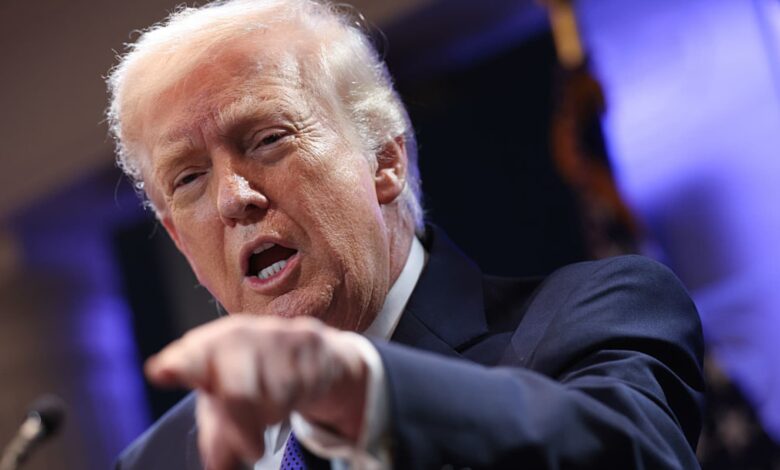
U.S. President Donald Trump speaks during a press briefing held at the White House February 20, 2026 in Washington, DC.
Kevin Dietsch | Getty Images News | Getty Images
President Donald Trump announced on Saturday that he would be increasing global tariffs from 10% to 15%, following a Supreme Court ruling that struck down a significant portion of his trade agenda.
In a post on Truth Social, Trump declared that the new tariffs would take effect immediately and hinted at the possibility of additional levies in the future.
“I, as President of the United States of America, will be, effective immediately, raising the 10% Worldwide Tariff on Countries, many of which have been ‘ripping’ the U.S. off for decades, without retribution (until I came along!), to the fully allowed, and legally tested, 15% level,” he stated.
He also mentioned that the Trump Administration would establish new tariffs in the coming months.
While Trump claimed that the new tariffs would be implemented without delay, there is uncertainty regarding the official documentation detailing the timing. A White House fact sheet released on Friday indicated that the initial 10% tariffs were scheduled to go into effect on Tuesday, February 24.
The White House has not yet responded to requests for clarification from CNBC.
Following a 6-3 Supreme Court ruling against Trump’s tariff policies, the President retaliated by imposing a 10% global tariff under Section 122 of the Trade Act of 1974, which allows temporary levies for 150 days, with extensions requiring congressional approval.
In response to the Court’s decision, Trump criticized the ruling, labeling it as “ridiculous, poorly written, and extraordinarily anti-American” in a social media post. He specifically targeted Justices Neil Gorsuch and Amy Coney Barrett for siding with the majority.
Democratic lawmakers celebrated the Supreme Court’s decision, with Senate Minority Leader Chuck Schumer denouncing the tariffs as “chaotic and illegal.” Tariffs and the economy are poised to be central issues for Democrats in the upcoming midterm elections.
Republicans displayed a range of opinions on the ruling, with some criticizing the Supreme Court and others highlighting Congress’s constitutional authority to impose tariffs.
Stocks initially surged following the Court’s decision, then fluctuated before ultimately stabilizing. Investors anticipate that the ruling could ease tensions with trading partners, potentially leading to refunds for affected businesses and a reduction in inflation.
The process for issuing refunds by the U.S. government remains uncertain, with estimates suggesting potential refunds exceeding $175 billion for importers impacted by the Court’s decision.