Trump’s “unprecedented” firing of Fed Governor Lisa Cook raises untested questions
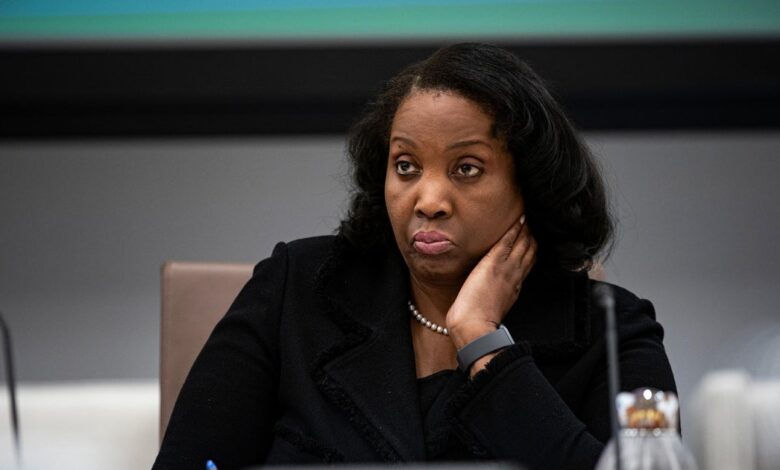
The legal battle surrounding President Trump’s attempt to fire Lisa Cook from the Federal Reserve Bank’s Board of Governors has raised questions about the boundaries of executive authority and the independence of federal agencies. Cook, who was appointed by President Joe Biden, is facing removal by Trump over allegations of mortgage fraud, which she denies.
The move by Trump to oust Cook is part of a larger pattern of aggressive removals of Democratic-appointed members of independent agencies, challenging the traditional limits of presidential power. Legal scholars believe that the Supreme Court may ultimately have to weigh in on the legality of Cook’s removal and whether it constitutes “good cause” as required by the Federal Reserve Act.
The law governing the Federal Reserve System stipulates that a member of the Board of Governors can only be removed “for cause,” but the term is not clearly defined. Cook argues that good cause should be limited to instances of inefficiency, neglect of duty, malfeasance in office, or comparable misconduct. The courts will have to determine whether Trump’s allegations against Cook meet this standard.
In recent years, the Supreme Court has asserted the president’s power to remove executive officers without cause, as seen in decisions regarding the Consumer Financial Protection Bureau and the Federal Housing Finance Authority. The court’s interpretation of “good cause” in the context of the Federal Reserve System will be crucial in determining the legality of Cook’s removal.
The outcome of this legal battle will have broader implications for the independence of federal agencies and the balance of power between the executive and legislative branches. The Supreme Court’s decision on the matter could set a precedent for future challenges to executive authority and the removal of officials from independent agencies. In a recent development, the Supreme Court has ruled that the President’s power to remove the head of an agency with a single top officer cannot be restricted, even by “modest restrictions” as stated in the Constitution. This decision came in response to emergency appeals from ousted officials of the NLRB and the MSPB, multi-member bodies, who were fired by President Trump despite Congress shielding them from being removed at will.
The Supreme Court allowed Mr. Trump to fire these officials while their legal challenges are ongoing, highlighting the unique case of the Federal Reserve. Two fired officials, Gwynne Wilcox and Cathy Harris, raised concerns about the constitutionality of the Fed’s for-cause removal protections. However, the court deemed the Fed as a “uniquely structured, quasi-private entity” with historical significance akin to the First and Second Banks of the United States.
Justice Elena Kagan dissented, arguing that the majority created a “bespoke Federal Reserve exception” without sufficient justification. Legal experts also weighed in on the ruling, with some questioning whether the Fed’s powers are different enough to warrant this exception.
The President’s removal powers have been a subject of debate, with the Supreme Court recognizing narrow exceptions to Congress’s authority to restrict the president’s ability to remove certain officials without cause. In the case of Humphrey’s Executor v. United States, the court ruled that Congress can limit the president’s authority over multi-member commissions that do not exercise executive power.
While the majority in the recent Supreme Court decision acknowledged the executive power of the NLRB and MSPB, they found the Fed to be different due to its monetary powers. The Board of Governors’ oversight and regulatory authority over the banking system were cited as core executive powers by some experts, contrasting with the court’s view of the Fed’s distinct nature.
Overall, the ruling sheds light on the complex interplay between the President’s removal powers and congressional oversight, particularly in the case of independent agencies like the Federal Reserve. The debate over the Fed’s unique status and the extent of its executive powers continues to be a point of contention among legal scholars and policymakers.