UK economy fails to grow in January ahead of Iran war energy shock
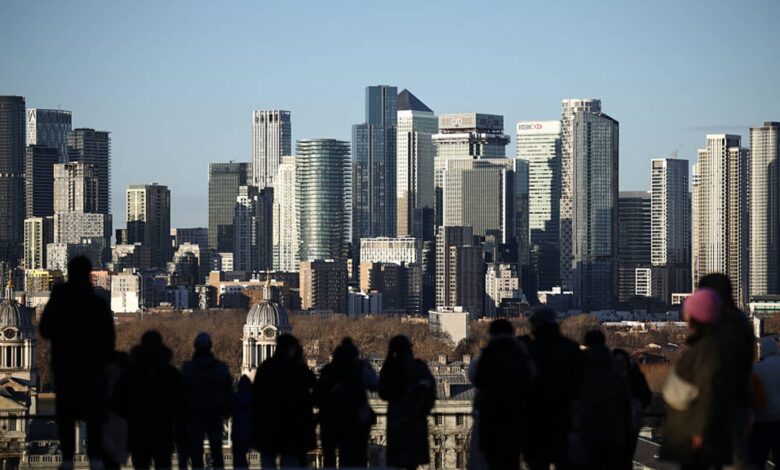
People enjoy the view from Greenwich Park, with Canary Wharf in the background, on a cold but sunny day in London, U.K., on January 2, 2026.
Photo by Henry Nicholls | Afp | Getty Images
The U.K. economy stagnated in January as growth continued to slow even before the U.S.-Iran conflict caused a global energy price shock.
Preliminary data released on Friday fell below the 0.2% month-on-month gross domestic product growth forecast by economists surveyed by Reuters. In December, the economy expanded by 0.1%.
During the last quarter of 2025, the U.K. economy only grew by a disappointing 0.1%.
According to the Office for National Statistics, the services sector showed no growth in January, while production shrank by 0.1% and construction saw a modest 0.2% growth.
In her recent Spring Statement, U.K. Finance Minister Rachel Reeves highlighted the growth as a testament to the government’s “right economic plan for the country.”
However, new data indicates a lackluster British economy, now facing additional pressure following the U.S.-Iran conflict outbreak.
The conflict has led to a surge in oil and gas prices, raising concerns about energy importers like the U.K. and prompting analysts to reassess the possibility of a Bank of England interest rate cut later this month.
In the U.K., mortgage rates have climbed amid the escalating conflict, while government borrowing costs have experienced significant fluctuations.
As of Friday morning, markets are currently pricing in a mere 1.83% chance of a rate cut from the central bank on March 19, based on LSEG data.
British government bonds, known as gilts, remained relatively stable across most maturities following the latest data release. Short-term 2-year gilt yields decreased by 3 basis points.
The British pound weakened by 0.4% against the U.S. dollar and remained unchanged against the euro.
Deutsche Bank’s Chief UK Economist Sanjay Raja expressed disappointment with the GDP update, stating that the report was not as expected.
Raja predicted that rising energy prices would squeeze real disposable incomes, restricting spending, investment, and corporate hiring plans.
Suren Thiru, chief economist at the Institute of Chartered Accountants in England and Wales, mentioned that any hopes of an imminent BoE rate cut had vanished, despite the struggling U.K. economy.
Thiru emphasized that the Middle East conflict had eliminated any remaining economic momentum, leading to concerns about stagflation and eroding fiscal flexibility.
He added, “While these disappointing figures may raise worries about the economy’s health, the likelihood of an interest rate cut next week is minimal due to the inflation risks triggered by the conflict.”