UK finance minister Reeves delivers the Spring Statement
The latest update on the U.K. economy and public finances was delivered by Finance Minister Rachel Reeves, revealing lower growth expectations this year compared to previous estimates.
During her address to the House of Commons, Reeves defended the government’s economic plan, which was met with criticism from opposition lawmakers.
She emphasized the importance of stability in the face of increasing global uncertainties, particularly due to the escalating conflict in the Middle East.
Economists were surprised by the revisions announced so soon after the Autumn Budget, with expectations tempered leading up to the spring budget update.
Reeves highlighted the government’s focus on the annual Autumn Budget as the primary fiscal event, emphasizing the importance of stability for economic growth.
She pointed out positive indicators such as lower inflation, reduced borrowing, improved living standards, and overall economic growth.
The U.K. economy saw marginal growth of 0.1% in the fourth quarter, according to preliminary figures released by the Office for National Statistics in February.
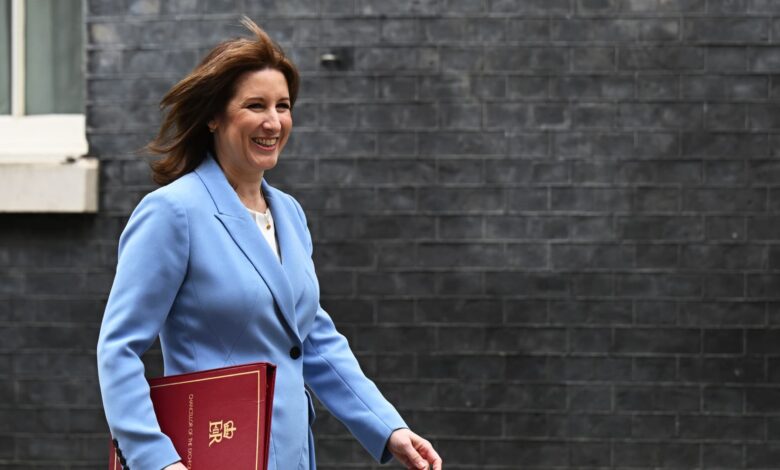
U.K. Chancellor of the Exchequer Rachel Reeves departs No.11 Downing Street to present the government’s Spring Forecast to the House of Commons on March 3, 2026 in London, England.
Leon Neal | Getty Images News | Getty Images
Chancellor Reeves had announced that the Spring Statement would provide an interim update on the economy and public finances without significant policy changes, unless warranted by a major shift in the economic outlook.
Expectations for the 2026 Spring Statement were low, as much of the focus remained on the Autumn Budget unveiled just three months prior.
Reeves was expected to highlight the positive impact of her proposed measures, including tax increases and increased spending on defense and infrastructure.
She reaffirmed her commitment to the government’s economic plan, emphasizing stability in public finances and investments in key areas.
The OBR revised its growth forecasts, predicting lower growth for 2026 but slightly higher figures for 2027 and 2028, with stable growth expected in the following years.
Number crunching
The OBR’s assessment of the government’s tax and spending plans, along with updated economic and fiscal outlook, was a key component of the Spring Statement.
Reeves highlighted the OBR’s revised forecasts, indicating lower growth for 2026 but improved projections for the subsequent years.
The OBR acknowledged the challenging fiscal context and emphasized the importance of stabilizing debt amidst economic uncertainties.
Analysts monitored Reeves’ fiscal headroom to meet her targets, considering recent spending initiatives and policy adjustments.
Reeves expressed confidence in meeting borrowing targets, with a surplus expected by 2029/2030, signaling financial stability.
Britain’s Chancellor of the Exchequer Rachel Reeves (R) stands with Britain’s Prime Minister Keir Starmer (L) as she is applauded after delivering her speech on the second day of the annual Labour Party conference in Liverpool, north-west England, on September 29, 2025.
Oli Scarff | Afp | Getty Images
Reeves and the Labour Party treaded cautiously to avoid unsettling consumers and businesses ahead of upcoming elections, prioritizing economic stability.