What is RAG as a Service? A Complete Guide
Retrieval-Augmented Generation as a Service (RAGaaS) is revolutionizing the way businesses harness AI for real-time, context-aware answers. But have you ever wondered how it accomplishes this and why businesses shy away from custom RAG system development? This article aims to address all your queries, covering everything from its definition to its significance for businesses, along with the benefits and real-world applications with examples.
In recent years, the advent of powerful conversational AI models like ChatGPT has sparked conversations across industries about generative AI and large language models (LLMs). Businesses are now exploring ways to leverage AI trends to enhance their operations. By leveraging LLMs, tech companies are assisting businesses in achieving automation and artificial intelligence.
However, standalone LLM solutions face challenges in distinguishing between facts and taught facts, leading to hallucinations and difficulties in keeping up with dynamic enterprise data. The solution lies in developing custom AI pipelines, custom RAG solutions, and utilizing data science solutions. However, this process is costly, intricate, and time-consuming.
This is where RAG as a Service (RAGaaS) comes into play. Instead of investing millions in developing a RAG solution, businesses can access scalable, secure, and high-performing RAG solutions through RAGaaS, eliminating the need for heavy upfront investments.
But how does RAGaaS achieve this? Let’s delve into the key aspects:
What is RAG as a Service?
Similar to Software as a Service (SaaS) and AI as a Service, RAG as a Service (RAGaaS) offers managed services and solutions in the form of APIs that enable businesses to integrate retrieval with LLMs to generate accurate, up-to-date, and contextually relevant AI responses from their training dataset. Instead of burdening businesses with in-house infrastructure and custom solutions, RAGaaS allows them to entrust model and data management to the service provider, who takes care of data ingestion, indexing, retrieval, and LLM integration.
How RAG as a Service Works
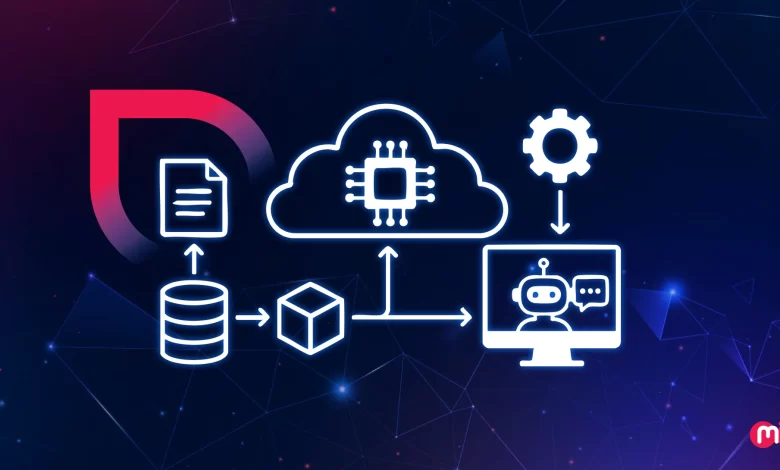
RAGaaS combines data ingestion and indexing, retrieval mechanism, generation mechanism, and integration & deployment to simplify the development and maintenance of RAG pipelines. Each component plays a crucial role in the process:
- Data Ingestion and Indexing: Involves cleaning, structuring, and transforming unstructured data into embeddings, which are indexed in a vector database for semantic search.
- Retrieval Mechanism: Conducts real-time similarity searches in vector databases to retrieve relevant data snippets based on user queries.
- Generation Mechanism: Combines retrieval context with original prompts to generate comprehensive and accurate natural language responses.
- Integration and Deployment: Serves generated responses through customized APIs, chatbots, or other platforms while ensuring security, governance, and scalability.
Top Benefits of RAG as a Service
Businesses should consider RAGaaS for its speed, cost-effectiveness, compliance, customer experience enhancement, and more. The key benefits include:
- Competitive Advantage: Faster deployment of RAG pipelines helps businesses gain a competitive edge.
- Lower TCO vs. Custom RAG: RAGaaS reduces infrastructure and maintenance costs by up to 40% compared to custom solutions.
- Higher CSAT and Fewer Errors: Accurate and context-aware responses lead to improved customer satisfaction and reduced support costs.
- Reduced Hallucinations: RAGaaS ensures verified data sources, minimizing trust issues and compliance risks.
- Enterprise-Grade Security: Compliance with industry standards ensures data security and access controls.
- Scalability and Modularity: Effortless scaling without rebuilding RAG pipelines, ideal for fast-growing enterprises.
- Improved Data Control: Customizable data indexing, retrieval, and generation for enhanced control.
- Traceable & Validated Responses: Responses linked to authoritative sources build trust in AI output.
In conclusion, adopting RAGaaS streamlines AI integration by offering a scalable, secure, and optimized solution that aligns seamlessly with existing tech stacks. Whether for automating compliance, enhancing customer support, or empowering data-driven decisions, RAGaaS accelerates deployment, reduces costs, and unlocks tangible business outcomes without the hassle of custom development.
MindInventory: Your Partner in RAGaaS Solutions
MindInventory, a leading Generative AI development company, specializes in building and integrating RAGaaS solutions. With expertise in OpenAI, Google Vertex AI, AWS AI, and Microsoft Azure AI, MindInventory ensures tailored, secure, and high-performing RAGaaS platforms. From end-to-end development to seamless integration, MindInventory offers comprehensive support for businesses looking to leverage AI solutions without the technical overhead.
FAQs About RAG-as-a-Service
- Why do businesses need RAG as a Service?: RAGaaS offers a cost-effective, scalable, and secure solution for accurate, context-aware responses without the complexity of custom development.
- What does great RAG as a Service look like in practice?: Great RAGaaS integrates structured and unstructured data seamlessly to deliver fast, context-aware answers while maintaining security and compliance.
- Why should you choose RAG as a service instead of a custom RAG implementation?: RAGaaS offers faster deployment, reduced overhead, and greater flexibility compared to custom implementations.
- Does RAGaaS ensure data privacy & compliance?: Yes, leading RAGaaS providers adhere to stringent security and compliance standards, ensuring data integrity and privacy.
- What industries benefit most from RAGaaS?: Industries handling vast, dynamic data sets like healthcare, finance, legal, retail, and supply chain benefit significantly from RAGaaS.
- What’s the difference between Retrieval-Augmented Generation and semantic search?: While semantic search finds relevant documents, RAG combines retrieval with LLM-powered generation to provide context-rich, conversational responses.
- How is RAG as a Service different from Fine-tuning?: Fine-tuning alters model weights with new data, while RAG retrieves real-time data for dynamic, accurate responses without retraining.
- Is RAG better than fine-tuning?: RAG is preferred for dynamic knowledge updates and cost-efficiency, while fine-tuning is suitable for static tasks, offering flexibility and scalability.