What student loan repayment will look like after Trump’s budget bill
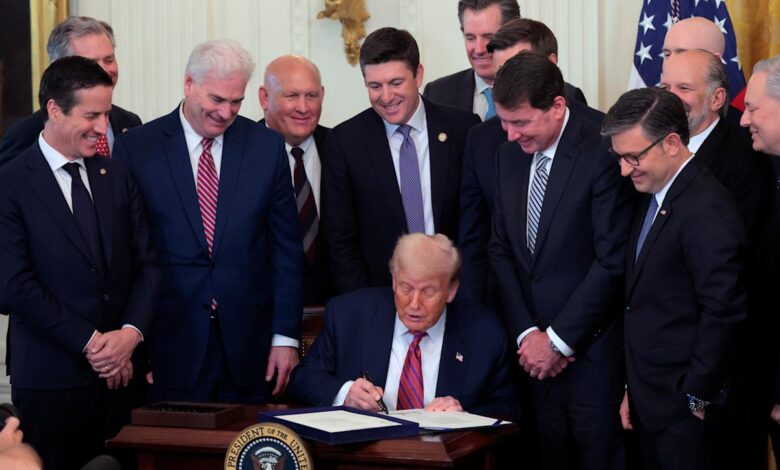
President Trump’s One Big Beautiful Bill (OBBB) has brought significant changes to the federal student loan system, affecting both current and future borrowers. With approximately 42.5 million people holding outstanding federal student loans as of 2025, the impact of these changes is widespread.
One major change introduced by the OBBB is the creation of a new standard repayment plan. This plan, which will go into effect on July 1, 2026, replaces the current system of fixed monthly payments over 10 years with a tiered repayment schedule based on borrowers’ loan balances. This new standard repayment plan will apply to any borrower who takes out a federal student loan on or after July 1, 2026.
In addition to the standard repayment plan, the OBBB also introduces the Repayment Assistance Plan (RAP). Unlike the current income-driven repayment (IDR) plans, the RAP requires all borrowers to make minimum payments of at least $10 per month. Payments under the RAP are based on the borrower’s income, with adjustments made for dependents. For example, a borrower with an annual income of $45,000 and one child would have a monthly payment of $100 under the RAP.
The RAP also waives interest that accrues if the payment amount does not cover the full amount due. However, borrowers under the RAP will be in repayment for 30 years. This new plan will apply to undergraduate and graduate borrowers who take out loans on or after July 1, 2026.
It’s important to note that borrowers who take out new loans after July 1, 2026, will only have access to the new standard and RAP repayment plans. This means that current IDR plans, extended repayment, and graduated repayment options will no longer be available to new borrowers.
For existing undergraduate and graduate borrowers, the transition to the new repayment plans will take place on July 1, 2028. This gives legacy borrowers with existing loans some time to adjust to the changes brought about by the OBBB.
Overall, the OBBB has brought sweeping changes to the federal student loan system, impacting millions of borrowers across the country. It’s important for current and future borrowers to be aware of these changes and how they may affect their repayment options. The landscape of student loan repayment is changing, and borrowers need to be aware of the upcoming changes that will affect their repayment options. As of July 1, 2026, new regulations will be implemented that will phase out most of the existing repayment plans. However, if you do not take out any new loans after this date, you can continue under the following repayment plans for the time being:
1. Income-Contingent Repayment (ICR)
2. Income-based Repayment (IBR)
3. Pay As You Earn (PAYE)
4. Saving on a Valuable Education (SAVE)
5. Extended repayment
6. Graduated repayment
It is important to note that all borrowers in discontinued payment plans will be required to enroll in a new plan by July 1, 2028. The options for new plans include IBR, the new RAP, or the new Standard Repayment plan.
One group that will be significantly impacted by these changes is Parent PLUS Loan borrowers. As of July 1, 2026, those who take out new Parent PLUS Loans will only be eligible for the standard repayment plan. This means that parents will no longer qualify for alternative payment plans or Public Service Loan Forgiveness.
Existing Parent PLUS Loan borrowers will also be affected by these changes. Only those who consolidate their loans by July 1, 2026, and enroll in an Income-Driven Repayment (IDR) plan will have access to alternative payment plans. It is crucial for current borrowers to complete the consolidation process before the deadline to maintain access to these options.
For all student loan borrowers, consolidating with a Direct Consolidation Loan could provide some relief if they are struggling to afford their payments. However, the usefulness of consolidation will be reduced after July 1, 2026, as the new repayment plans have longer terms and consolidating may cause borrowers to lose access to alternative payment options.
The Office of Borrower Benefits and Budgeting (OBBB) has made significant changes to federal financial aid and repayment options, and more details are still forthcoming. It is essential for borrowers to stay informed about these changes and reach out to their loan servicer for assistance in understanding their options and enrolling in a new repayment plan.
As the July 1, 2026 deadline approaches, borrowers should stay updated on the latest developments through the announcement page on the Federal Student Aid website. Adapting to these changes may require some adjustments, but staying informed and proactive will help borrowers navigate the new landscape of student loan repayment effectively. The world of technology is constantly evolving, with new innovations and advancements being made every day. One of the most exciting developments in recent years is the rise of artificial intelligence (AI). AI is a branch of computer science that aims to create machines that can perform tasks that typically require human intelligence, such as speech recognition, decision-making, and language translation.
One area where AI is making a big impact is in the field of healthcare. AI has the potential to revolutionize the way we diagnose and treat diseases, making healthcare more efficient, accurate, and personalized. For example, AI-powered algorithms can analyze medical images such as X-rays and MRIs to detect abnormalities that may be missed by human doctors. This can lead to earlier detection of diseases such as cancer, improving patient outcomes and saving lives.
AI is also being used to develop personalized treatment plans for patients. By analyzing large amounts of data from patient records, genetic information, and medical research, AI algorithms can help doctors tailor treatments to individual patients based on their unique biology and medical history. This can lead to more effective treatments with fewer side effects, improving patient quality of life.
In addition to diagnosis and treatment, AI is also being used to improve the overall efficiency of healthcare systems. AI-powered chatbots and virtual assistants can help patients schedule appointments, refill prescriptions, and get answers to medical questions, reducing the burden on healthcare providers and improving patient satisfaction. AI can also help hospitals and clinics optimize their resources, such as scheduling staff and equipment more efficiently, leading to cost savings and better patient care.
Despite the many benefits of AI in healthcare, there are also challenges and ethical considerations that need to be addressed. For example, there are concerns about data privacy and security, as AI algorithms rely on vast amounts of sensitive patient data to function effectively. There are also questions about the potential for bias in AI algorithms, as they are only as good as the data they are trained on. It is important for developers and healthcare providers to be transparent about how AI is being used and to ensure that it is being used ethically and responsibly.
Overall, the potential of AI in healthcare is vast, and its impact is already being felt in hospitals and clinics around the world. As technology continues to advance, we can expect AI to play an even greater role in improving the quality, efficiency, and accessibility of healthcare for all.