What to know about the congressional fight over ICE restrictions, and another possible government shutdown
Following the recent end of a partial government shutdown, there are concerns that another one may be looming if Democrats and Republicans fail to reach an agreement on potential restrictions to be imposed on immigration enforcement tactics. This issue has gained attention after two fatal shootings by federal law enforcement in Minneapolis last month.
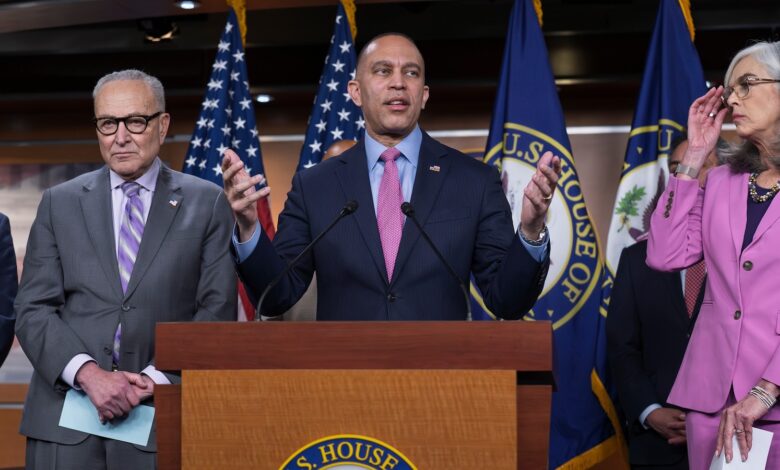
House Minority Leader Hakeem Jeffries and the majority of his caucus voted against a funding deal struck between Senate Democrats and the White House. Democratic leaders are now presenting a united front as they outline their demands for reform within the Department of Homeland Security, emphasizing the need for Republicans to take the matter seriously ahead of the Feb. 13 deadline to fund the agency.
Jeffries emphasized the alignment between the House and Senate Democrats, stating that he and Senate Minority Leader Chuck Schumer are in agreement on the way forward. Schumer echoed this sentiment, highlighting a positive and productive meeting between the two leaders.
In response to the public outcry over recent immigration enforcement actions, Democrats are pushing to separate DHS funding, particularly in light of the deaths of Renee Good and Alex Pretti in Minneapolis. Polling conducted by Ipsos indicates that 62% of Americans believe that current ICE efforts to address unauthorized immigration are excessive.
Democrats have outlined 10 key demands for DHS funding in a letter to Republican leaders. These demands include requirements for judicial warrants before agents can enter private property, a ban on ICE agents wearing face masks, mandatory use of body cameras, and the establishment of new laws for use-of-force standards.
Additionally, Jeffries and Schumer called on the Trump administration to demonstrate good faith by scaling back enforcement activities in Minnesota and removing Homeland Security Secretary Kristi Noem from her position.
Sen. Patty Murray, the top Democratic appropriator in the Senate, emphasized the importance of reining in abuses by ICE and CBP in any legislative bill. Despite these efforts, bipartisan negotiations have yet to begin, with Speaker Mike Johnson adjourning the House early on Wednesday.
Schumer reiterated the Democrats’ readiness to negotiate and find a resolution to the funding issue, signaling a willingness to engage in discussions to address the concerns raised regarding immigration enforcement tactics.
In a recent statement, Senate Majority Leader Chuck Schumer made it clear that Republicans need to take real action on reform if they want to earn the votes of Democrats. “If [Republicans are] not serious and they don’t put in real reform, they shouldn’t expect our votes. Plain and simple,” Schumer emphasized.
Schumer’s sentiments were echoed by Representative Hakeem Jeffries, who expressed uncertainty about negotiating with President Donald Trump or congressional Republicans. Schumer reported that Senate Majority Leader John Thune directed Democrats to speak with the White House, indicating the confusion surrounding the negotiations.
Thune criticized Schumer and Jeffries, accusing them of being “afraid of their shadows” and succumbing to pressure from their left. However, Jeffries fired back, calling Thune “scared of his own shadow” and emphasizing the need for bold and transformative changes in the Department of Homeland Security’s operations.
On the Republican side, Speaker of the House Mike Johnson highlighted the challenges of compromising with Democrats, particularly on issues like body cameras and face masks for agents. Johnson expressed willingness to negotiate in good faith but firmly stated that Republicans would not support a ban on face masks for agents due to concerns about their safety and privacy.
As the negotiations continue, both parties have yet to translate their proposals into legislative text. With a looming deadline approaching, Democrats are pushing for immediate action to address pressing issues like immigration enforcement policies. Jeffries emphasized the urgency of finding a resolution by the specified date, citing the ongoing security concerns faced by American citizens.
Despite the ongoing negotiations, Democrats are wary of the possibility of a government shutdown, with Jeffries accusing Republicans of laying the groundwork for such an outcome. He criticized Johnson for advocating for the deployment of masked and lawless ICE agents in communities across America, labeling his stance as unreasonable.
As the discussions progress, both parties will need to navigate the complexities of immigration reform and find common ground to address the critical issues facing the Department of Homeland Security. The outcome of these negotiations will have far-reaching implications for national security and immigration policies in the United States. The ongoing standoff between Democrats and Republicans over the Department of Homeland Security (DHS) appropriations bill continues to escalate, with both sides at an impasse. Senator Johnson, a key player in the negotiations, expressed his frustration with the current situation, stating that it goes against the wishes of the American people.
Johnson emphasized the importance of finding a resolution to the funding issue, as shutting down DHS next week would have far-reaching consequences. While Immigration and Customs Enforcement (ICE) has been at the center of attention, the DHS bill also funds crucial agencies such as the Transportation Security Administration, FEMA, the Coast Guard, and the Secret Service.
Despite some funding allocated for ICE in the bill, a lapse in funding at DHS would not completely halt operations due to the agency’s recent financial boost. However, essential functions such as FEMA operations, TSA screening at airports, and Coast Guard activities would be affected.
Senator Johnson urged both parties to prioritize the well-being of the country and avoid playing partisan games that could disrupt critical DHS functions. He called for productive negotiations over the next two weeks to reach a resolution and prevent any shutdown of vital services.
As the political deadlock continues, the impact of a potential DHS shutdown looms large. It is essential for lawmakers to set aside their differences and work towards a solution that ensures the safety and security of the nation. Stay tuned for further updates as the situation unfolds.