What to know about Trump’s latest round of tariffs
Written by WYATTE GRANTHAM-PHILIPS, AP Business Writer
NEW YORK (AP) — President Donald Trump has initiated trade disputes with almost all of America’s trading partners, and there seems to be no resolution in sight.
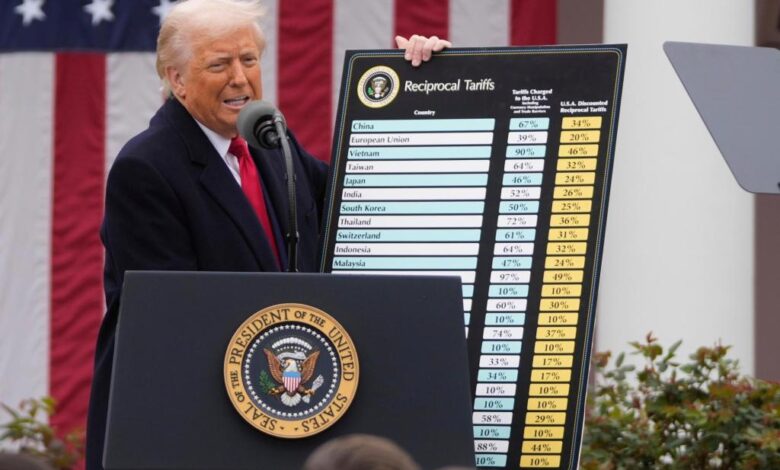
Several new tariffs on goods from other countries have already been implemented, with more scheduled to come into effect as early as Wednesday. Trump has vowed to increase rates for his latest round of tariffs, which he refers to as “reciprocal” tariffs.
With numerous back-and-forth tariff actions and threats, it can be challenging to keep track of the current situation. Here is an overview of the latest developments:
What tariffs will be enforced on Wednesday?
Trump announced his most recent and extensive round of tariffs on April 2, known as “Liberation Day,” as part of his reciprocal trade strategy. These tariffs involve taxing nearly all of America’s trading partners at a minimum of 10%, with higher rates for countries that have trade surpluses with the U.S.
The baseline 10% tariff has already been implemented, and the higher import tax rates on various countries and territories will take effect on Wednesday. The steeper levies go up to 50%, with the highest rate applied to countries like Lesotho, Madagascar, Vietnam, Taiwan, South Korea, Japan, and the European Union.
Economists caution that these tariffs will lead to increased prices for everyday consumer goods, especially when combined with previous trade measures. Trump has also threatened to impose additional tariffs on Chinese goods, potentially bringing the total to 104%.
White House press secretary Karoline Leavitt confirmed that there are no plans to delay the upcoming rate increases.
Are more tariffs on the horizon?
In response to Trump’s tariffs, China has announced a 34% tariff on all U.S. goods, matching the rate set by Trump. China has indicated that it will fight back against the U.S. to protect its interests.
While some countries are considering countermeasures, there are hopes for negotiations to resolve the situation. The European Union has suggested a mutual reduction of tariffs, although they remain prepared to take countermeasures if necessary.
Trump may introduce additional product-specific tariffs in the future, targeting items like copper, lumber, and pharmaceutical drugs.
What other tariffs are currently in effect?
Several tariffs are already in place, including the 10% baseline tax imposed by Trump. Additional tariffs on auto imports and steel and aluminum have also been implemented.
Canada has responded with a 25% tariff on non-compliant auto imports from the U.S. The expanded steel and aluminum tariffs are set at 25% across the board.
While Mexico and Canada were exempt from recent tariff increases, they were previously subjected to 25% duties by Trump. Imports complying with the USMCA can enter the U.S. duty-free, while non-compliant imports face a 25% tariff, which may decrease to 12% once certain conditions are met.
The situation remains fluid, with ongoing negotiations and potential escalations in tariffs between the U.S. and its trading partners.
Original Publication Date: April 8, 2025 at 4:12 PM MDT