What Trump’s hand bruise signifies, explained by vascular surgeons
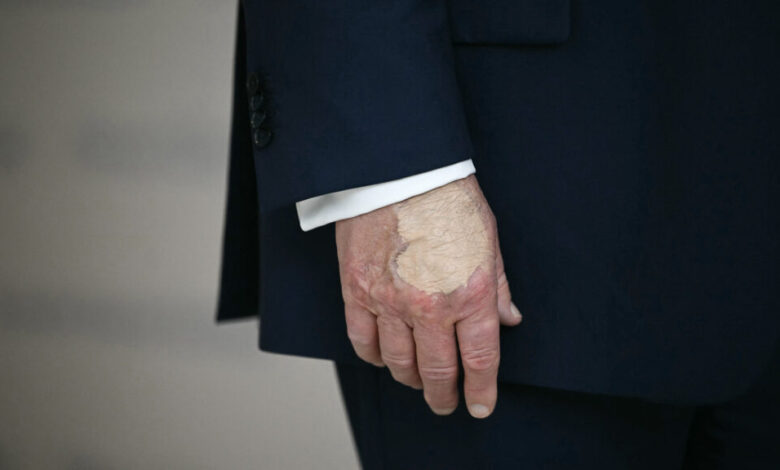
President Trump recently drew attention to his health after being seen with a bruised hand and what appeared to be makeup covering a discolored patch of skin. This has sparked renewed interest in his overall health, especially his cardiovascular health. The spotlight on Trump’s case has shed light on a common but often overlooked condition known as chronic venous insufficiency (CVI).
CVI affects approximately 2.5 million people in the United States, with one of its main symptoms being swollen legs. Many individuals may not even realize they have CVI, attributing leg swelling to a long day on their feet. In CVI, the valves in the veins fail to efficiently return blood to the heart, leading to pooling of blood in the legs.
Dr. Gregory Magee, chief of vascular and endovascular surgery at NYU Langone Health, emphasized that CVI is a prevalent issue that can be effectively treated with simple methods. Compression stockings are a common solution to help push blood upward towards the heart and alleviate symptoms. In severe cases, minimally invasive procedures can remove problematic veins from circulation.
While bruising on Trump’s hand is unlikely to be directly related to CVI, it may be a side effect of aspirin usage, which is often part of cardiovascular prevention programs. As people age, their skin becomes thinner, making them more prone to bruising. Trump’s age of 79 puts him at a higher risk for such issues.
CVI occurs when valves in the veins fail to prevent blood from pooling in the legs, leading to symptoms like varicose veins, spider veins, and dark spots on the skin. In more severe cases, individuals may develop ulcers that do not heal properly, potentially leading to serious complications.
It is important for individuals with CVI to manage their symptoms through lifestyle changes such as wearing compression socks, elevating their legs, and maintaining a low-salt diet. Regular exercise and weight management can also help improve blood flow in the legs and alleviate discomfort associated with CVI.
While CVI itself does not typically lead to life-threatening conditions like deep vein thrombosis, it is essential to monitor symptoms and seek medical attention if any sudden changes occur. By raising awareness about CVI and its management, individuals can take proactive steps to maintain their vascular health and prevent complications associated with this common condition.