What will it take for ships to start sailing through the Strait of Hormuz again?
Following the recent attacks by the U.S. and Israel on Iran, the usually bustling Strait of Hormuz has become eerily quiet. What was once a passage for around 100 vessels per day has now dwindled to just one or two ships crossing the narrow waterway, as reported by MarineTraffic, a ship tracking website.
The closure of the strait, which typically handles approximately 20% of daily global oil shipments, has led to a surge in energy prices worldwide due to the disruption caused by the conflict with Iran.
Mike Sommers, CEO of the American Petroleum Institute, expressed grave concerns about the impact of the strait’s closure on the global economy, referring to it as a “nightmare scenario.” He emphasized the irreplaceable nature of the 20 million barrels of oil that pass through the strait regularly.
Experts have outlined key steps that need to be taken in order for oil tankers to safely resume their journeys through the strait.
Reasons for the Standstill
The current halt in maritime traffic through the Strait of Hormuz is primarily due to the heightened risks posed by suspected Iranian drones targeting ships in the region. Additionally, many insurers have withdrawn coverage for tankers navigating through the area, further deterring commercial vessels from entering the strait.
According to Jerry Kalogiratos, CEO of Capital Clean Energy Carriers, ensuring the safety of seafarers and vessels is paramount, leading to the reluctance of shipping companies to resume operations in the region.
Timeline for Resuming Ship Traffic
Kalogiratos highlighted the need for clear indications that the strait is secure for marine traffic before vessels can safely navigate through it. He mentioned that a ceasefire and assurance from Iran regarding safety would be crucial for ships to begin transiting through the strait again.
Vikas Dwivedi, an energy strategist at Macquarie Group, emphasized the importance of multiple successful crossings in rebuilding confidence among shipping companies. He stated that a series of safe passages through the strait would encourage more vessels to resume their journeys.
Despite the White House’s offer to insure ships and provide U.S. Navy escorts for protection, Kalogiratos emphasized the need for concrete guarantees regarding the safety of crew members aboard the vessels.
Pursuing De-escalation
Michael Ryan, head of freight at Sparta Commodities, emphasized the necessity of a sustained reduction in military threats from Iran to instill confidence among shipping companies. He mentioned that insurers would need to re-enter the region and lower premiums to a manageable level before vessels can return to the strait.
However, with Iran’s Supreme Leader Ayatollah Mojtaba Khamenei insisting on keeping the strait closed, achieving the required level of security for commercial operations seems unlikely in the near future.
Monitoring Ship Movements
Ships navigating through the strait are equipped with Automated Identification System (AIS) trackers that allow their locations to be tracked. While some vessels have deactivated their AIS to avoid detection, monitoring systems like MarineTraffic are crucial for observing the movement of ships in the region.
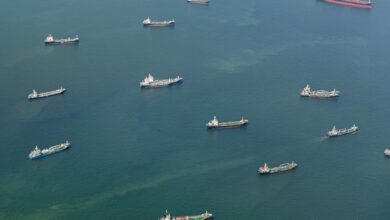
Currently, the usual flow of maritime traffic through the strait has come to a halt, with numerous tankers anchored on either side of the waterway. Observing the movements of these vessels will be essential in determining when it is safe for commercial ships to resume their journeys through the Strait of Hormuz.