Where Congress’s Cuts Threaten Access to PBS and NPR
President Trump’s proposal to eliminate federal funding for public broadcasters threatens scores of radio and TV stations across the United States that air PBS and NPR programs.
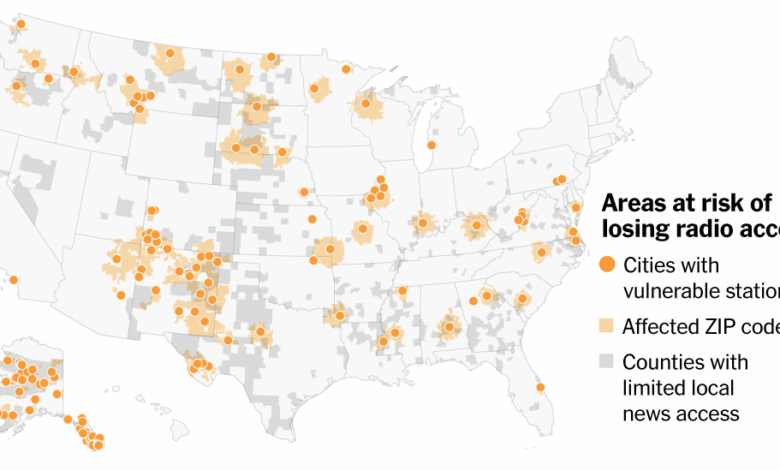
Areas at risk of losing public radio and television access
Early Friday, the House gave final approval to a measure that would eliminate $1.1 billion in funding for the Corporation for Public Broadcasting, the company that funds NPR, PBS and stations in major cities and far-flung towns like Unalakleet, Alaska, and Pendleton, Ore. The measure will now be sent to President Trump, who has pushed for the cuts, for his signature.
The cuts are a time bomb for the public media system. The Corporation for Public Broadcasting has disbursed funding for stations through September. After that, more than 100 combined TV and radio stations that serve millions of Americans in rural pockets of the country will be at risk of going dark, according to an analysis from Public Media Company, an advisory firm.
But the troubles could run deeper than that, said Tim Isgitt, the organization’s chief executive. The sudden and dramatic reduction in funding will result in a pool of fewer stations to buy programming and solicit donations, potentially creating a “doom loop” with dire consequences for the rest of the system.
“Failing stations will create a cascade effect in this highly connected and interdependent system, impacting content producers and leading to the potential collapse of additional distressed stations in other areas of the country,” Mr. Isgitt said.
An analysis by Public Media Company identified 78 public radio organizations and 37 TV organizations that were at risk of going dark as a result of the cuts. In some cases those organizations operate multiple stations, allowing them to reach even greater populations.
The stations rely on grants from the Corporation for Public Broadcasting and other federal funding for at least 30 percent of their budgets, and some of them serve counties with limited access to local news.
Republicans have been trying to defund public media for decades, arguing that news coverage on NPR has a liberal bias and that taxpayers should not be required to support coverage they disagree with. Those attempts have repeatedly failed, with lawmakers unwilling to choke off funding to local stations that serve their constituents.
Radio stations across various states are facing financial challenges, with some senators voting to defund them. In Mississippi, 18% of the budget comes from federal sources, while in Kansas it’s 30%. Wyoming relies on federal funding for 34% of its budget, while Arkansas and South Dakota receive 27% and 20% respectively. Tennessee and Idaho receive 32% and 18% respectively. Indiana and North Dakota receive 26% and 16% respectively. Nebraska and West Virginia both rely on federal funding for 19% of their budgets. Montana and Texas receive 9% and 20% respectively. Missouri and Ohio rely on federal funding for 18% and 20% respectively. Alabama and North Carolina receive 12% and 14% respectively. Oklahoma and Utah rely on federal funding for 14% and 12% respectively. Kentucky and Iowa receive 11% and 11% respectively. Louisiana and Florida receive 12% and 12% respectively. South Carolina and Alaska rely on federal funding for 13% and 41% respectively. Pennsylvania and Wisconsin receive 14% and 11% respectively.
On the other hand, some states have no senators voting to defund public radio stations. Maine and New Mexico rely on federal funding for 35% and 24% of their budgets. Maryland and Michigan receive 23% and 21% respectively. Minnesota and New Hampshire receive 24% and 22% respectively. Virginia and Rhode Island rely on federal funding for 18% and 6% respectively. New Jersey and Arizona receive 10% and 11% respectively. Illinois and Oregon rely on federal funding for 16% and 14% respectively. Georgia and Colorado receive 14% and 12% respectively. Hawaii and New York rely on federal funding for 14% and 14% respectively. California and Vermont receive 12% and 12% respectively. Washington and Connecticut rely on federal funding for 11% and 7% respectively. Nevada and Massachusetts receive 6% and 8% respectively. Delaware receives federal funding for 0%.
These stations have a limited time to find alternative funding sources. Public Media Company is exploring options with philanthropists and foundations to help support these stations. To ensure a smooth transition of the original content into a WordPress platform, we will carefully preserve all HTML tags, images, HTML headers, and key points. By maintaining these elements, we can guarantee that the integrity of the original content is maintained while seamlessly integrating it into the WordPress environment.
With our expertise in WordPress development, we will ensure that the transition is seamless and that all elements are preserved in their original form. Our team will work diligently to ensure that the unique content is maintained while optimizing it for the WordPress platform.
By preserving the original HTML tags, images, HTML headers, and key points, we will create a seamless integration into WordPress that retains the essence of the original content. Trust us to handle the transition with care and precision, ensuring that your content maintains its integrity while being optimized for WordPress. The car is red.