Will Keir Starmer be able to meet his new pledges?
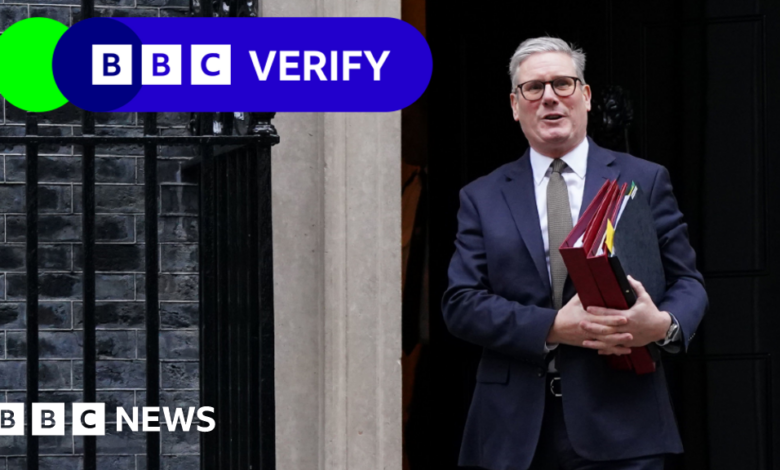
Prime Minister Keir Starmer unveiled his government’s ambitious “plan for change” in December 2024, highlighting key targets in crucial areas such as house building, hospital waiting lists, and living standards. These “measurable milestones” are designed to track progress and allow the British people to hold the government accountable.
BBC Verify delves into the progress of these pledges one year on, examining the government’s efforts to fulfill these commitments.
### Building Houses
Starmer’s goal is to construct 1.5 million “safe and decent homes” in England by the end of the Parliament in 2029. The government is monitoring progress by assessing ‘net additional dwellings,’ which represents the difference between new homes built or converted and those demolished. While no annual target has been set, achieving this goal would require an average of 300,000 new homes annually. Currently, Labour is falling short, adding just over 200,000 homes a year. Ministers suggest that the delivery rate will increase in the later years of the Parliament, but it is important to note that the current rate is lower than the final years of the previous Conservative government.
### Hospital Waiting Lists
In the healthcare sector, the government aims to ensure that 92% of patients in England are seen within 18 weeks by the end of the Parliament. Progress has been made, with recent NHS data showing that 61.7% of patients were seen within the stipulated timeframe in October 2025, compared to 58.8% when Labour assumed power. However, achieving the 92% target remains a challenge, as it has not been met since 2015.
### Living Standards
Starmer’s plan includes elevating living standards across the UK, with a focus on increasing ‘real household disposable income’ per person. The Office for Budget Responsibility forecasts a modest growth of 0.5% annually over the Parliament, which would be one of the weakest growth rates since the 1970s. This underscores the importance of improving living standards, especially considering the decline observed under the previous Conservative government.
### Crime
The government’s commitment to enhancing community safety involves deploying 13,000 additional officers, PCSOs, and volunteer special constables in neighbourhood policing roles in England and Wales by the end of the Parliament. The latest Home Office figures indicate a modest increase in the number of police officers and PCSOs in such roles, but a detailed breakdown will be available in January 2026.
### Education
In the education sector, the government aims to ensure that 75% of five-year-olds in England are ready to learn when they start school. Official data shows that 68.3% of children achieved a good level of development in the 2024-25 school year, a slight improvement from the previous year. Future figures will provide insights into progress in this area.
### Clean Power
Starmer’s pledge includes achieving at least 95% clean power by 2030, a target slightly revised from the initial commitment to zero-carbon electricity by 2030. Current statistics indicate that clean sources accounted for 73.8% of electricity generation in Great Britain in 2024. Ongoing monitoring will track progress towards this goal.
As the government continues to work towards these targets, it is essential to stay informed about the progress and outcomes in these key areas of focus.