

How tariffs will continue to reshape the global economy in 2026

The Impact of Tariffs on the Global Economy
By Jonathan Josephs, Business reporter, BBC News
President Trump’s favorite word is tariffs. He reminded the world of that in his pre-Christmas “address to the nation”. With the world still unwrapping the tariffs “gift” from the first year of his second term in office, he said they were bringing jobs, higher wages, and economic growth to the US.
That is hotly contested. What is less debatable is that they’ve refashioned the global economy and will continue to do so into 2026.
The International Monetary Fund (IMF) says that although “the tariff shock is smaller than originally announced,” it is a key reason why it now expects the rate of global economic growth to slow to 3.1% in 2026. A year ago, it predicted a 3.3% expansion this year.
For the head of the IMF, Kristalina Georgieva, things are “better than we feared, worse than it needs to be.” Speaking on a podcast recently, she explained that growth had fallen from a pre-Covid average of 3.7%.
“This growth is too slow to meet the aspirations of people around the world for better lives,” she said.
Yet the impact of the tariffs on the global economy was not as bad as it could have been, notes Maurice Obstfeld of the Peterson Institute for International Economics, who is also a former chief economist at the IMF. He says this is the case because “countries didn’t retaliate strongly against the US.”
Obstfeld adds: “And the one country that did forcefully hit back, which is China, induced the US to back down very quickly. So we certainly avoided a trade disaster.”
However, after five rounds of trade talks, the world’s two biggest economies still have more tariffs and other trade restrictions in place against each other than when Trump took office for the second time.
The tariffs have pushed up costs for many businesses and increased uncertainty, which makes it harder to plan for and invest in the future.
Despite the resilience seen so far, “these frictions and uncertainties take their toll over time,” such as through efficiency loses, according to Obstfeld.
Some of the damage of tariffs has been mitigated by lower interest rates, a fall in the value of the dollar, businesses finding clever ways around them, and, crucially, the many exemptions they contain.
This may help explain why the UN trade agency UNCTAD is forecasting that the value of global trade grew 7% last year to reach more than $35tn (£26tn).
Yet Obstfeld says the loopholes in US tariffs are a double-edged sword. “The exemptions mean lower tariffs in practice, but they also introduce a lot of uncertainty about how you get them.”
Countries including the UK, South Korea, and Japan have managed to navigate those mysteries and agree trade deals with Trump. Others will hope they can do so during 2026.
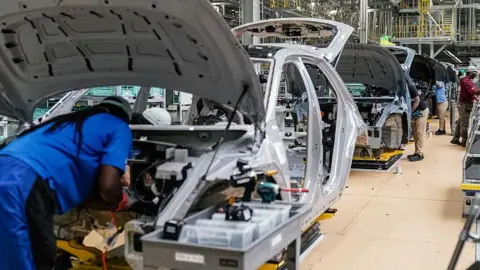
Whilst some economists have expressed doubt about how strongly the US is now growing, between July and September it expanded by 4.3%, the strongest annual growth in two years.
“This is a very, very resilient economy, and I don’t see why that wouldn’t continue going forward,” says Aditya Bhave, a senior economist at Bank of America.
He thinks tariffs have added between 0.3% and 0.5% to US inflation, which in November was 2.7%, but “we probably haven’t seen the full impact” yet. That matters given the US economy is driven by consumer spending, and that it accounts for 26% of the global economy, according to the IMF.
Cost of living pressures are still a problem for people in many parts of the world, but there are some encouraging signs for them. In the eurozone, inflation has stabilized and is now running at 2.1%.
The UK’s inflation rate currently stands at 3.2%, exceeding the central bank’s 2% target, mirroring the situation in the US. This persistent inflation rate is a cause for concern as it can lead to higher costs of living for citizens.
One significant factor influencing the global economy this year is the renegotiation of the US Mexico Canada Agreement (USMCA) trade deal, signed by Trump during his first term in office. The outcome of this renegotiation could have far-reaching implications for trade relations in North America.
Additionally, EU member states are set to vote on ratifying a South American trade deal that was signed over a year ago. This trade deal could potentially open up new trading opportunities for both South America and the EU.
In the US, a crucial Supreme Court decision on the legality of Trump’s tariffs is eagerly awaited. This decision could have a significant impact on US trade policy and its relations with other countries.
Oil prices are another key factor affecting the global economy. Wall Street bank Goldman Sachs predicts a decrease in the price of benchmark Brent Crude by around 8% to $56 a barrel. This forecast is based on strong oil production in the US and Russia, rather than political interventions in countries like Venezuela.
Global shipping routes are also under scrutiny, with the resumption of shipping through the Red Sea potentially leading to lower transportation costs. However, challenges such as attacks by Houthi rebels in Yemen continue to pose risks to global shipping routes.
China remains a critical player in the global economy, with its trade relations with the US continuing to be a point of contention. Tariffs, rare earth metals, and access to high-end computer chips are some of the issues at the forefront of US-China trade talks.
In Europe, the continent’s increasing reliance on cheap Chinese imports is a cause for concern. The EU is looking to crack down on this reliance in the coming months to protect its own industries and foster fair trade practices.
Overall, the global economy is facing several challenges and opportunities in the year ahead. Trade negotiations, oil prices, and geopolitical tensions will continue to shape the economic landscape, requiring careful navigation and cooperation between countries to ensure sustainable growth and prosperity. The United States Trade Representative, Jamieson Greer, recently emphasized the importance of re-industrialization and increasing the manufacturing sector’s share of the economy as being in the national interest. In an op-ed, Greer hinted towards the possibility of tariffs staying in place, stating that new investments in industries such as automotive, shipbuilding, and pharmaceuticals in the US would not be happening without them.
Despite this push for re-industrialization, data shows that the number of Americans employed in manufacturing jobs has actually slightly decreased to just under 12.7 million since the beginning of Trump’s second term. However, Maurice Obstfeld, an economist, points out that the US economy has continued to grow due to resilient consumers who are still spending money, as well as significant investments in artificial intelligence that have propelled stock markets to record highs.
With some of Trump’s key policy goals, such as creating new manufacturing jobs, yet to be achieved, Obstfeld believes that tariffs are likely to remain a significant part of policy and discussion moving forward. It is clear that the impact of tariffs on the economy is complex and multifaceted, with both positive and negative consequences.
For more insights on global business stories and developments, be sure to explore additional articles on our platform. Stay informed and engaged with the latest trends and analysis in the world of international trade and economics. headlined “The Impact of Social Media on Mental Health”
In today’s digital age, social media has become an integral part of our daily lives. With platforms like Facebook, Instagram, Twitter, and TikTok, we are constantly connected to others and bombarded with information and images. While social media has its benefits, such as connecting with friends and family, sharing experiences, and staying informed, it also has a significant impact on mental health.
One of the most concerning effects of social media on mental health is its potential to exacerbate feelings of loneliness and isolation. While social media allows us to stay connected with others, it can also lead to feelings of inadequacy and FOMO (fear of missing out) as we compare our lives to the carefully curated highlight reels of others. This can lead to feelings of loneliness and isolation, as well as a negative impact on self-esteem and self-worth.
Furthermore, social media can also contribute to anxiety and depression. The constant stream of information and images can be overwhelming and lead to feelings of anxiety and stress. Additionally, cyberbullying and online harassment are prevalent on social media platforms, which can have a devastating impact on mental health. Research has shown that individuals who spend a significant amount of time on social media are more likely to experience symptoms of depression and anxiety.
Another concerning aspect of social media is its potential to negatively impact sleep patterns. The blue light emitted from screens can disrupt the production of melatonin, a hormone that regulates sleep, leading to difficulty falling asleep and poor sleep quality. This can have a ripple effect on mental health, as poor sleep is linked to an increased risk of anxiety and depression.
Despite these negative effects, it is important to note that social media can also have positive impacts on mental health. For example, social media can be a valuable tool for connecting with support groups, sharing experiences, and accessing mental health resources. Additionally, social media can provide a platform for raising awareness about mental health issues and reducing stigma.
To mitigate the negative impact of social media on mental health, it is important to practice mindfulness and set boundaries when using social media. This can include limiting screen time, unfollowing accounts that trigger negative emotions, and taking breaks from social media when needed. It is also important to prioritize real-life social connections and engage in activities that promote mental well-being, such as exercise, mindfulness, and spending time in nature.
In conclusion, social media has a significant impact on mental health, both positive and negative. While social media can be a valuable tool for connecting with others and accessing information, it is important to be mindful of its potential negative effects and take steps to protect our mental health. By setting boundaries, practicing self-care, and prioritizing real-life connections, we can navigate the digital landscape in a way that promotes mental well-being.



