
U.S. and Israel Negotiate $16.5 Billion Military Aid Deal Through 2033 Despite Trump’s Pledge to End Funding
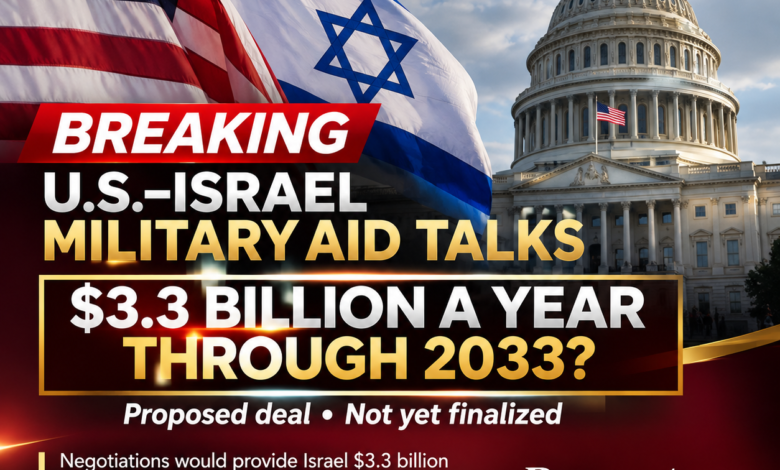
WASHINGTON, D.C. / JERUSALEM — The United States and Israel are negotiating a new military assistance framework that would continue approximately $3.3 billion in annual direct U.S. military financing through 2033, despite President Donald Trump’s earlier announcement that funding would end in 2026, according to Israeli outlet Ynet.
Prime Minister Benjamin Netanyahu’s office confirmed Wednesday that military assistance would be phased out gradually rather than terminated at the end of this year. No final agreement has been announced.
What the proposed agreement includes
The existing U.S.–Israel arrangement runs through 2028 and provides approximately $3.8 billion annually: $3.3 billion in Foreign Military Financing, primarily for U.S.-made weapons and equipment, plus $500 million for joint missile-defense projects.
The emerging framework would maintain roughly $3.3 billion annually for five years after 2028, totaling about $16.5 billion in direct financing. It would halve the overall commitment compared with a ten-year, $33 billion arrangement, not halve the annual amount. Separate missile-defense cooperation, including Iron Dome, David’s Sling and Arrow, could receive more than its current $500 million annually, although no new amount has been determined.
Why Trump’s announcement caused confusion
Trump said during a November 3 Fox News interview that U.S. aid to Israel would stop at the end of 2026. Ynet reports that the remarks surprised Israeli officials involved in the negotiations. Netanyahu’s office has since described a gradual shift from aid toward strategic partnership.
Why Israel wants a deal before January
Israeli negotiators reportedly hope to finalize the framework before a new Democratic-controlled Congress takes office in January 2027. Officials fear lawmakers could impose conditions, delay appropriations or scrutinize the agreement more closely. A bilateral memorandum of understanding does not require Senate ratification, but Congress must still appropriate funds annually.
Where does the money go?
Much of the direct financing pays U.S. defense manufacturers for weapons and equipment. Supporters cite industrial jobs and security cooperation; critics question the federal cost and the strategic and humanitarian implications of continued military support. U.S. manufacturing benefits do not erase the budgetary expense.
What’s at stake?
The central questions are how much funding will continue, what missile-defense spending might add, what oversight Congress will exercise, and whether the administration’s stated plans align with the emerging agreement.
No new five-year agreement has been finalized, and future U.S. funding remains subject to congressional appropriations.
Brownstone Worldwide — Changing the narrative of how we tell our stories OUR way.
Sources: Ynet, November 9; Ynet, November 11; CTech, November 9.