Aurora council to vote on crackdown on nitrous oxide at vape shops
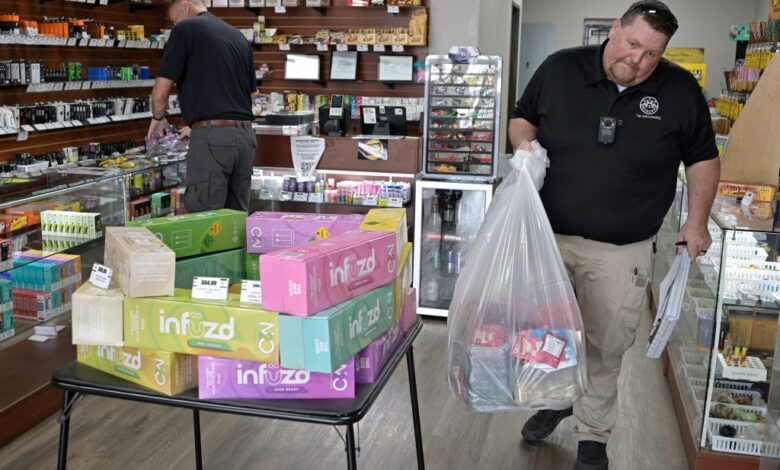
Upon entering Vapor Maven in Aurora last week, Trevor Vaughn quickly assessed the situation.
“We’re going to be here for a bit,” remarked Aurora’s manager of licensing, observing that the strip mall vape shop near South Buckley Road and East Mississippi Avenue was operating without a cannabis license. “There is a ton of THC product in here.”
Vaughn then noticed a display of neatly stacked Infuzd nitrous oxide canisters at the center of the shop. Curious, he asked the store manager about them.
“They are supposed to be used to make whipped cream,” the manager explained, eliciting a knowing smile from Vaughn. She opted to remain anonymous and requested that JS, who was present during the visit with licensing officials, refrain from taking her photograph.
Vaughn informed the manager that Vapor Maven had a limited time before the nitrous tanks, often used for a quick and potent high through inhaling the gas, would likely be confiscated. The Aurora City Council was set to approve a comprehensive measure on Monday evening, banning the sale of various “gray market” substances and drug paraphernalia commonly found in convenience stores, gas stations, and smoke and vape shops.
Aside from products found to be sold outside licensed retailers, such as those containing THC, Aurora has identified several concerning substances. These substances, largely unregulated and potentially harmful, are often disguised as innocuous items, according to officials.
Some of these substances include nitrous oxide, Amanita Muscaria (an adulterated hallucinogenic mushroom), Mad Honey (honey containing grayanotoxins, which can cause nausea, vomiting, or dizziness), synthetic cannabinoids, and poppers (a nitrate product deemed unsafe for inhalation or ingestion).
The city’s ordinance is also aimed at items often used as drug paraphernalia.
For instance, “Roses in a glass” – thin glass tubes filled with a mini silk rose and steel mesh scrubbing pads as filters – have been utilized to create what Vaughn referred to as a makeshift “crack kit.” Vape shops often provide distinctive bulbed pipes known as oil burners for meth users seeking their fix.
“It’s safe to say I encounter these items frequently,” Vaughn remarked.
Nitrous oxide abuse is becoming increasingly common at concerts, raising health concerns
The concern is not limited to Aurora, where the city council unanimously supported the proposed ordinance in a preliminary vote on July 28.
Recently, Denver officials issued a warning after discovering edible products made with psilocybin mushrooms illegally for sale at local gas stations and vape shops. While psilocybin is decriminalized for personal use, cultivation, and sharing in Colorado, selling the drug remains illegal.
The warning on July 24 followed an investigation by the Colorado Department of Public Health and Environment into products from California’s Prophet Premium Blends sold under the Diamond Shruumz brand, which were linked to 113 illnesses in the U.S., including at least two in Colorado.
Aurora Councilwoman Alison Coombs, a co-sponsor of the measure set for final approval, highlighted the lack of regular inspections by state health authorities in the city.
“The concern regarding these substances is that they are unregulated, and consumers are unaware of what they are ingesting,” Coombs explained. “It poses a health and safety risk.”
The worries extend beyond the user. The city believes that concentrated outlets selling these products often lead to “elevated crime rates and open-air drug use” in the vicinity.
“The issue isn’t isolated to one location but spreads throughout the city, where an aggregation of establishments selling these products correlates with increased criminal activity,” Coombs noted.

‘Addressing the Root of the Issue’
At Vapor Maven, Vaughn and Lead Licensing Investigator Charles Keyes conducted an inventory and removed the offending products from shelves.
After an extensive inspection, they filled three 96-gallon trash bags with various suspected cannabis products, ranging from loose gummies and edibles to THC vape cartridges and pre-rolled joints.
“All of these products are illegal,” Keyes stated.
The Aurora inspectors communicated with a higher-up in the store’s parent company over the phone, offering the option to surrender the THC products or contest the issue in court. Attempts to reach the owner of Vapor Maven, based in Arkansas, were unsuccessful as of last week.
Nitrous oxide is currently a prevalent trend in the recreational drug scene, according to Vaughn.
“Nitrous has become increasingly common in the past year, with larger tanks and a variety of flavors,” he noted.
The Post recently highlighted the surge in nitrous oxide usage for recreational purposes in Colorado, particularly among music enthusiasts at concerts. While the gas has been traditionally used in dental procedures or culinary settings for whipped cream, recreational use can lead to addiction, harm, and even death, experts caution.
Between 2019 and 2023, the Centers for Disease Control and Prevention reported a 110% increase in deaths in the U.S. due to hypoxia, caused by oxygen deprivation to the brain from nitrous oxide abuse.
Back at his office in Aurora’s city headquarters, Vaughn showcased a tank of strawberry shortcake-flavored Euro Gas, one among many nitrous oxide flavors and brands flooding the market. This tank was part of the hundreds of products confiscated by Vaughn and Keyes from Aurora’s numerous smoke and vape shops within a couple of weeks.
Vaughn pointed out that a significant portion of the seized products failed to comply with Colorado’s labeling regulations. Several packages displayed QR codes that were supposed to reveal product information, but scanning them led to inactive websites.
Approximately 3 million Americans aged 12 and above used inhalants in the past year, per the Substance Abuse and Mental Health Services Administration. This includes nitrous oxide, poppers, household solvents, and aerosols. The survey also noted that around 564,000 individuals aged 12 to 17 had used inhalants within the same timeframe.
Given these statistics, University of Maryland law professor Kathi Hoke believes that Aurora’s focus on targeting retail outlets, rather than users, is a sound strategy.
“Addressing the root of the issue at the retail level is crucial,” stated Hoke, a public health law expert.
According to Hoke, Aurora has legal grounds to prohibit these gray-market products. While some may have legitimate purposes, their presentation, marketing, and sale are significant factors to consider.
For instance, the argument that nitrous oxide dispensers, often paired with balloons for inhalation at vape and smoke shops, are solely intended for culinary use may not hold up.
“These are not items a chef typically acquires,” Hoke remarked. “Considering the context is entirely reasonable for the city.”

Implementation of the Law
In Denver, where a recent alert on psilocybin-laced edibles was issued, Department of Excise and Licenses spokesperson Eric Escudero expressed growing concerns over certain businesses’ offerings.
However, for now, Denver has not enacted a blanket ban on nitrous oxide tanks. According to Escudero, the sale of these dispensers may or may not violate the law, depending on the circumstances. He emphasized that any illegal sales at licensed establishments in Denver could result in enforcement actions, including license suspension, revocation, and fines.
“If any illegal sales occur at a business holding a liquor, retail tobacco, or any other type of license in Denver, the city can take enforcement action, which may lead to license penalties,” he stated.
Grier Bailey, executive director of the Colorado Wyoming Petroleum Marketers Association and the Convenience Store Association, criticized municipal bans on flavored tobacco as an assault on retailers and a violation of adults’ rights to legal products.
However, when it comes to illegal or legally ambiguous products, Bailey’s perspective differs.
“I would remind store owners, particularly newcomers in the retail sector or those from regions lacking strong consumer protections, that regulations exist for a reason,” Bailey remarked. “While new markets and products can be innovative and profitable, regulations offer implicit protection, labels, and consumer transparency.”
If approved on Monday, Aurora’s measure will take effect in early September.
Vaughn mentioned that his team of four will conduct inspections. Despite the small team, Vaughn noted that most businesses, after a visit from a city enforcement officer, refrain from further violations due to the risk of losing their business licenses.
“While some may attempt to evade detection, in my experience, business owners are inclined to do the right thing,” he explained. “The potential loss of their business is a significant motivator in their decision-making.”
Receive more Colorado news by subscribing to our daily Your Morning Dozen email newsletter.